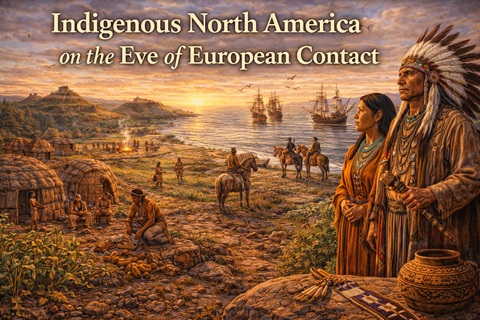
Just before European explorers arrived in the late 1400s, North America was home to millions of Indigenous people living in diverse and complex societies. These groups had developed unique cultures, economies, and political systems shaped by their environments. From large cities in the Mississippi River Valley to nomadic groups on the Great Plains, Indigenous North America was vibrant and interconnected. In this lesson, students will explore what life was like across the continent just before European contact and why this moment is important in history.
What You Will Learn
- The diversity of Indigenous cultures and societies across North America
- How geography influenced different ways of life
- The level of complexity and organization in pre-contact societies
A Continent of Diversity
On the eve of European contact, North America was not a single culture but a mosaic of many different societies. Groups such as those in the Eastern Woodlands, Great Plains, Southwest, and Pacific Coast each developed distinct ways of life based on their surroundings. Languages, traditions, and social structures varied widely across regions.
Some societies lived in large, permanent settlements with organized governments, while others followed seasonal patterns of movement. Despite these differences, all groups shared deep connections to their environments and strong cultural traditions. This diversity is one of the defining features of Indigenous North America.
Complex Societies and Networks
Many Indigenous societies had developed complex systems of leadership, trade, and communication. Large centers like those of the Mississippian culture included planned cities, social hierarchies, and religious structures. Confederations such as the Iroquois demonstrated advanced political organization and cooperation.
Trade networks connected distant regions, allowing goods like shells, copper, and food to travel across the continent. These networks also spread ideas, technologies, and cultural practices. Far from being isolated, many Indigenous groups were part of a dynamic and interconnected world.
Daily Life and Cultural Traditions
Daily life varied by region but often included a mix of farming, hunting, gathering, and fishing. People built homes suited to their environments, from longhouses in forested areas to adobe structures in the Southwest. Clothing, tools, and food sources reflected the resources available in each region.
Cultural traditions such as storytelling, ceremonies, and spiritual beliefs played a central role in community life. These practices helped pass down knowledge, maintain social bonds, and explain the world around them. On the eve of contact, Indigenous cultures were thriving, resilient, and deeply rooted in their histories.
Conclusion
Indigenous North America before European contact was a land of rich diversity, complex societies, and strong cultural traditions. Understanding this period helps us recognize that Indigenous peoples had well-developed civilizations long before Europeans arrived. This knowledge is essential for appreciating the full history of North America and the lasting contributions of its first peoples.
Key Terms
- Pre-Columbian: Referring to the time in the Americas before the arrival of Christopher Columbus and other Europeans.
- Confederation: An alliance of groups or nations that work together while maintaining their independence.
Review Questions
- What does it mean to say Indigenous North America was diverse?
- How were different Indigenous societies connected to one another?
- What are some examples of daily life across different regions?
Think Further
Extension Activity: Create a Regional Comparison Chart
Objective:
Students will demonstrate their understanding of pre-contact Indigenous diversity by comparing how geography shaped different societies.
Instructions: Students will choose two different regions of Indigenous North America (such as the Great Plains and the Southwest). They will create a chart comparing environment, housing, food sources, and social organization. Students will also write a short paragraph explaining how geography influenced the differences between the two regions.
From Indigenous North America to European Colonization
Indigenous North America Before 1500
The European Age of Exploration
From Revolution to the Eve of Civil War
The Early Republic
The Jacksonian Era
Westward Expansion
The Late 19th Century
The American Civil War
Reconstruction
The Gilded Age
The Early 20th Century
The Progressive Era
World War I
The Roaring 20s and the Great Depression
Modern America Emerges
World War II
The Cold War
Post Cold War America
Modern America