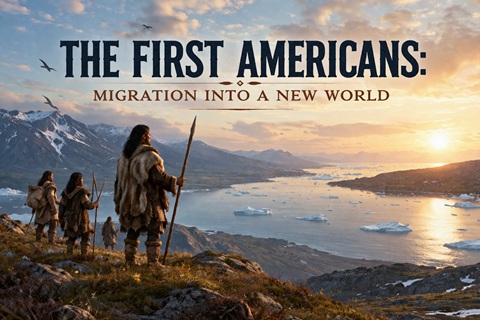
Migration into a New World
Thousands of years ago, long before recorded history in North America, the first people began arriving on the continent. These early groups traveled great distances, likely from Asia, during the last Ice Age. Over time, they spread across North and South America, adapting to different environments and developing unique cultures. In this lesson, you will explore how and why these first Americans migrated, and how they lived.
What You Will Learn
- How the first humans migrated into North America
- What life was like during the Ice Age
- How early peoples adapted to different environments
The Journey Across the Land Bridge
During the last Ice Age, much of the Earth’s water was frozen in glaciers. This caused sea levels to drop, exposing a land bridge called Beringia between Asia and North America. Scientists believe that groups of people crossed this land bridge from Siberia into present-day Alaska more than 15,000 years ago.
These early migrants were likely following large animals such as mammoths and bison, which they hunted for food. Over many generations, people slowly moved farther south and east, eventually spreading across the continents. This migration was not a single event, but a long process that took thousands of years.
Life During the Ice Age
The Ice Age was a challenging time to live. Much of North America was covered in ice sheets, and the climate was colder than it is today. Early Americans had to survive in harsh conditions, relying on hunting, fishing, and gathering plants for food.
To adapt, these groups developed important skills and tools. They made weapons like spears and stone tools to hunt animals and prepare food. They also created clothing from animal skins to stay warm and built shelters to protect themselves from the cold. These innovations helped them survive and thrive in a difficult environment.
Spreading Across the Americas
As the climate warmed and glaciers began to melt, new lands became accessible. People continued to move southward into Central and South America, as well as eastward across North America. Over time, different groups settled in a variety of environments, from forests and plains to deserts and mountains.
As these groups spread out, they developed distinct cultures based on their surroundings. Some became skilled hunters, while others focused more on gathering plants or fishing. These early communities laid the foundation for the diverse Native American cultures that would later exist across the Americas.
Conclusion
The story of the first Americans is one of movement, adaptation, and survival. By crossing the Bering Land Bridge and spreading across the continents, these early peoples shaped the history of North America. Their ability to adapt to new environments helped them build the foundations of the many cultures that would follow.
Key Terms
- Beringia (Land Bridge): A strip of land that once connected Asia and North America during the Ice Age, allowing people and animals to migrate between continents.
- Ice Age: A period of time when much of the Earth’s surface was covered with large sheets of ice, leading to colder global temperatures.
Review Questions
- What was Beringia, and why was it important to early migration?
- How did Ice Age conditions affect the lives of early Americans?
- Why did early peoples spread out across different parts of the Americas?
Think Further
Extension Activity: Map + Writing Assignment
Objective: Students will demonstrate understanding of early human migration into North America by mapping migration routes and writing a first-person narrative that reflects the challenges and decisions of early peoples.
Part 1: Mapping the Journey
Using a blank map showing Asia, Alaska, and North America, do the following:
- Label Siberia, Alaska, the Arctic Ocean, and the Pacific Ocean
- Draw and label the Bering Land Bridge (Beringia)
- Trace a possible migration route from Asia into North America
- Continue the route moving south and east across the continent
- Add at least 2–3 symbols (with a legend) to show challenges (ice, mountains, animals, etc.)
Part 2: Journal
After completing the map, write a short journal entry (1–2 paragraphs) from the perspective of a young traveler in their group. Their writing should include:
- A description of the landscape they are traveling through
- At least one challenge they face (weather, food, animals, etc.)
From Indigenous North America to European Colonization
Indigenous North America Before 1500
The European Age of Exploration
From Revolution to the Eve of Civil War
The Early Republic
The Jacksonian Era
Westward Expansion
The Late 19th Century
The American Civil War
Reconstruction
The Gilded Age
The Early 20th Century
The Progressive Era
World War I
The Roaring 20s and the Great Depression
Modern America Emerges
World War II
The Cold War
Post Cold War America
Modern America