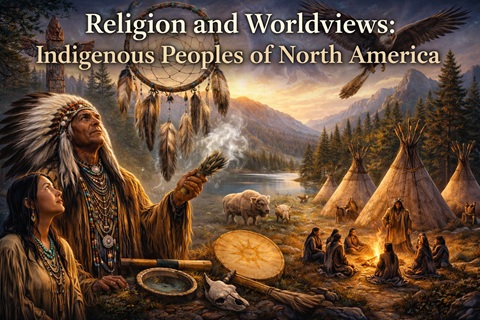
Indigenous peoples of North America developed rich and diverse belief systems long before European contact. These worldviews were deeply connected to nature, community, and a sense of balance in the world. Rather than separating religion from daily life, spiritual beliefs were woven into hunting, farming, storytelling, and governance. In this lesson, students will explore how Indigenous religions emphasized respect for the natural world, the importance of oral traditions, and the role of ceremonies in maintaining harmony.
What You Will Learn
- How Indigenous worldviews are connected to nature and the environment
- The importance of oral traditions and storytelling in preserving beliefs
- The role of ceremonies and rituals in community life
A Deep Connection to Nature
Many Indigenous belief systems are centered on the idea that all parts of the natural world—animals, plants, water, and even the land itself—are alive and deserve respect. This perspective is often called a “holistic worldview,” meaning everything is interconnected. Humans are not seen as separate from nature but as part of it, with a responsibility to care for it.
Because of this connection, daily activities such as hunting or farming were often guided by spiritual beliefs. For example, hunters might give thanks to an animal’s spirit after a successful hunt, recognizing the animal’s sacrifice. This respect helped maintain balance and ensured that resources were used wisely and sustainably.
Oral Traditions and Storytelling
Instead of written texts, many Indigenous cultures passed down their beliefs through oral traditions. Stories, songs, and legends were used to teach lessons about the world, explain natural events, and preserve cultural values. Elders played an important role as keepers of this knowledge, sharing it with younger generations.
These stories often included creation narratives that explained how the world and people came to be. While the details varied widely among different groups, they all helped shape a community’s identity and understanding of the universe. Storytelling was not just entertainment—it was a key way of teaching history, morality, and spiritual beliefs.
Ceremonies and Community Life
Ceremonies and rituals were central to Indigenous spiritual life. These events could mark important moments such as seasonal changes, harvests, or life transitions like birth and adulthood. Ceremonies often included music, dance, and symbolic actions that reflected a community’s beliefs and values.
Participation in ceremonies helped strengthen community bonds and maintain spiritual balance. For example, some groups held ceremonies to give thanks for a successful harvest or to ask for guidance in difficult times. These shared experiences reinforced the idea that spirituality was not just personal but deeply connected to the well-being of the entire community.
Conclusion
Indigenous religions and worldviews of North America are diverse, but they share common themes of respect for nature, the importance of storytelling, and the role of community in spiritual life. By understanding these beliefs, we gain a deeper appreciation for how Indigenous peoples viewed their place in the world. These perspectives continue to influence Indigenous communities today and offer valuable lessons about sustainability, respect, and interconnectedness.
Key Terms
- Animism: The belief that all things in nature—plants, animals, and even objects—have a spirit or life force.
- Oral Tradition: The practice of passing down stories, beliefs, and history by speaking rather than writing them down.
Review Questions
- How did Indigenous peoples’ connection to nature influence their daily lives?
- Why were oral traditions important in Indigenous cultures?
- What role did ceremonies play in maintaining community and spiritual balance?
Think Further
Extension Activity: Create a Cultural Story and Symbol Map
Objective:
Students will demonstrate their understanding of Indigenous worldviews by connecting storytelling and environmental relationships through writing and visual representation.
Instructions:
Students will choose a specific Indigenous group (teacher may assign or provide options). First, they will research one traditional story or belief from that group and write a short narrative (1–2 paragraphs) explaining its meaning and lesson.
Next, students will create a simple map or illustrated diagram showing how that group’s beliefs connect to the natural environment (e.g., animals, landforms, seasons).
From Indigenous North America to European Colonization
Indigenous North America Before 1500
The European Age of Exploration
From Revolution to the Eve of Civil War
The Early Republic
The Jacksonian Era
Westward Expansion
The Late 19th Century
The American Civil War
Reconstruction
The Gilded Age
The Early 20th Century
The Progressive Era
World War I
The Roaring 20s and the Great Depression
Modern America Emerges
World War II
The Cold War
Post Cold War America
Modern America