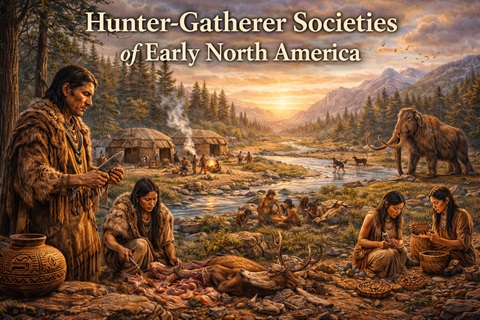
Long before farming and permanent settlements, the first peoples of North America lived as hunter-gatherers. These early societies relied on hunting animals, fishing, and gathering wild plants for survival. Their way of life required deep knowledge of the environment and the ability to adapt to changing seasons. In this lesson, students will explore how hunter-gatherer societies lived, moved across the land, and laid the foundations for later Indigenous cultures.
What You Will Learn
- How hunter-gatherer societies survived using natural resources
- Why mobility was important for early peoples
- How early technologies and cooperation supported daily life
Living Off the Land
Hunter-gatherer societies depended entirely on the natural environment for food and materials. They hunted animals such as deer, bison, and smaller game, while also gathering berries, nuts, roots, and seeds. Fishing in rivers and lakes provided another important food source.
Because food sources changed with the seasons, these groups developed a deep understanding of animal behavior and plant growth. This knowledge helped them find food throughout the year and avoid overusing resources. Their survival depended on respecting and carefully using what the land provided.
Mobility and Seasonal Movement
Unlike later farming societies, hunter-gatherers did not stay in one place permanently. Instead, they moved from place to place following animal migrations and seasonal plant cycles. This movement is called a nomadic lifestyle.
Homes were temporary and easy to build and take down, such as simple shelters made from animal hides, wood, or plant materials. Moving regularly allowed groups to take advantage of different resources at different times of the year and prevented depletion of any one area.
Tools, Cooperation, and Community
Hunter-gatherer societies developed tools that made survival easier. They crafted spears, bows and arrows, fishing nets, and stone tools for cutting and scraping. These technologies improved hunting success and food preparation.
Cooperation was essential for survival. People worked together to hunt large animals, gather food, and care for one another. Knowledge and skills were shared within the group, often passed down through observation and storytelling. These strong social bonds helped early communities thrive in challenging environments.
Conclusion
Hunter-gatherer societies were highly skilled and adaptable, using their knowledge of the land to survive and thrive. Their mobility, cooperation, and innovative tools allowed them to live successfully across a wide range of environments in North America. These early ways of life laid the groundwork for the diverse Indigenous cultures that developed later.
Key Terms
- Hunter-Gatherer: A person or group that survives by hunting animals and gathering wild plants rather than farming.
- Nomadic: A lifestyle in which people move from place to place instead of living in one permanent location.
Review Questions
- Why did hunter-gatherer societies move frequently?
- What types of food did hunter-gatherers rely on?
- How did cooperation help these groups survive?
Think Further
Extension Activity: Plan a Seasonal Survival Route
Objective:
Students will demonstrate their understanding of hunter-gatherer life by mapping seasonal movement and resource use.
Instructions:
Students will create a simple map showing how a hunter-gatherer group might move throughout the year. The map should include different locations for each season and explain what resources (food, water, shelter) are available in each place. Students will also write a short explanation (1–2 paragraphs) describing why the group moves and how the environment shapes their decisions.
From Indigenous North America to European Colonization
Indigenous North America Before 1500
The European Age of Exploration
From Revolution to the Eve of Civil War
The Early Republic
The Jacksonian Era
Westward Expansion
The Late 19th Century
The American Civil War
Reconstruction
The Gilded Age
The Early 20th Century
The Progressive Era
World War I
The Roaring 20s and the Great Depression
Modern America Emerges
World War II
The Cold War
Post Cold War America
Modern America