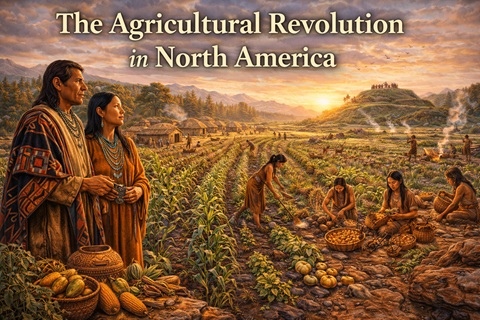
The Agricultural Revolution in North America marked a major turning point in how Indigenous peoples lived. Instead of relying only on hunting and gathering, many groups began to grow crops and settle in one place. This shift led to the development of villages, new technologies, and more complex societies. In this lesson, students will explore how agriculture began, what crops were grown, and how farming changed daily life.
What You Will Learn
- How and why agriculture developed in North America
- The importance of key crops like corn, beans, and squash
- How farming changed settlement patterns and society
The Beginnings of Farming
Agriculture in North America developed gradually over thousands of years. Indigenous peoples experimented with planting and cultivating wild plants, eventually learning how to grow reliable food sources. One of the most important crops was corn (maize), which became a staple food for many societies.
Farming allowed people to produce more food in one place, reducing the need to move constantly. As a result, groups began to settle in permanent or semi-permanent villages. This change marked a shift from a fully nomadic lifestyle to more stable communities.
The “3 Sisters” and Farming Techniques
Many Indigenous farmers grew corn, beans, and squash together in a system known as the “Three Sisters.” These crops supported each other: corn provided a structure for beans to climb, beans added nutrients to the soil, and squash spread across the ground to block weeds and retain moisture.
In addition to planting methods, Indigenous peoples developed techniques such as crop rotation and controlled burning to maintain soil fertility. These practices showed a deep understanding of the environment and helped ensure long-term success in farming.
Changes in Society and Daily Life
The shift to agriculture brought many changes to daily life. Permanent villages led to the construction of more durable homes and the growth of larger populations. People could store surplus food, which provided security during difficult times.
With more stable communities, societies became more organized. New roles developed, including farmers, builders, and leaders. Trade networks expanded as communities exchanged surplus goods. While farming required hard work, it also allowed for cultural development, including art, ceremonies, and governance systems.
Conclusion
The Agricultural Revolution in North America transformed how Indigenous peoples lived and organized their societies. By developing farming techniques and cultivating important crops, they created stable communities and laid the foundation for more complex cultures. This shift highlights the ingenuity and adaptability of early peoples in shaping their environment and future.
Key Terms
- Agriculture: The practice of growing crops and raising food in a planned and organized way.
- Maize (Corn): A staple crop first cultivated by Indigenous peoples that became a central part of many diets.
Review Questions
- Why was the development of agriculture an important turning point?
- How did the “Three Sisters” farming method work?
- What changes occurred in society as a result of farming?
Think Further
Extension Activity: Create a Farming Plan for an Early Village
Objective:
Students will demonstrate their understanding of early agriculture by designing a village that reflects farming practices and community organization.
Instructions:
Students will design a plan for a small farming village. The plan should include fields for crops, housing areas, storage spaces, and water sources. Students will also write a short explanation (1–2 paragraphs) describing how their village uses farming to support the community and why their layout is effective.
From Indigenous North America to European Colonization
Indigenous North America Before 1500
The European Age of Exploration
From Revolution to the Eve of Civil War
The Early Republic
The Jacksonian Era
Westward Expansion
The Late 19th Century
The American Civil War
Reconstruction
The Gilded Age
The Early 20th Century
The Progressive Era
World War I
The Roaring 20s and the Great Depression
Modern America Emerges
World War II
The Cold War
Post Cold War America
Modern America