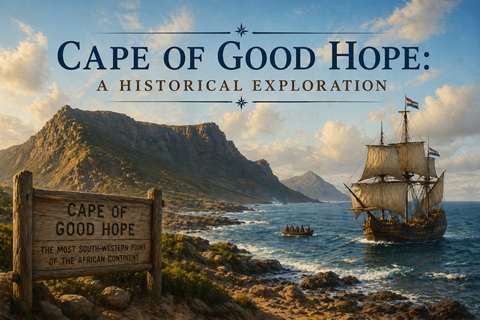
The Cape of Good Hope, located at the southern tip of Africa, became one of the most important landmarks during the Age of Exploration. It marked a turning point in global trade by providing a sea route from Europe to Asia. When Bartolomeu Dias first sailed around it in 1488, he proved that the Atlantic and Indian Oceans were connected. This discovery opened the door for future explorers and helped reshape world trade.
What You Will Learn
- Why the Cape of Good Hope was important to explorers
- Who discovered the route around the southern tip of Africa
- How this discovery changed global trade and exploration
The Challenge of Reaching Asia
For centuries, European nations wanted direct access to Asia’s valuable goods, such as spices, silk, and precious metals. However, land routes were long, expensive, and often controlled by powerful empires. As a result, countries like Portugal began searching for a sea route that would allow them to bypass these obstacles.
The southern tip of Africa presented a major challenge. Sailors feared the unknown waters, strong currents, and dangerous storms in that region. Many believed it might be impossible to sail around Africa. Despite these fears, explorers continued to push further south in search of a new route.
Bartolomeu Dias and the Discovery
In 1488, Bartolomeu Dias led a Portuguese expedition that successfully sailed around the southern tip of Africa. Originally, he named it the “Cape of Storms” because of the rough weather his crew faced. However, the Portuguese king later renamed it the “Cape of Good Hope” because it offered hope for a sea route to Asia.
Dias’s voyage proved that it was possible to reach the Indian Ocean by sailing around Africa. Although he did not continue all the way to Asia, his journey provided valuable knowledge about ocean routes, winds, and currents. This information helped future explorers continue the journey.
Impact on Exploration and Trade
The discovery of the Cape of Good Hope had a huge impact on global trade. It allowed European ships to sail directly to Asia, avoiding costly and dangerous land routes. This led to increased trade and helped Portugal become a major trading power.
Later, explorers like Vasco da Gama used this route to reach India, establishing a direct trade connection between Europe and Asia. While this brought wealth and new goods to Europe, it also increased competition and conflict over trade routes and territories.
Conclusion
The Cape of Good Hope was a key milestone in the Age of Exploration. Its discovery opened a new pathway for trade and travel, connecting Europe to Asia by sea. While it brought new opportunities for wealth and expansion, it also led to increased competition and global conflict. Understanding its importance helps us see how geography can shape history.
Key Terms
- Cape: A point of land that extends into a body of water.
- Trade Route: A path used for the exchange of goods between different regions.
Review Questions
- Why were European nations searching for a sea route to Asia?
- What challenges did sailors face near the Cape of Good Hope?
- How did the discovery of the Cape of Good Hope change global trade?
Think Further
Extension Activity: Route to Asia Map & Reflection
Objective:
To help students understand the geographic and historical significance of the Cape of Good Hope and its role in connecting continents.
Instructions:
- Draw or print a world map showing Europe, Africa, and Asia.
- Trace the route taken by Bartolomeu Dias and later by Vasco da Gama.
- Label key locations such as Portugal, the Cape of Good Hope, and India.
- Write a short paragraph explaining why this route was important and what challenges explorers faced.
From Indigenous North America to European Colonization
Indigenous North America Before 1500
The European Age of Exploration
From Revolution to the Eve of Civil War
The Early Republic
The Jacksonian Era
Westward Expansion
The Late 19th Century
The American Civil War
Reconstruction
The Gilded Age
The Early 20th Century
The Progressive Era
World War I
The Roaring 20s and the Great Depression
Modern America Emerges
World War II
The Cold War
Post Cold War America
Modern America
📘 Get A Free Unit Resource Pack
Save hours of prep time with our unit packs: ready-to-use lessons, activities, and assessments designed for middle school history.
25-30 Reproduceable Pages (including a DBQ!)