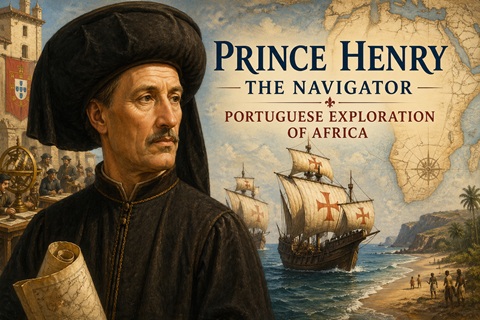
During the early 1400s, Portugal became a leading nation in ocean exploration, largely due to the efforts of Prince Henry the Navigator. Although he did not personally lead voyages, Prince Henry supported and organized expeditions along the west coast of Africa. His work helped improve navigation, expand trade, and increase European knowledge of the world. These early Portuguese explorations laid the foundation for later global voyages.
What You Will Learn
- Who Prince Henry the Navigator was and why he is important
- Why Portugal explored the coast of Africa
- How these voyages changed trade and knowledge
Who Was Prince Henry, the Navigator?
Prince Henry the Navigator was a Portuguese prince born in 1394. He was the son of the king of Portugal and became deeply interested in exploration and navigation. Although he was called “the Navigator,” he rarely went on voyages himself. Instead, he supported exploration by providing money, ships, and knowledge to sailors.
Prince Henry is often credited with creating a center for learning about navigation in Portugal. There, mapmakers, sailors, and scientists worked together to improve maps and tools. His leadership helped Portugal become a major power in exploration during the 15th century.
Why Explore the Coast of Africa?
Portugal had several reasons for exploring the west coast of Africa. One major goal was to find a sea route to Asia. European traders wanted direct access to valuable goods like spices and gold without relying on overland routes controlled by other empires.
Another reason was to expand trade and influence. Portuguese explorers began trading with African kingdoms, exchanging goods such as gold, ivory, and unfortunately, enslaved people. These early voyages marked the beginning of a long period of European involvement in Africa that would have lasting effects.
Results of Portuguese Exploration
Under Prince Henry’s guidance, Portuguese explorers traveled farther down the African coast than ever before. They mapped new lands, discovered islands like the Azores and Madeira, and gained valuable knowledge about ocean currents and wind patterns.
These explorations opened the door for future voyages, including those of Vasco da Gama, who eventually found a sea route to India. While these achievements expanded trade and knowledge, they also contributed to the growth of the transatlantic slave trade, which had devastating consequences for millions of people.
Conclusion
Prince Henry the Navigator played a key role in starting the Age of Exploration. By supporting voyages along the African coast, he helped Portugal become a leader in exploration and trade. His efforts led to important discoveries and new trade routes, but they also had serious negative impacts, especially through the expansion of the slave trade. Understanding his role helps us better understand both the achievements and consequences of early exploration.
Key Terms
- Navigator: A person who plans and directs the course of a ship or voyage.
- Trade Route: A path used for the exchange of goods between different places.
Review Questions
- Why is Prince Henry called “the Navigator” even though he did not sail on many voyages?
- What were the main reasons Portugal explored the coast of Africa?
- What were some positive and negative results of Portuguese exploration?
Think Further
Extension Activity: Map the Portuguese Voyages
Objective:
Students will create a map showing early Portuguese exploration along the coast of Africa.
Instructions:
Part 1: Heading title
- Draw or print a map of Africa and the Atlantic Ocean.
- Trace the routes of Portuguese explorers traveling south along the west coast.
- Label important locations such as Portugal, the Azores, Madeira, and key coastal points in Africa.
- Write a short paragraph explaining why each location was important.
From Indigenous North America to European Colonization
Indigenous North America Before 1500
The European Age of Exploration
From Revolution to the Eve of Civil War
The Early Republic
The Jacksonian Era
Westward Expansion
The Late 19th Century
The American Civil War
Reconstruction
The Gilded Age
The Early 20th Century
The Progressive Era
World War I
The Roaring 20s and the Great Depression
Modern America Emerges
World War II
The Cold War
Post Cold War America
Modern America
📘 Get A Free Unit Resource Pack
Save hours of prep time with our unit packs: ready-to-use lessons, activities, and assessments designed for middle school history.
25-30 Reproduceable Pages (including a DBQ!)