How Did New Tools Make the Age of Exploration Possible?
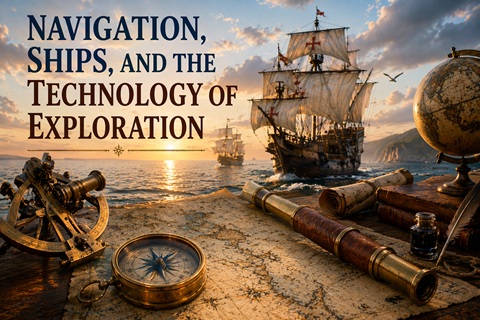
During the Age of Exploration, new technologies made it possible for sailors to travel farther and more safely than ever before. Advances in ship design, navigation tools, and mapmaking allowed explorers to cross vast oceans and discover new lands. Innovations like the caravel, the compass, and the astrolabe helped explorers such as Christopher Columbus and Ferdinand Magellan navigate unknown waters. These tools and technologies played a key role in shaping global exploration and connection.
What You Will Learn
- How new ship designs improved long-distance travel
- What tools explorers used to navigate the oceans
- Why these technologies were important to exploration
Ships Built for Exploration
Before the Age of Exploration, most ships were not designed for long ocean voyages. They were often large, slow, and difficult to control in rough waters. However, European shipbuilders developed a new type of vessel called the caravel. This ship was smaller, faster, and more maneuverable, making it ideal for exploring unknown coastlines and crossing open seas.
Caravels used triangular sails, known as lateen sails, which allowed them to sail against the wind. This gave sailors much more control and flexibility. Later ships, like carracks, were larger and could carry more cargo and supplies, making them useful for long-distance trade and extended journeys.
Tools for Navigation
Explorers relied on several important tools to find their way at sea. The magnetic compass helped sailors determine direction, even when land was not visible. This tool was especially useful during cloudy weather or at night.
Another important tool was the astrolabe, which allowed sailors to measure the angle of the sun or stars above the horizon. By doing this, they could estimate their latitude (how far north or south they were). These tools, along with simple instruments like the cross-staff, made navigation more accurate and reliable.
Maps & Knowledge of the World
Accurate maps were essential for successful exploration. Early maps were often incomplete or incorrect, but over time, cartographers improved their work by using information gathered from explorers. Portolan charts, for example, showed coastlines, ports, and sea routes with greater detail than earlier maps.
As explorers traveled and recorded their journeys, knowledge of the world expanded. This information was shared and improved upon, leading to better maps and safer travel. The combination of improved ships, navigation tools, and maps allowed Europeans to explore and connect distant parts of the world.
Conclusion
The technology of exploration made the Age of Discovery possible. Without advances in ships, navigation tools, and mapmaking, long ocean voyages would have been too dangerous and uncertain. These innovations helped explorers travel across the globe, leading to new discoveries and global connections that continue to shape our world today
Key Terms
- Caravel: A small, fast ship developed by the Portuguese, designed for long voyages and exploration.
- Compass: A navigation tool that uses Earth’s magnetic field to show direction.
Review Questions
- What made the caravel different from earlier ships?
- How did tools like the compass and astrolabe help sailors navigate?
- Why were improved maps important for exploration?
Think Further
Extension Activity: Build and Test a Model Navigation Tool
Objective:
To help students understand how navigation tools worked and why they were essential for successful exploration.
Instructions:
- Create a basic astrolabe using a paper plate, string, and straw.
- Use the tool to measure the angle of an object (like a tree or building) to simulate how sailors measured the stars.
- Record your measurements and observations in a “navigator’s log.”
- Optional: Compare your results with a partner and discuss differences.
From Indigenous North America to European Colonization
Indigenous North America Before 1500
The European Age of Exploration
From Revolution to the Eve of Civil War
The Early Republic
The Jacksonian Era
Westward Expansion
The Late 19th Century
The American Civil War
Reconstruction
The Gilded Age
The Early 20th Century
The Progressive Era
World War I
The Roaring 20s and the Great Depression
Modern America Emerges
World War II
The Cold War
Post Cold War America
Modern America