Overview
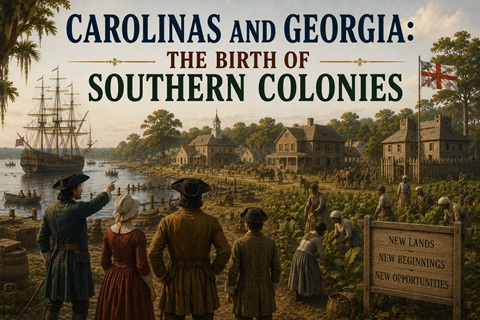
The colonies of North Carolina, South Carolina, and Georgia were the last of the thirteen English colonies to be established. Located in the southern part of North America, these colonies developed economies based on agriculture and trade. Their warm climate and fertile land allowed settlers to grow valuable cash crops, while their coastal locations supported commerce with other colonies and countries. Although they shared many similarities, each colony had its own unique history and purpose. Together, they helped shape the development of the Southern Colonies and played an important role in Colonial America. This lesson follows the lesson plan outline provided in the uploaded document.
What You Will Learn
- Explain how and why the Carolinas and Georgia were founded.
- Describe the economic activities that helped these colonies grow.
- Understand the role of the Southern Colonies in Colonial America.
The Founding of the Carolinas and Georgia
The Carolina colony was originally granted by King Charles II to a group of English nobles in 1663. The colony was named in honor of the king and stretched across a large area of land south of Virginia. Over time, differences between settlers in the northern and southern parts of the colony led to its division into North Carolina and South Carolina in 1712.
Georgia was founded later, in 1733, by James Oglethorpe and a group of trustees. Oglethorpe envisioned Georgia as a place where poor English citizens could build new lives and where debtors might have a second chance. Georgia also served as a buffer colony between the English colonies and Spanish Florida, helping protect Britain’s southern frontier. Like the Carolinas, Georgia attracted settlers seeking opportunity and land.
Agriculture and Economic Growth
The warm climate and long growing season of the Southern Colonies made agriculture the foundation of their economies. In South Carolina and Georgia, large plantations produced valuable cash crops such as rice and indigo. These crops were in high demand in Europe and generated significant profits for landowners.
North Carolina developed somewhat differently. Many settlers established smaller farms and focused on crops such as tobacco. Coastal ports allowed colonists to trade agricultural products and other goods with neighboring colonies and overseas markets. As the colonies expanded, agriculture and trade created wealth and encouraged continued settlement throughout the region.
The Southern Colonies and Colonial America
The Carolinas and Georgia became important contributors to the economy of Colonial America. Their agricultural products supported trade networks that connected the colonies with Europe, Africa, and the Caribbean. Growing populations led to the development of towns, ports, and local governments that helped manage colonial affairs.
Like other Southern Colonies, the Carolinas and Georgia relied heavily on enslaved African labor, especially on large plantations. Enslaved people played a crucial role in producing rice, indigo, and other crops, yet they endured harsh conditions and the loss of freedom. Understanding the history of these colonies requires recognizing both their economic success and the human costs associated with slavery. These realities would have lasting effects on American history.
Conclusion
The Carolinas and Georgia were among the last English colonies established in North America, but they quickly became important parts of Colonial America. Their fertile land, successful agricultural economies, and strategic locations helped them grow and prosper. At the same time, their reliance on enslaved labor shaped the social and economic development of the South. Together, these colonies contributed significantly to the growth of the English colonial world.
Key Terms
- Cash Crop – A crop grown primarily to be sold for profit rather than for personal use.
- Buffer Colony – A colony established to protect other territories from potential threats or rival powers.
Review Questions
- Why were the Carolinas and Georgia founded?
- What economic activities helped these colonies become successful?
- How did the use of enslaved labor influence the development of the Southern Colonies?
Extension Activity
Plan a New Southern Colony
Objective
Design a colonial settlement in the Southern Colonies and explain how it would grow and succeed.
Instructions
- Choose a location in either North Carolina, South Carolina, or Georgia.
- Create a map showing important features such as rivers, farmland, towns, ports, and transportation routes.
- Identify the crops and industries that would support your colony’s economy.
- Explain how settlers would govern the colony and protect it from potential threats.
- Describe the daily lives of different groups living in the colony, including farmers, merchants, and laborers.
- Conclude with a written explanation of why your colony would be successful and how it would contribute to Colonial America.
From Indigenous North America to European Colonization
Indigenous North America Before 1500
The European Age of Exploration
From Revolution to the Eve of Civil War
The Early Republic
The Jacksonian Era
Westward Expansion
The Late 19th Century
The American Civil War
Reconstruction
The Gilded Age
The Early 20th Century
The Progressive Era
World War I
The Roaring 20s and the Great Depression
Modern America Emerges
World War II
The Cold War
Post Cold War America
Modern America