Overview
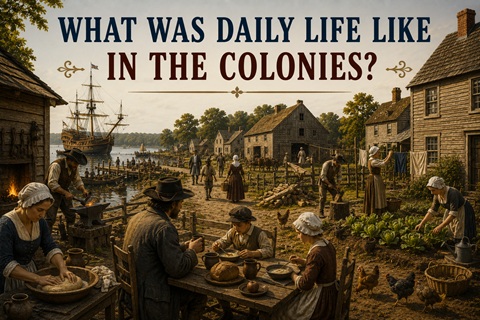
Daily life in the American colonies varied depending on where people lived, their occupations, and their social status. Most colonists spent much of their time working to provide food, clothing, shelter, and other necessities for their families. Life on a New England farm differed from life on a Southern plantation or in a busy colonial city, but all colonists faced the challenges of living in a developing society. By examining how people worked, learned, worshiped, and spent their free time, we can gain a better understanding of everyday life in Colonial America. This lesson follows the lesson plan outline provided in the uploaded document.
What You Will Learn
- Describe the work and responsibilities of colonial families.
- Explain the roles of education, religion, and community in colonial life.
- Understand how daily life differed among various groups of colonists.
Work and Family Responsibilities
Most colonists lived on farms and worked hard every day to support their families. Farmers grew crops, cared for livestock, repaired buildings, and prepared for changing seasons. Because stores were rare and transportation was difficult, families often produced many of the goods they needed themselves. Men typically handled heavy farm labor, while women managed households, prepared meals, made clothing, and cared for children.
Children also had important responsibilities. Boys often helped with farming, hunting, and caring for animals, while girls learned household skills from their mothers. Although childhood included some opportunities for play, most children were expected to contribute to the family’s success. Every member of the household played a role in helping the family survive and prosper.
Education, Religion, and Community Life
Education was important in many colonial communities, especially in New England, where people believed that individuals should be able to read the Bible. Some children attended schools, while others learned at home or through apprenticeships. Apprentices worked under skilled craftsmen to learn trades such as blacksmithing, carpentry, or printing.
Religion was a central part of life throughout the colonies. Most communities had churches that served as places of worship and social gathering. Colonists attended religious services regularly, and religious beliefs often influenced laws, customs, and daily behavior. Community events such as church gatherings, town meetings, and market days helped bring people together and strengthened local connections.
Differences in Colonial Life
Life in the colonies depended greatly on a person’s location and social position. In New England, families often lived in small towns centered around churches and meetinghouses. In the Middle Colonies, diverse populations created communities with a variety of languages, cultures, and religions. In the Southern Colonies, many people lived on farms or plantations spread across large areas of land.
Not everyone experienced colonial life in the same way. Wealthy landowners often enjoyed greater comfort and influence than ordinary farmers. Enslaved Africans faced harsh conditions and were denied freedom and basic rights. Indigenous peoples experienced increasing pressure as colonial settlements expanded into their lands. Understanding these differences helps us recognize that Colonial America was a complex society with many different experiences.
Conclusion
Daily life in the colonies revolved around work, family, religion, and community. Colonists spent much of their time meeting basic needs while building farms, towns, and businesses. Although experiences varied based on region, occupation, and social status, the routines and challenges of everyday life helped shape the culture and development of Colonial America.
Key Terms
- Apprentice – A young person who learns a trade by working under an experienced craftsperson.
- Plantation – A large farm that grows cash crops for sale and profit.
Review Questions
- What responsibilities did family members have in colonial households?
- How did education and religion influence daily life in the colonies?
- Why did daily life differ among people living in different regions and social classes?
Extension Activity
Create a Colonial Life Museum Exhibit
Objective
Design a museum exhibit that teaches visitors about everyday life in Colonial America.
Instructions
- Choose a specific colonial region: New England, the Middle Colonies, or the Southern Colonies.
- Research the daily activities, clothing, food, homes, education, and occupations of people living there.
- Create exhibit panels featuring written descriptions and illustrations of colonial life.
- Include at least five artifacts or replica items that represent daily activities and explain their importance.
- Develop a timeline showing a typical day in the life of a colonial child or adult.
- Conclude with a curator’s statement explaining what modern visitors can learn from the everyday experiences of colonial Americans.
From Indigenous North America to European Colonization
Indigenous North America Before 1500
The European Age of Exploration
From Revolution to the Eve of Civil War
The Early Republic
The Jacksonian Era
Westward Expansion
The Late 19th Century
The American Civil War
Reconstruction
The Gilded Age
The Early 20th Century
The Progressive Era
World War I
The Roaring 20s and the Great Depression
Modern America Emerges
World War II
The Cold War
Post Cold War America
Modern America