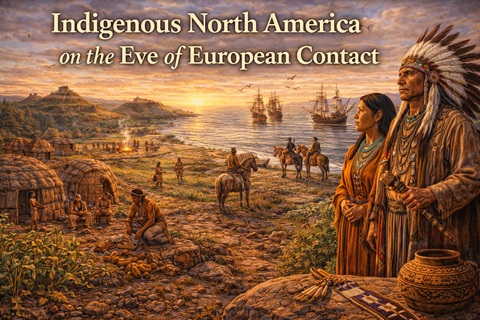
Indigenous North America on the Eve of European Contact

In the year 1491, just one year before the voyage of Christopher Columbus, North America was already home to a vast and diverse population of Indigenous peoples. For thousands of years, Native societies had developed across the continent, adapting to many different environments and creating cultures shaped by the land around them.

Map showing the diverse population of indigenous cultures on the eve of European contact

From the forests of the Eastern Woodlands to the deserts of the Southwest, from the icy coasts of Alaska to the grasslands of the Great Plains, Indigenous peoples built communities that were rich in tradition, knowledge, and creativity.

These societies did not form a single civilization. Instead, North America contained hundreds of tribes and nations, each with its own language, customs, and way of life.

Yet despite their diversity, Indigenous peoples across the continent were connected through trade, diplomacy, shared technologies, and deep cultural traditions.

By the time Europeans first arrived, North America was not an empty wilderness. It was a continent filled with thriving societies whose history stretched back thousands of years.


A Continent of Many Peoples

Scholars estimate that millions of Indigenous people lived in North America before European contact.

Exact numbers are difficult to determine, but many historians believe that between 5 and 10 million people may have lived north of present-day Mexico around the year 1500.

These people belonged to hundreds of distinct cultural groups and spoke many different languages. Some tribes lived in small bands of hunters and gatherers, while others formed large farming communities and powerful alliances.

Archaeologists and historians often divide North America into several cultural regions, each shaped by geography and climate.

These regions include:

Each region developed unique traditions and ways of life.


The Arctic and Subarctic

In the far northern regions of North America, including Alaska and northern Canada, Indigenous peoples lived in one of the harshest environments on Earth.

Winters were long and extremely cold. Farming was nearly impossible, so people depended heavily on hunting and fishing.

Groups such as the Inuit and Aleut developed remarkable skills for survival in these icy landscapes.

They hunted animals such as:

  • Seals
  • Whales
  • Caribou
  • Fish

They built homes suited to the environment, including winter shelters made from snow blocks, often called igloos, as well as skin-covered tents used during warmer seasons.

These northern cultures developed tools, clothing, and hunting techniques perfectly adapted to the Arctic environment.


The Pacific Coast

Along the Pacific Northwest Coast, Indigenous societies benefited from one of the richest natural environments in North America.

Dense forests, abundant rivers, and access to the Pacific Ocean provided a wide variety of food sources.

Coastal peoples relied heavily on fishing—especially the annual runs of salmon.

Because food was plentiful, many communities built large permanent villages with wooden houses made from cedar planks.

They were also famous for their:

  • Massive ocean-going canoes
  • Beautiful carved totem poles
  • Elaborate ceremonies such as potlatches

These coastal societies developed complex social systems and impressive artistic traditions.


The Desert Southwest

In the dry deserts of the American Southwest, Indigenous peoples created impressive farming societies despite limited rainfall.

Groups such as the Ancestral Pueblo people built stone villages and cliff dwellings in places like Chaco Canyon and Mesa Verde.

Turquoise artwork

Using irrigation systems and careful farming techniques, they grew crops such as:

  • Corn
  • Beans
  • Squash
  • Cotton

These communities built multi-story pueblos and ceremonial structures known as kivas.

Although some of these settlements were eventually abandoned, the descendants of these peoples continue to live in Pueblo communities across the Southwest today.


The Great Plains

The vast grasslands of the Great Plains were home to societies that adapted to a landscape dominated by roaming herds of bison.

Many Plains peoples relied heavily on bison hunting. The animal provided food, clothing, shelter materials, and tools.

Some groups built farming villages along rivers, while others followed bison herds across the prairie.

Before the arrival of horses from Europe, Plains hunters often used clever strategies such as buffalo jumps, where herds were driven over cliffs.

Image of a native village, indicative of the diverse population of North America on the eve of European contact

The arrival of horses in later centuries would transform Plains life, but long before that time Indigenous peoples had already developed effective ways of living on the grasslands.


The Eastern Woodlands

The forests of eastern North America supported some of the largest Indigenous populations on the continent.

Fertile soil and abundant rainfall allowed many communities to practice agriculture.

Woodland farmers often grew crops using the Three Sisters method:

  • Corn
  • Beans
  • Squash

Villages were commonly built near rivers and lakes, which provided transportation and fishing opportunities.

Some Woodland societies developed powerful alliances and confederacies. One famous example was the Iroquois Confederacy, a union of several nations that worked together for peace and mutual defense.

Earlier cultures in the region had also built impressive earthworks and ceremonial mounds, especially in the Mississippi River Valley.


Trade Across the Continent

Even though many Indigenous societies were separated by great distances, they were connected through extensive trade networks.

Trade routes stretched across rivers, forests, deserts, and plains.

Common trade goods included:

Image of turquoise art
  • Turquoise from the Southwest
  • Copper from the Great Lakes
  • Shells from coastal regions
  • Obsidian from volcanic areas
  • Animal hides and furs
  • Food crops such as corn

Trade allowed communities to obtain valuable resources that were not available in their own regions.

These networks also helped spread new ideas, technologies, and cultural traditions.


Diverse Languages and Cultures

North America before European contact was one of the most linguistically diverse regions in the world.

Hundreds of languages were spoken across the continent.

Some tribes shared related language families, while others spoke completely different languages.

Language played a key role in preserving cultural traditions. Through language, communities passed down stories, laws, spiritual teachings, and historical knowledge.

Oral traditions ensured that important cultural knowledge could survive across generations.


Complex Societies and Political Systems

Indigenous societies across North America developed many different forms of leadership and government.

Some groups were organized into small bands led by respected elders or skilled hunters.

Others created larger political systems involving councils and alliances.

For example, the Iroquois Confederacy developed a sophisticated council system that balanced cooperation among several nations.

Leadership often depended on qualities such as wisdom, generosity, bravery, and the ability to guide the community.

Decisions were often made through discussion and consensus rather than through the authority of a single ruler.


A Continent of Living Cultures

By the late 1400s, Indigenous peoples had lived in North America for thousands of years.

They had built cities, villages, and trade networks. They had developed farming techniques, artistic traditions, spiritual beliefs, and systems of government.

These societies were not static. They changed and adapted over time, responding to environmental changes, migrations, and cultural exchanges.

Far from being isolated or primitive, Indigenous North America was a dynamic world filled with innovation and diversity.


The Arrival of Europeans

In 1492, Christopher Columbus reached islands in the Caribbean while sailing for Spain.

Although he never reached the mainland of North America during that first voyage, his journey marked the beginning of sustained contact between Europe and the Americas.

Over the next century, explorers, traders, missionaries, and settlers from Europe would begin arriving in greater numbers.

This contact would bring dramatic changes to Indigenous societies, including:

  • New trade opportunities
  • New technologies
  • New alliances and conflicts
  • The devastating spread of European diseases

Many Indigenous communities would face enormous challenges in the centuries that followed.

Yet their cultures, traditions, and identities would endure.


Understanding North America Before European Contact

Studying Indigenous North America before European contact helps us better understand the full history of the continent.

Long before European explorers arrived, Native peoples had already created diverse civilizations adapted to the many environments of North America.

They were farmers, hunters, traders, artists, engineers, storytellers, and spiritual leaders.

Their knowledge of the land, their systems of cooperation, and their cultural traditions shaped the history of North America in ways that continue to influence the continent today.

Recognizing this rich and complex past allows us to see North American history not as beginning with European exploration, but as part of a much longer human story.


Leave a Comment