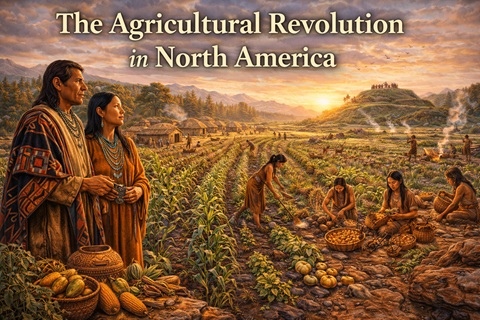
Domestication, diffusion, and the transformation of Indigenous life
For most of human history, people survived by hunting animals and gathering wild plants. This was true in North America for thousands of years after the first humans arrived near the end of the last Ice Age. Early peoples followed migrating animals, gathered seasonal plants, and moved across the landscape in search of food. These highly skilled hunter-gatherer societies adapted well to their environments, but their way of life depended heavily on nature’s rhythms.
Then, gradually and almost imperceptibly at first, a profound transformation began. People started cultivating plants instead of relying solely on wild foods. Over generations they learned to select seeds, manage soils, and shape landscapes to produce reliable harvests. This shift from foraging to farming—often called the Agricultural Revolution—would become one of the most important turning points in the history of North America.
Agriculture did not replace hunting and gathering overnight. For centuries, many Indigenous societies practiced a mixed economy that combined farming with traditional food gathering. But as farming became more productive, it changed nearly every aspect of life: population increased, permanent villages developed, social structures became more complex, and new cultural traditions emerged.
At the heart of this transformation were three remarkable plants—maize (corn), beans, and squash—often known together as the “Three Sisters.” (You can find more information on the 3 Sisters in our article about Mississippian civilization.) These crops, first domesticated in what is now Mexico, eventually spread across much of North America and reshaped the continent’s cultural landscape.
The Origins of Agriculture in Mexico
The story of agriculture in North America begins far to the south, in the fertile valleys of Mesoamerica, a region that includes present-day Mexico and parts of Central America. Archaeological evidence suggests that people living in this region began experimenting with plant cultivation as early as 9,000 years ago, and by around 5000–4000 BCE, early forms of agriculture had clearly taken root.
The most important of these early domesticated plants was maize.
Maize did not begin as the familiar tall stalk with golden kernels that we know today. Its ancestor, a wild grass called teosinte, still grows in parts of Mexico. Teosinte looks quite different from modern corn. Its kernels are small and encased in hard shells, and its ears contain only a handful of seeds.
Yet early farmers recognized its potential.
Through a process of selective breeding, they repeatedly planted seeds from plants that had desirable traits—larger kernels, softer shells, or more seeds per ear. Over generations, these choices gradually transformed the plant. The ears became larger, the kernels easier to eat, and the plant more productive. By roughly 4000 BCE, maize had already begun to resemble the crop we recognize today.
The domestication of maize was a scientific achievement of extraordinary sophistication. Without modern tools or genetic knowledge, Indigenous farmers successfully reshaped a wild plant into one of the world’s most productive crops.
But maize did not stand alone.
Alongside corn, Mesoamerican farmers also domesticated beans and squash, creating a trio of crops that would prove remarkably efficient when grown together.
The “Three Sisters”: Maize, Beans, and Squash

Traditional Indigenous farming method known as the “Three Sisters.” Tall maize stalks support climbing bean vines, while squash plants spread along the ground, shading the soil and helping conserve moisture.
Indigenous agricultural systems often centered around three plants that worked together both ecologically and nutritionally. These were maize, beans, and squash, known collectively as the Three Sisters.
Each plant played a different role in the agricultural system.
Maize formed the backbone of the diet. People used the large quantities of carbohydrate-rich kernels produced by the plant in a variety of ways. They would eat the fresh kernels, dry them for storage, or grind them into flour. Corn could be roasted, boiled, or turned into breads and porridges. Its versatility made it an ideal staple food.
Beans complemented maize in several important ways. They provided protein and essential nutrients that corn lacked, making the combination of corn and beans nutritionally complete. Even more importantly for farmers, bean plants have the ability to fix nitrogen in the soil. Through a relationship with bacteria in their roots, beans help replenish nutrients that crops like corn consume.
Squash added a third dimension to the system. Squash plants spread wide across the ground, producing large leaves that shaded the soil. This shade helped retain moisture and suppress weeds. The squash itself—whether pumpkins, gourds, or other varieties—provided vitamins and minerals that rounded out the diet.
A Mutually Supportive Agricultural Ecosystem
The way these crops were planted was equally ingenious. Farmers typically planted maize first. As the corn stalks grew taller, villagers planted beans nearby so their vines could climb the corn stalks like natural trellises. They also planted squash around the base, where its sprawling leaves covered the ground.
Together, the three plants formed a mutually supportive agricultural ecosystem:
- Corn provided structure for beans.
- Beans replenished soil nutrients.
- Squash protected the soil and reduced weeds.
This system required no metal tools, no fertilizers, and no plows. Yet, it produced abundant harvests, and the indigenous population sustained this system for generations.
The Three Sisters became the agricultural foundation for many Indigenous cultures across North America.
The Spread of Agriculture Northward

Map illustrating the gradual spread of maize agriculture from Mesoamerica northward into the American Southwest and eventually across much of eastern North America.
Agriculture did not remain confined to Mexico. Over thousands of years, knowledge of farming gradually spread northward through trade, migration, and cultural exchange.
Archaeological evidence suggests that maize began moving north into what is now the American Southwest by about 2000 BCE. Early farming communities in regions such as present-day Arizona and New Mexico began cultivating corn in river valleys and desert oases.
Farming in the Southwest required adaptation. With limited rainfall in this region, farmers often relied on irrigation canals or carefully timed planting seasons. Some communities developed impressive irrigation systems that directed water from rivers into their fields.
Over time, agriculture spread further into the Great Plains, the Mississippi River valley, and eventually the Eastern Woodlands. The process took thousands of years, and the people continually modified farming practices to suit different climates and landscapes.
In the Eastern Woodlands—covering much of what is now the eastern United States—maize agriculture became firmly established by around 1000 CE. Here, the Three Sisters system flourished in fertile river valleys and forest clearings.
Meanwhile, some Indigenous cultures continued to rely primarily on hunting and gathering. The spread of agriculture was not uniform across the continent. Regions such as the Arctic and parts of the northern forests remained dominated by foraging lifestyles due to shorter growing seasons and harsh climates.
But wherever maize agriculture took hold, it brought dramatic changes.
The Rise of Permanent Villages

Agriculture allowed many Indigenous communities to establish permanent villages. Families lived in longhouses or wooden dwellings surrounded by fields of maize, beans, and squash.
One of the most visible effects of agriculture was the development of permanent settlements.
Hunter-gatherer societies often moved seasonally in search of food. While some groups returned regularly to the same locations, they rarely built large permanent communities. Farming, however, required people to stay near their fields for long periods of time.
As agriculture expanded, many Indigenous societies began establishing year-round villages.
In the American Southwest, the Ancestral Pueblo peoples built multi-story stone and adobe dwellings clustered around plazas. Some settlements grew into large communities with hundreds of rooms. Famous sites such as Chaco Canyon and Mesa Verde reveal a complex society supported largely by maize agriculture.
In the Eastern Woodlands, farming communities often built villages surrounded by wooden palisades. Villagers typically constructed houses with wood frames covered with bark or woven mats.
Among the Haudenosaunee (Iroquois) of the Northeast, families lived in longhouses—large communal structures that housed multiple families related through maternal lines. Villages might contain dozens of longhouses, while the surrounding fields produced corn, beans, and squash.
These villages were not just places to live; they were centers of social life, governance, trade, and ceremony.
Agriculture made them possible.
Population Growth

Reconstruction of Cahokia, the largest Mississippian city in North America. Agricultural surplus from maize farming supported large populations, monumental earthworks, and complex societies.
Reliable food supplies allowed populations to grow in ways that were difficult for hunter-gatherer societies.
When people depended entirely on wild resources, population sizes were naturally limited by the availability of food. Agriculture, however, allowed communities to produce food in larger quantities and store surplus harvests for future use.
Stored maize could last for months or even years if kept dry. This stability reduced the risk of famine and allowed communities to support larger numbers of people.
Archaeologists estimate that by the time Europeans arrived in North America around 1500 CE, the continent may have been home to several million Indigenous inhabitants. Many of these populations were concentrated in regions where agriculture was well established, particularly the Mississippi River valley and the Eastern Woodlands.
Large agricultural populations also made possible the development of complex societies.
The Mississippian Civilization
Perhaps the most dramatic example of agricultural society in North America was the Mississippian culture, which flourished between about 800 and 1500 CE.
Centered in the Mississippi River valley and spreading across much of the southeastern United States, Mississippian societies were built upon intensive maize agriculture.
Their cities were organized around large ceremonial centers dominated by earthen platform mounds. These mounds served as foundations for temples, council houses, or elite residences.
The largest Mississippian city was Cahokia, located near present-day St. Louis. At its peak around 1100 CE, Cahokia may have had 20,000 or more residents, making it one of the largest cities in North America at the time.
Cahokia contained enormous mounds, broad plazas, and neighborhoods filled with houses. Surrounding the city were extensive fields of corn that fed the population.
Such large urban centers would not have been possible without agriculture.
Maize farming produced the surplus food necessary to support artisans, leaders, and religious specialists who were not directly involved in food production.
Changes in Social Organization
Agriculture also influenced the way societies were organized.
In many farming communities, land and harvests were managed collectively by extended families or clans. Work was often divided along gender lines. In numerous Indigenous cultures, women played a central role in agriculture, planting, tending, and harvesting crops.
Among the Haudenosaunee, for example, women controlled the agricultural fields and owned the longhouses where families lived. This economic role gave women significant influence in social and political life.
Agriculture also encouraged trade networks.
Communities exchanged surplus crops for goods such as stone tools, shells, copper, and other materials. Trade routes stretched across vast distances. Shells from the Gulf Coast, for example, have been found at archaeological sites hundreds of miles inland.
These exchanges connected diverse cultures across the continent.
Agriculture and the Landscape
Farming did more than change human societies—it reshaped the environment itself.
Indigenous farmers cleared fields by cutting and burning vegetation, a practice sometimes called slash-and-burn agriculture. The ash from burned plants enriched the soil, allowing crops to grow more effectively.
Fields were typically cultivated for several years and then allowed to lie fallow so the soil could recover.
In some regions, Indigenous peoples developed sophisticated landscape management techniques. They created irrigation canals, terraced hillsides, and managed forests through controlled burning.
These practices demonstrate that Indigenous societies were active stewards of the land long before European colonization.
Cultural and Spiritual Significance
Agriculture was not merely an economic activity; it held deep cultural and spiritual meaning.
Many Indigenous traditions viewed corn as a sacred gift. Ceremonies celebrated the planting season, the growth of crops, and the harvest.
Among the Haudenosaunee, the Green Corn Festival marked the beginning of the harvest season and included rituals of thanksgiving and renewal. Similar agricultural ceremonies existed across the continent.
The Three Sisters themselves were often represented in stories and traditions that emphasized cooperation and balance—mirroring the way the plants grew together in the fields.
These beliefs reinforced the connection between people, crops, and the natural world.
A Gradual Transformation
It is important to remember that the Agricultural Revolution in North America did not occur suddenly.
For thousands of years, Indigenous societies combined farming with hunting, fishing, and gathering. Even in highly agricultural communities, wild foods remained important parts of the diet.
This mixed economy provided resilience. If crops failed due to drought or pests, people could still rely on wild resources.
Agriculture gradually expanded as people refined their farming techniques and adapted them to different environments.
The Turning Point
Despite its gradual nature, agriculture ultimately represented a profound turning point in the history of North America.
By domesticating plants such as maize, beans, and squash, Indigenous peoples transformed their relationship with the land. Instead of simply harvesting what nature provided, they began shaping ecosystems to meet human needs.
This transformation led to:
- Larger populations
- Permanent villages and towns
- Complex trade networks
- New forms of political organization
- Rich agricultural traditions and ceremonies
By the time Europeans arrived in the late fifteenth century, agriculture had already shaped the cultural landscape of much of North America for centuries.
The societies that European explorers encountered—from the farming villages of the Eastern Woodlands to the great mound-building cities of the Mississippi valley—were the result of thousands of years of agricultural knowledge and innovation.
Conclusion
The Agricultural Revolution in North America stands as one of the most important developments in the continent’s history.
Beginning in the valleys of ancient Mexico with the domestication of maize from wild teosinte, Indigenous farmers gradually created one of the most productive agricultural systems in the world. By combining maize, beans, and squash in the ingenious Three Sisters system, they built a sustainable method of farming that nourished communities for generations.
Over thousands of years, agriculture spread northward across the continent, reshaping societies along the way. Villages grew into towns, populations increased, and complex cultures flourished.
From the longhouse villages of the Haudenosaunee to the great mound city of Cahokia, agricultural societies became the backbone of Indigenous North America.
What makes this transformation particularly remarkable is that it occurred through careful observation, experimentation, and accumulated knowledge passed down across generations. Long before modern agricultural science existed, Indigenous farmers had already mastered the art of shaping plants, soils, and landscapes to sustain human life.
In this sense, the Agricultural Revolution was more than a technological change. It was a profound shift in the relationship between people and the environment—a shift that laid the foundations for many of the cultures that defined North America before European contact.
And it all began with a humble grass growing in the valleys of ancient Mexico, patiently cultivated by farmers who could not have imagined just how far their discovery would spread.
Related Articles: