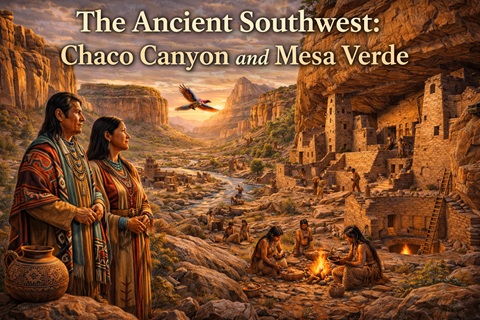
In the dry lands of the American Southwest, Indigenous peoples known today as the Ancestral Puebloans built remarkable communities that adapted to a challenging environment. Two of the most well-known sites, Chaco Canyon and Mesa Verde, reveal advanced knowledge of architecture, farming, and community organization. In this lesson, students will explore how these societies thrived in the desert, built impressive structures, and created lasting cultural traditions.
What You Will Learn
How Ancestral Puebloans adapted to the environment of the Southwest The significance of Chaco Canyon and Mesa Verde as cultural centers The role of architecture, farming, and trade in these societies
Life in the Desert Southwest
The Southwest region is known for its hot, dry climate with limited rainfall. Despite these challenges, the Ancestral Puebloans developed farming techniques that allowed them to grow crops such as corn, beans, and squash. They carefully managed water through irrigation and by planting in areas that collected rainwater.
People in this region built communities that were both practical and well-planned. They used local materials like stone and adobe (a mixture of clay, sand, and water) to construct homes that stayed cool in the summer and warm in the winter. Their ability to adapt to the environment shows their deep understanding of the land.
Chaco Canyon: A Center of Culture
Chaco Canyon was a major cultural and economic center between about 900 and 1150 CE. The people there built large stone structures known as “great houses,” some of which had hundreds of rooms. These buildings were carefully planned and aligned with the sun and stars, suggesting that astronomy played an important role in their culture.
Chaco Canyon was also a hub of trade and communication. Roads connected it to other communities across the region, allowing goods such as pottery, turquoise, and food to be exchanged. This network helped spread ideas and strengthened connections between different groups.
Mesa Verde: Cliff Dwellings and Community
The people of Mesa Verde built their homes (known as cliff dwellings) into the sides of steep hills. These structures provided protection from weather and potential threats. The dwellings included living spaces, storage rooms, and kivas, which the people used for ceremonies and gatherings.
The people of Mesa Verde lived in closely connected communities where cooperation was essential. They shared resources, worked together to build homes, and practiced ceremonies that reinforced their cultural identity. Over time, people abandoned many of these communities, likely due to drought and changing environmental conditions.
Conclusion
The civilizations of Chaco Canyon and Mesa Verde demonstrate the ingenuity and resilience of the Ancestral Puebloans. Through advanced building techniques, careful resource management, and strong community organization, they created lasting and impressive societies in a challenging environment. Their achievements continue to teach us about adaptation, innovation, and cultural strength.
Key Terms
- Ancestral Puebloans: Indigenous peoples of the Southwest known for building complex communities such as those at Chaco Canyon and Mesa Verde.
- Kiva: A circular, underground or semi-underground room used for religious ceremonies and community gatherings.
Review Questions
- How did the Ancestral Puebloans adapt to the dry environment of the Southwest?
- What made Chaco Canyon an important center?
- Why were cliff dwellings at Mesa Verde useful for the people who lived there?
Think Further
Extension Activity: Design a Desert Community
Objective:
Students will demonstrate their understanding of Southwest societies by designing a community that reflects environmental adaptation and cultural practices.
Instructions:
Students will create a model or drawing of a Southwest community inspired by Chaco Canyon or Mesa Verde. Their design should include homes, farming areas, water sources, and a kiva or central gathering place. Students will also write a short explanation (1–2 paragraphs) describing how their design solves the challenges of living in a dry environment.
From Indigenous North America to European Colonization
Indigenous North America Before 1500
The European Age of Exploration
From Revolution to the Eve of Civil War
The Early Republic
The Jacksonian Era
Westward Expansion
The Late 19th Century
The American Civil War
Reconstruction
The Gilded Age
The Early 20th Century
The Progressive Era
World War I
The Roaring 20s and the Great Depression
Modern America Emerges
World War II
The Cold War
Post Cold War America
Modern America