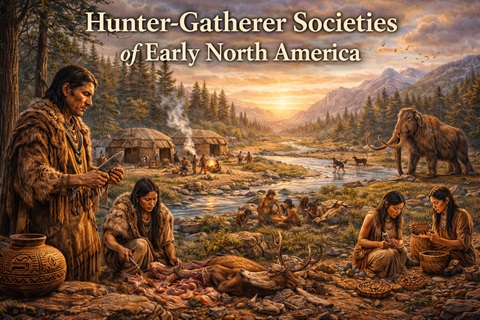
Hunter-Gatherer Societies of Early North America

Long before cities, farms, or written languages appeared in North America, the continent was home to small communities of people who lived by hunting animals and gathering wild plants. These early inhabitants—often called hunter-gatherers—developed ways of life that were closely tied to the rhythms of the natural world. Their survival depended on understanding the landscape, the seasons, and the animals that moved across it.

For thousands of years, this hunter-gatherer way of life formed the foundation of human culture in North America. Early societies were mobile, flexible, and deeply knowledgeable about their environment. They hunted large Ice Age animals, gathered edible plants, crafted tools from stone and bone, and traveled across vast territories. Over time, environmental changes—especially the end of the Ice Age—transformed both the landscape and the strategies people used to survive.

Understanding these early societies helps us see the first chapter of North American history: a world shaped not by cities or nations, but by mobility, adaptation, and intimate knowledge of the natural environment.


Most scholars agree that the first humans arrived in North America during the last Ice Age, a period when massive glaciers covered much of the northern hemisphere. Sea levels were lower than they are today, exposing a land bridge known as Beringia between Siberia and Alaska.

At different times between roughly 20,000 and 15,000 years ago, groups of people migrated across this land bridge. They did not necessarily know they were entering a new continent. Instead, they were following the animals they hunted and moving into new hunting territories.

These early travelers likely moved slowly, over many generations. Small bands spread across Alaska and eventually moved southward through ice-free corridors or along the Pacific coast. By around 13,000 years ago, humans had spread widely across North America.

Archaeological evidence for these early people includes stone tools, spear points, campsites, and animal bones bearing marks of human butchering. One of the most famous archaeological cultures associated with early North Americans is the Clovis culture, named after stone spear points first discovered near Clovis, New Mexico in the 1930s.

Clovis spear points are distinctive: long, finely crafted stone blades with a fluted groove at the base that allowed them to be attached to spears. These tools show remarkable craftsmanship and were likely used for hunting large animals.

Although the Clovis people are not necessarily the very first Americans, they represent one of the earliest widespread archaeological cultures known across the continent.


The earliest societies in North America were nomadic, meaning they moved from place to place rather than settling permanently in one location. Nomadic life was not random wandering. Instead, it followed patterns based on food availability, animal migrations, and seasonal weather.

Typical hunter-gatherer groups were small—often 20 to 50 individuals—organized into extended family bands. These bands worked together to hunt animals, gather plants, care for children, and share resources.

Nomadic life had several advantages:

  • It allowed people to follow migrating animals.
  • It prevented local food sources from being overused.
  • It allowed groups to adapt to changing environmental conditions.

Because they moved frequently, these early communities owned relatively few possessions. Everything they carried needed to be portable. Tools were therefore carefully designed to be useful and durable.

Common tools included:

  • Stone spear points
  • Scrapers for preparing hides
  • Knives made from flint or obsidian
  • Bone needles for sewing clothing
  • Hammerstones for shaping tools

Animal hides were used to create clothing, blankets, and portable shelters. Camps were often temporary, consisting of simple structures made from wood poles, hides, and brush.

Despite their mobility, early hunter-gatherers were far from primitive. Archaeological evidence shows sophisticated knowledge of stone tool production, coordinated hunting strategies, and the ability to survive in a wide range of environments—from the Arctic tundra to the deserts of the Southwest.


One of the most dramatic aspects of early North American life was the hunting of megafauna, the large animals that roamed the continent during the Ice Age.

These animals were enormous compared to many modern species and included:

  • Mammoths
  • Mastodons
  • Giant ground sloths
  • Saber-toothed cats
  • Ancient bison
  • Camels
  • Horses native to North America

For hunter-gatherers, these animals represented an enormous source of food and materials. A single mammoth could provide thousands of pounds of meat, as well as bones, ivory, and hides that could be used for tools and shelter.

Hunting such large animals required cooperation and strategy. Early hunters likely worked together to drive animals into traps, cliffs, or marshy ground where they could be killed more easily.

Archaeological sites provide evidence of these hunting strategies. At some locations, researchers have found piles of mammoth bones associated with stone spear points and butchering tools.

One famous example is the Colby site in Wyoming, where archaeologists discovered mammoth remains along with stone tools, suggesting a coordinated hunt. Similar sites have been found throughout the Great Plains and Southwest.

The primary weapon used in megafauna hunting was likely the spear, sometimes thrown with the help of a tool called an atlatl, or spear-thrower. The atlatl acted as a lever, allowing hunters to throw spears with greater speed and force.

Hunting megafauna was dangerous. A mammoth or giant bison could easily kill a hunter. Success depended on teamwork, planning, and careful knowledge of animal behavior.


Life in a Hunter-Gatherer Band

Daily life in early North American societies was centered around survival, but it was also structured by cooperation and social relationships.

Work was often divided by age and ability. While the exact roles varied from group to group, common patterns likely included:

  • Men participating more often in large-animal hunts
  • Women gathering plants, seeds, berries, and nuts
  • Children learning skills through observation and practice
  • Elders sharing knowledge and guiding decisions

Plant gathering was an extremely important part of the diet. In many hunter-gatherer societies around the world, gathered foods provide a large portion of daily calories.

Common plant foods included:

  • Wild berries
  • Roots and tubers
  • Nuts such as acorns and walnuts
  • Edible seeds and grasses

Gathering required extensive knowledge of local environments. People needed to know where plants grew, when they ripened, and how to prepare them safely.

Social cooperation was essential. Food was often shared among members of the group, reducing the risk that any individual would go hungry.

Hunter-gatherer societies also developed spiritual beliefs connected to the natural world. Many early cultures likely viewed animals, plants, and natural forces as spiritually significant. Although direct evidence is limited, archaeological discoveries—such as decorated tools or ritual burials—suggest the presence of complex belief systems.


The End of the Ice Age

Around 11,700 years ago, the last Ice Age came to an end. The global climate warmed, glaciers retreated, and ecosystems across North America changed dramatically.

This period of transition had profound effects on both animals and humans.

As the climate warmed:

  • Forests spread into areas once dominated by grasslands.
  • Lakes and rivers expanded as glaciers melted.
  • New plant species appeared across the continent.

But the warming climate was also associated with a major event known as the Ice Age megafaunal extinction. Many large animals that had dominated the continent for thousands of years disappeared.

Extinct species included:

  • Mammoths
  • Mastodons
  • Giant ground sloths
  • American lions
  • Saber-toothed cats
  • Short-faced bears
  • North American horses
  • Camels

Scientists continue to debate the exact cause of these extinctions. Two major explanations are often discussed.

Climate Change

As temperatures rose, ecosystems changed rapidly. Plants that supported megafauna disappeared in many areas, and animals that were adapted to cold Ice Age environments struggled to survive in warmer climates.

Human Hunting

Another possibility is that human hunting contributed to the decline of large animals. Even small human populations could have placed pressure on slow-reproducing species like mammoths.

Most researchers now believe the extinctions were likely caused by a combination of climate change and human hunting.

Regardless of the cause, the disappearance of megafauna forced early human societies to adapt.


The Transition to New Hunting Strategies

With the extinction of many large animals, hunter-gatherer societies could no longer rely primarily on megafauna hunting. Instead, they began to diversify their diets and hunting techniques.

This transition marks the beginning of what archaeologists often call the Archaic period, which followed the earlier Paleoindian era.

Rather than focusing on a few large species, people began hunting a wider range of animals, including:

  • Deer
  • Elk
  • Smaller bison
  • Rabbits
  • Birds
  • Fish

Fishing became increasingly important in many regions, especially near rivers, lakes, and coastal areas.

Tool technology also evolved. Spear points became smaller and more varied, reflecting the hunting of different animals. Grinding stones were used to process seeds and nuts, indicating an increased reliance on plant foods.

In many regions, people also began to develop new technologies such as:

  • Fishhooks
  • Nets
  • Basketry
  • Storage pits for food

These innovations allowed hunter-gatherers to exploit a broader range of resources and adapt to diverse environments.


Even after the disappearance of megafauna, most early North American societies remained mobile. However, their movements often followed regular seasonal migration patterns.

Rather than wandering randomly, groups moved between familiar locations at different times of year.

A typical yearly cycle might include:

Spring:
Groups moved toward rivers and wetlands where fish and migrating birds were abundant.

Summer:
Communities might gather in larger groups to harvest berries, hunt deer, and participate in social gatherings or trade.

Autumn:
People collected nuts, seeds, and roots that could be stored for winter.

Winter:
Groups often moved to sheltered areas where fuel and food were available, forming smaller camps during the cold months.

These seasonal movements allowed people to take advantage of resources as they became available.

Some landscapes were particularly important gathering places. For example, large bison herds migrating across the plains attracted hunters from multiple bands.

Similarly, salmon runs in the Pacific Northwest became key seasonal events for coastal communities.

Over generations, these migration routes became part of cultural tradition. Knowledge of the land—where animals moved, where plants grew, where water could be found—was passed down through stories and teaching.


Trade and Interaction Between Groups

Even early hunter-gatherer societies were not completely isolated. Archaeological evidence shows that people traded materials across long distances.

One important example is obsidian, a volcanic glass used to make extremely sharp tools. Obsidian found at archaeological sites can often be traced back to specific volcanic sources, revealing trade networks that stretched hundreds of miles.

Other traded materials included:

  • Marine shells
  • High-quality flint for tools
  • Decorative stones
  • Pigments used for art or ritual

These exchanges suggest that early North American societies maintained networks of interaction long before agriculture or cities emerged.

Trade likely served multiple purposes: obtaining useful materials, strengthening alliances between groups, and facilitating cultural exchange.


The Foundations of Later Cultures

Although hunter-gatherer societies lacked permanent cities or large political systems, they laid the foundations for later Native American cultures.

Over thousands of years, people developed deep knowledge of North America’s diverse environments. They learned how to manage landscapes, harvest plants sustainably, and track animal migrations.

These skills allowed later societies to experiment with new ways of living, including horticulture and eventually agriculture in certain regions.

By the time Europeans arrived in the late fifteenth century, Native American societies were extraordinarily diverse. Some groups remained primarily hunter-gatherers, while others had developed farming villages, trade networks, and complex political systems.

Yet all of these cultures ultimately traced their roots back to the early hunter-gatherer societies that first explored the continent.


Conclusion

The hunter-gatherer societies of early North America represent the earliest stage of human history on the continent. These small, mobile communities lived in close relationship with the natural world, adapting their strategies to changing climates, landscapes, and animal populations.

Early nomadic cultures spread across the continent during the Ice Age, hunting megafauna such as mammoths and mastodons. Their survival depended on cooperation, skill, and detailed knowledge of the environment.

When the Ice Age ended and many large animals disappeared, human societies adapted once again. They broadened their diets, developed new tools, and followed seasonal migration patterns that allowed them to make use of diverse resources.

These early peoples were not merely surviving in a harsh landscape—they were innovators, explorers, and skilled managers of the environment. Their knowledge and traditions formed the foundation upon which later Native American cultures would build.

The story of North America begins not with cities or colonies, but with these early hunter-gatherer societies—small bands of people moving across a vast landscape, learning its rhythms, and shaping the first chapter of the continent’s human history.

Leave a Comment