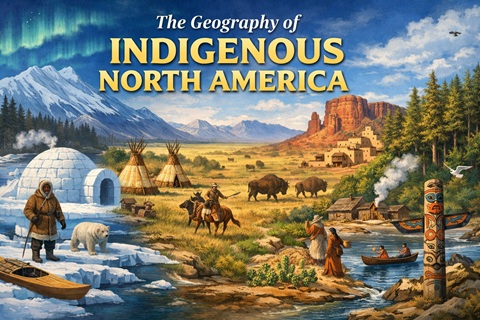
The Geography of Indigenous North America

Map showing the cultural regions of pre-Columbian indigenous America.
Major cultural and geographic regions of Indigenous North America before European contact.

Before Europeans crossed the Atlantic and began mapping the continent according to their own understanding, North America was already a richly known landscape. For thousands of years, Indigenous peoples had explored its rivers, mountains, plains, forests, deserts, and coastlines. They knew where the salmon runs came each year, where buffalo herds migrated across the grasslands, where the richest soils could grow corn, and where the seasons brought drought or rain.

To understand the history of Indigenous North America, we must first understand its geography. The land itself shaped how people lived, what they ate, how they traveled, and how their societies developed. Unlike the colonial period that followed—when governments attempted to impose political boundaries—the Indigenous world was organized primarily around natural landscapes. Rivers, mountain ranges, forests, and plains defined regions of culture and life.

Historians and anthropologists often divide Indigenous North America into several major geographic-cultural regions. Each of these regions had its own environment, resources, and distinctive ways of life. Though the boundaries between them were never rigid, they help us understand how Indigenous peoples adapted to the diverse landscapes of the continent.


A Continent of Extraordinary Diversity

North America is one of the most geographically varied continents on Earth. Stretching from the Arctic tundra in the far north to the tropical forests of southern Mexico, it contains almost every type of landscape imaginable.

The continent includes:

  • frozen tundra and permafrost
  • dense boreal forests
  • vast inland plains
  • towering mountain ranges
  • fertile river valleys
  • arid deserts
  • temperate rainforests
  • coastal marshlands

Because of this diversity, Indigenous cultures developed in dramatically different ways depending on where they lived.

People in the Arctic relied heavily on hunting sea mammals and caribou. Communities along the Pacific Coast harvested salmon and built massive cedar houses. Farmers in the Mississippi Valley cultivated corn, beans, and squash in fertile floodplains. On the Great Plains, tribes followed the seasonal movements of bison herds.

In short, geography did not simply influence Indigenous societies—it shaped them.


The Arctic: Life on the Frozen Edge

The northernmost region of North America is the Arctic, stretching across Alaska, northern Canada, and Greenland. This is a land of long winters, short summers, and harsh environmental conditions.

The ground in much of the Arctic remains permanently frozen beneath the surface, a condition known as permafrost. Trees cannot grow in this environment, leaving the region covered mostly with tundra vegetation—low shrubs, mosses, and grasses.

Yet despite these extreme conditions, Indigenous peoples have lived in the Arctic for thousands of years. The most well-known are the Inuit, though several related cultures inhabited the region historically.

Because farming was impossible in the Arctic, survival depended on hunting and fishing. Arctic peoples became highly skilled hunters of:

  • seals
  • walrus
  • whales
  • caribou
  • Arctic fish

The ocean was especially important. Sea ice served as both a hunting platform and a travel route during winter. Hunters used tools made from bone, ivory, and stone to capture animals whose meat, fat, and hides were essential for survival.

Homes were designed to suit the climate. Temporary winter shelters made from blocks of snow—often called igloos—were used during hunting expeditions. More permanent houses were built partly underground using driftwood, sod, and animal skins to insulate against the cold.

Transportation also reflected geography. In winter, dog sleds allowed people to travel across frozen landscapes. In summer, lightweight boats called kayaks and larger skin-covered boats called umiaks allowed travel along the coasts.

Though the Arctic environment might appear inhospitable, Indigenous knowledge of the land made it a livable—and even familiar—place.


The Subarctic: Forests of the Far North

South of the Arctic lies the Subarctic region, a vast belt of forest stretching from Alaska across Canada to the Atlantic Ocean.

This region is dominated by the boreal forest, often called the taiga. It consists mainly of evergreen trees such as spruce, fir, and pine. Winters here are still long and cold, but summers are somewhat warmer than in the Arctic.

The Subarctic landscape is filled with rivers, lakes, and wetlands. Travel by water was therefore essential. Indigenous peoples of the region developed lightweight birchbark canoes, which could be carried easily between waterways.

The forests provided abundant wildlife. Moose, caribou, bear, and smaller animals such as beaver and hare were important food sources. Fishing also played a major role in the diet.

Because food resources were scattered across large areas, Subarctic societies tended to live in small, mobile bands rather than large permanent settlements. Families moved seasonally, following animal migrations and harvesting resources as they became available.

Homes were usually simple and portable. Conical tents covered with animal hides—similar to those later used on the Plains—were common in some areas. In other places, dome-shaped lodges made from wooden poles and bark were used.

Life in the Subarctic demanded deep knowledge of the forest. Indigenous hunters understood animal behavior, migration patterns, and seasonal changes with remarkable precision.


The Northwest Coast: A Land of Abundance

Image of indigenous totum
Abundant salmon runs, dense cedar forests, and rich coastal waters supported large permanent villages along the Pacific Northwest.

Along the Pacific coast from northern California to Alaska lies one of the most resource-rich environments in North America: the Northwest Coast.

This region receives heavy rainfall, which supports dense temperate rainforests filled with massive cedar trees. Rivers flowing from the mountains into the Pacific Ocean provide ideal spawning grounds for salmon.

For Indigenous peoples of the Northwest Coast, salmon was the foundation of life. Each year, vast salmon runs returned from the ocean to the rivers where the fish had been born. Communities developed sophisticated fishing techniques to harvest and preserve this vital resource.

But salmon was only part of the region’s abundance. Coastal waters also provided:

  • shellfish
  • seals
  • whales
  • sea lions

The forests supplied wood for building houses, canoes, tools, and ceremonial objects.

Because food was plentiful, many Northwest Coast societies developed large, permanent villages. Houses were built from massive cedar planks and could shelter extended families.

The availability of resources also allowed for the development of complex social systems. Some societies included hereditary chiefs, nobles, and commoners. Ceremonial gatherings called potlatches played an important role in social and political life.

The famous totem poles of the region—carved from cedar logs—recorded family histories, clan identities, and mythological stories.

Geography made all of this possible. The combination of ocean, rivers, and forest created an environment of extraordinary productivity.


California: A Patchwork of Micro-Environments

Acorns from California’s oak forests were a staple food for many Indigenous communities.

The Indigenous cultures of California developed in one of the most environmentally diverse areas of North America.

California contains mountains, valleys, deserts, coastlines, and forests all within relatively short distances. As a result, the region supported a remarkable number of distinct tribes and languages. In fact, California had one of the highest concentrations of linguistic diversity in the world.

Many Indigenous communities relied heavily on acorns, which were harvested from oak forests and processed into flour. Though acorns require extensive preparation to remove bitter tannins, they provided a reliable and abundant food source.

Other important foods included:

  • fish
  • deer
  • small game
  • seeds and berries

Unlike many agricultural societies elsewhere on the continent, most California groups practiced little or no farming before European contact. Instead, they relied on careful management of wild resources.

One important technique was controlled burning, which cleared underbrush and encouraged the growth of useful plants. This practice helped maintain healthy ecosystems and improved hunting conditions.

Settlements were often small villages located near reliable food sources such as rivers, oak groves, or coastal areas.


The Great Basin: Life in a Harsh Landscape

Example of the rugged terrain of the Great Basin
Sparse rainfall and rugged terrain shaped a mobile lifestyle among Indigenous peoples of the Great Basin.

East of California’s Sierra Nevada mountains lies the Great Basin, a vast region covering much of modern Nevada and parts of Utah, Oregon, and Idaho.

This landscape is characterized by deserts, salt flats, and rugged mountain ranges. Rainfall is scarce, and rivers rarely reach the ocean. Instead, they flow into inland basins where the water evaporates.

Because of these harsh conditions, the Great Basin supported relatively small populations. Indigenous groups here developed highly mobile lifestyles designed to take advantage of scattered resources.

Food sources included:

  • small game
  • fish from desert lakes
  • seeds and roots
  • pine nuts

Pine nuts, harvested from pinyon pine trees, were especially important and often stored for winter use.

People in the Great Basin typically lived in small family groups that moved frequently throughout the year. Temporary shelters made from brush or reeds provided quick protection from the elements.

Despite the apparent barrenness of the desert, Indigenous peoples of the Great Basin possessed deep ecological knowledge that allowed them to survive in a challenging environment.


The Southwest: Desert Farmers

Indigenous farmers of the Southwest developed irrigation systems and built impressive pueblos adapted to the desert environment.

The Southwest region includes present-day Arizona, New Mexico, southern Utah, and parts of Colorado and Texas. It is a land of deserts, mesas, and dramatic rock formations.

Although much of the region is dry, Indigenous peoples here developed sophisticated farming techniques adapted to the desert environment.

Beginning thousands of years ago, farmers cultivated crops such as:

  • corn
  • beans
  • squash
  • cotton

To make agriculture possible, they used irrigation canals, terraced fields, and careful water management.

Several major cultural traditions flourished in the Southwest. Among them were the ancestors of the Pueblo peoples, whose impressive stone and adobe towns still stand today in places like Mesa Verde and Chaco Canyon.

These communities built multi-story dwellings and ceremonial structures known as kivas. Their societies were organized around farming villages and complex religious traditions connected to the cycles of nature.

Other groups in the Southwest maintained more mobile lifestyles, combining farming with hunting and gathering.

The desert environment required careful planning and cooperation. Water, more than any other resource, shaped life in the Southwest.


The Great Plains: The Sea of Grass

Buffalo grazing on the Great Plains
The vast grasslands of the Great Plains once supported millions of bison, which were central to the cultures of many Plains tribes.

The Great Plains stretch from the Rocky Mountains eastward to the Mississippi River. This enormous region is dominated by grasslands that once supported millions of bison.

Before the arrival of horses in the 1600s, Indigenous peoples of the Plains often lived along river valleys where farming was possible. Crops such as corn and squash were grown in fertile floodplains.

Hunting was also important. Bison, deer, and antelope provided meat, hides, and bones for tools.

After horses spread northward from Spanish settlements in the Southwest, Plains cultures changed dramatically. Horses made it possible to travel farther and hunt bison more efficiently.

Many Plains societies adopted a more mobile lifestyle centered on following bison herds across the grasslands.

The tipi, a portable cone-shaped lodge made from buffalo hides stretched over wooden poles, became the classic dwelling of the Plains. It could be assembled and disassembled quickly as groups moved with the seasons.

The Plains environment was defined by openness. With few natural barriers, people traveled widely and maintained trade networks that connected distant regions of the continent.


The Eastern Woodlands: Forests and Rivers

Eastern Woodlands mound
Fertile river valleys and dense forests allowed large agricultural societies to flourish in the Eastern Woodlands.

East of the Mississippi River lies the vast region known as the Eastern Woodlands. This area includes dense forests, fertile river valleys, and abundant wildlife.

The region is often divided into two subregions:

  • the Northeast
  • the Southeast

Both areas supported large agricultural societies that cultivated corn, beans, and squash—the famous “Three Sisters” crops that grew well together in shared fields.

In the Northeast, communities often lived in fortified villages surrounded by wooden palisades. Longhouses built from wooden frames and bark sheltered extended families.

One of the most influential political organizations in the region was the Haudenosaunee Confederacy, often called the Iroquois Confederacy. It united several nations into a powerful alliance governed by a council of representatives.

Farther south, the Southeast supported some of the largest Indigenous populations in North America. Fertile river valleys and long growing seasons allowed intensive agriculture.

Large ceremonial centers known as mound complexes were built by earlier cultures such as the Mississippian civilization. These earthen mounds supported temples, elite residences, and gathering spaces.

By the time Europeans arrived in the 1500s, many Southeastern societies were organized into chiefdoms with complex political structures.


Rivers, Trade, and Interconnected Worlds

Aerial image of a river and its tributaries
Rivers and waterways connected Indigenous communities across North America through vast trade networks.

Although geographic regions shaped cultural differences, Indigenous North America was not a collection of isolated societies.

Trade routes connected communities across vast distances. Rivers functioned as the highways of the continent, allowing goods and ideas to travel far beyond local territories.

Important trade items included:

  • shells from coastal regions
  • copper from the Great Lakes
  • obsidian from volcanic areas
  • turquoise from the Southwest

These materials have been found hundreds or even thousands of miles from their original sources.

Trade networks helped spread technologies, artistic styles, and cultural traditions across the continent. They also created relationships between peoples who lived in very different environments.

In this sense, the geography of North America not only shaped local cultures—it also connected them.


Geography as a Foundation of Culture

For Indigenous peoples, geography was never simply a backdrop to human life. The land itself was deeply intertwined with culture, spirituality, and identity.

Mountains, rivers, forests, and animals often held sacred significance. Stories passed down through generations explained how people were connected to particular landscapes and why those places mattered.

Rather than attempting to reshape the environment on a massive scale, Indigenous societies generally adapted themselves to the rhythms of the natural world.

They observed seasonal cycles, respected ecological limits, and developed sustainable ways of harvesting resources.

This deep relationship with the land allowed Indigenous communities to thrive in environments ranging from Arctic tundra to desert mesas.


Conclusion: Understanding the Land Before Colonization

When Europeans first arrived in North America, they encountered a continent already filled with knowledge, history, and established societies.

The geography of the land had shaped these societies over thousands of years. Each region—Arctic, Subarctic, Northwest Coast, California, Great Basin, Southwest, Plains, and Eastern Woodlands—produced distinct ways of life adapted to local conditions.

Understanding this geographic foundation helps us see Indigenous North America more clearly. Rather than a wilderness awaiting settlement, it was a mosaic of cultures deeply connected to the landscapes they inhabited.

The rivers, forests, plains, and deserts of North America were not empty spaces on a map. They were homes—known, understood, and cared for by the people who lived there long before the age of European exploration began.

And to understand the history of this continent, we must begin with that fundamental truth: the land shaped the people, and the people shaped their relationship with the land.

Leave a Comment