
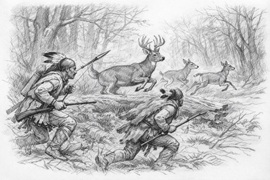
If you had traveled across eastern North America long before Europeans arrived, you would have entered a landscape very different from the open grasslands of the Great Plains or the deserts of the Southwest. Much of the eastern part of the continent was covered by dense forests, crossed by winding rivers and dotted with lakes.
This region is known as the Eastern Woodlands, and it stretched from the Atlantic Ocean westward to the Mississippi River, and from the Great Lakes southward to the Gulf of Mexico.
For thousands of years before 1500, this vast forested region was home to a wide variety of Indigenous cultures. These peoples developed sophisticated farming systems, built large villages, created powerful alliances, and maintained trade networks that connected communities across the continent.
Some of the most well-known peoples of the Eastern Woodlands include the Iroquois, Algonquin, Powhatan, Cherokee, Shawnee, Creek, and Choctaw, though many other tribes also lived throughout the region.
Although these societies differed in language and traditions, they shared many common features shaped by the forests, rivers, and fertile soil of the Eastern Woodlands.
The Geography of the Eastern Woodlands
The Eastern Woodlands region includes much of present-day:
- New England
- The Mid-Atlantic states
- The Great Lakes region
- The Ohio River Valley
- The Mississippi River Valley
- The Southeastern United States

This region contains a rich variety of landscapes, including:
- Thick hardwood forests
- Large river systems
- Fertile farmland
- Lakes and wetlands
Because rainfall was plentiful and the soil was fertile, many Woodland peoples practiced agriculture in addition to hunting and gathering.
The forests provided important resources such as:
- Deer and other game animals
- Nuts and berries
- Wood for building homes and tools
- Plants used for medicine and clothing
The many rivers also served as natural highways, allowing people to travel long distances by canoe.
Early Woodland Cultures
Archaeologists divide the history of the Eastern Woodlands into several periods. One important era is known as the Woodland Period, which lasted from roughly 1000 BCE to about 1000 CE.
During this time, several major developments took place.
People began making pottery, which allowed them to cook and store food more easily. Communities also developed more permanent villages and expanded their farming practices.

Another important development was the construction of burial mounds and ceremonial earthworks. Some of these structures were built by the Adena and Hopewell cultures, which lived mainly in the Ohio River Valley.
These early mound-building cultures created large earthworks shaped like animals, geometric figures, or ceremonial platforms.
Although these ancient cultures eventually declined, their traditions influenced many later Woodland societies.
Farming in the Forest
One of the most important features of Woodland life was agriculture.
Many Woodland peoples grew crops using a farming method sometimes called the “Three Sisters.”
The Three Sisters were:
- Corn
- Beans
- Squash
These plants were often grown together because they helped one another grow.
Corn provided tall stalks that beans could climb. Beans helped add nutrients to the soil. Squash spread across the ground, helping keep moisture in the soil and preventing weeds from growing.
This farming system was efficient and productive. It allowed Woodland communities to grow enough food to support large villages.
Farmers used simple tools such as digging sticks and stone hoes to prepare the soil.
Woodland Villages
Many Eastern Woodland peoples lived in permanent or semi-permanent villages.
These villages were often located near rivers or streams, which provided water, transportation, and fertile farmland.

Homes were built from materials found in the surrounding forests.
Two common types of Woodland homes were:
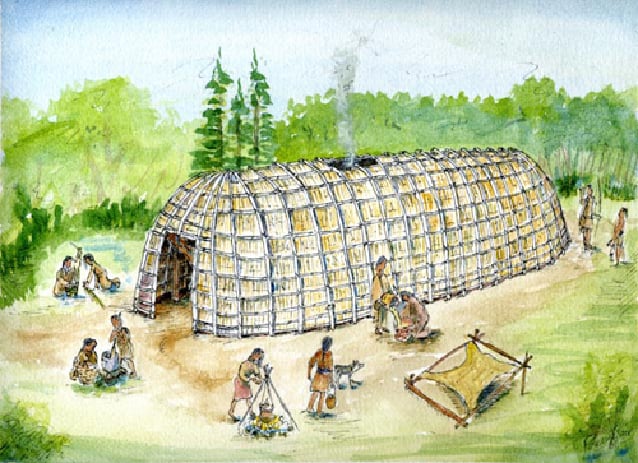
Longhouses
Longhouses were large rectangular buildings made from wooden frames covered with sheets of bark. They could be more than 100 feet long and were often home to several families from the same clan.
Longhouses were especially common among the Iroquois peoples.
Inside a longhouse, families shared cooking fires and living space, with sleeping platforms along the walls.
Wigwams
Some Woodland tribes built smaller dome-shaped homes known as wigwams.

These structures were made from flexible wooden poles covered with bark or woven mats.
Wigwams were easier to construct and were often used by groups that moved seasonally.
Hunting and Gathering
Although farming was important, hunting and gathering remained essential parts of Woodland life.
Hunters tracked animals such as:
- Deer
- Elk
- Bear
- Turkey
- Small game animals
Deer were particularly important because they provided both meat and hides.
Hides could be used to make clothing, blankets, and moccasins.
Women and children often gathered plant foods such as:
- Nuts (especially acorns and walnuts)
- Berries
- Wild fruits
- Roots and edible plants
Fishing was also common along rivers and lakes.
The Iroquois Confederacy
One of the most famous political alliances in the Eastern Woodlands was the Iroquois Confederacy, sometimes called the Haudenosaunee, which means “People of the Longhouse.”
The Confederacy was made up of several nations, including:
- Mohawk
- Oneida
- Onondaga
- Cayuga
- Seneca
- (Later, the Tuscarora joined)
According to tradition, these nations once fought frequently with one another. A leader known as the Great Peacemaker helped unite them into a confederation based on cooperation and shared decision-making.
The Iroquois Confederacy developed a system of government that balanced local independence with collective leadership.
Each nation kept control of its own affairs but sent representatives to a central council that made decisions affecting the entire confederacy.
This political system helped maintain peace among the member nations and made the confederacy a powerful force in the region.
Clan Systems and Family Life
Many Woodland societies were organized around clans, which were extended family groups connected through ancestry.
Clans were often identified by animals such as:
- Wolf
- Bear
- Turtle
- Deer
Members of the same clan considered themselves relatives and were expected to help one another.
In several Woodland cultures, including the Iroquois, family descent was traced through the mother’s line. This system is known as matrilineal descent.
Women often played important roles in Woodland societies. In some tribes, elder women helped choose tribal leaders and played a major role in managing farmland and household resources.
Trade and Communication
The Eastern Woodlands were connected by extensive trade networks.
Canoes made from hollowed-out logs or sheets of bark allowed people to travel easily along rivers and lakes.
Through trade, Woodland peoples exchanged goods such as:
- Copper from the Great Lakes
- Shell beads (called wampum)
- Stone tools
- Pottery
- Furs and animal hides
These trade networks allowed ideas and technologies to spread across large regions.
Religion and Spiritual Beliefs
Spiritual beliefs played an important role in Woodland societies.
Many people believed that the natural world was filled with powerful spirits.
Animals, rivers, forests, and even storms could be connected to spiritual forces.
Ceremonies were often held to ensure successful harvests, safe hunts, and the well-being of the community.
Storytelling was also important. Stories about animals and legendary figures helped explain the world and taught lessons about proper behavior.
Spiritual leaders sometimes guided ceremonies and helped heal the sick using knowledge of herbs and natural medicine.
The Southeastern Woodland Societies
Farther south, in regions that are now Georgia, Alabama, Mississippi, and Florida, Woodland cultures developed even larger and more complex societies.
Many of these communities were influenced by the ancient Mississippian culture, which built large ceremonial cities centered around massive earthen mounds.
One of the most famous Mississippian cities was Cahokia, located near present-day St. Louis. Around the year 1100, Cahokia may have been one of the largest cities in North America.
Although Cahokia eventually declined, many later Southeastern tribes inherited cultural traditions connected to this earlier civilization.
Tribes such as the Cherokee, Creek, and Choctaw lived in farming villages and maintained strong social and political traditions.
Eastern Woodland Cultures Before European Contact
By the late 1400s, when European explorers first began crossing the Atlantic Ocean, the Eastern Woodlands were home to millions of Indigenous people.
These societies had developed complex farming systems, political alliances, and trade networks.
Villages dotted river valleys and forest clearings throughout the region. Communities worked together to grow crops, hunt game, and maintain traditions passed down through generations.
Although each tribe had its own language and customs, the peoples of the Eastern Woodlands shared many cultural traditions shaped by the forests and rivers of their homeland.
The Legacy of the Eastern Woodlands
The societies of the Eastern Woodlands demonstrate the rich diversity of Indigenous life in North America before European contact.
Through farming, trade, and cooperation, Woodland peoples created thriving communities that lasted for centuries.
Their political alliances, agricultural knowledge, and cultural traditions helped shape the history of North America long before Europeans arrived.
Today, the descendants of these peoples—including the Haudenosaunee, Cherokee, Shawnee, Creek, and many others—continue to preserve their languages, traditions, and heritage.
Their history reminds us that the forests of eastern North America were once home to vibrant civilizations built on cooperation, respect for nature, and deep connections to community and family.