
Long before Europeans arrived in North America, the continent was home to a rich variety of cultures, languages, and political systems. Among the most remarkable of these societies was the Iroquois Confederation, a powerful alliance of Native nations that emerged in the woodlands of what is now the northeastern United States and southeastern Canada. Known to its people as the Haudenosaunee, or “People of the Longhouse,” the confederation represented one of the most sophisticated political organizations in pre-Columbian North America.
The Haudenosaunee Confederacy was more than a military alliance. It was a system of governance rooted in diplomacy, shared law, and cultural unity. Its founding narrative tells of rival nations brought together through a message of peace and mutual responsibility. The confederation’s governing principles were preserved through oral tradition in a body of law called the Great Law of Peace, which guided relations among the member nations and structured their political system.
By the time Europeans first encountered the peoples of the northeastern woodlands in the sixteenth and seventeenth centuries, the Iroquois Confederation had already become a dominant force in the region. Its leaders skillfully balanced internal unity with external diplomacy, and its people developed agricultural, social, and political practices well adapted to the environment of the eastern forests.
Understanding the pre-Columbian Iroquois Confederation offers insight into how Indigenous societies built stable governments, fostered cooperation among diverse communities, and maintained cultural traditions over generations. It also challenges the outdated stereotype that Native societies lacked complex political institutions. In reality, the Haudenosaunee created a political structure that was both durable and adaptable—one that endured for centuries and continues to shape the identity of its descendants today.
The Homeland of the Haudenosaunee
The Iroquois Confederation developed in the forested region south of the Great Lakes and east of the Appalachian Mountains. This landscape, rich with rivers, hardwood forests, and fertile soil, provided the environmental foundation for Iroquois life.
The core territory of the confederacy stretched across what is now central and western New York State, extending toward Lake Ontario and Lake Erie. The five original nations occupied neighboring territories arranged roughly from east to west: the Mohawk, Oneida, Onondaga, Cayuga, and Seneca.
The geography of the region played an important role in shaping Haudenosaunee society. Thick forests supplied timber for homes and tools. Rivers and lakes offered fish and transportation routes. Fertile clearings provided space for agriculture. Game animals such as deer, bear, and turkey thrived in the woodland environment, supporting hunting traditions that supplemented farming.
The Haudenosaunee often described their confederation metaphorically as a longhouse, a structure central to their daily lives. In a traditional longhouse, multiple families lived under one roof, sharing space while maintaining distinct households. In the same way, the confederation united several nations within a single political “house.” The Mohawk guarded the eastern door, the Seneca guarded the western door, and the Onondaga—located near the center—served as the keepers of the council fire.
This symbolic geography helped reinforce the idea that the confederation was not simply a loose alliance but a shared political home.
The Nations of the Confederacy
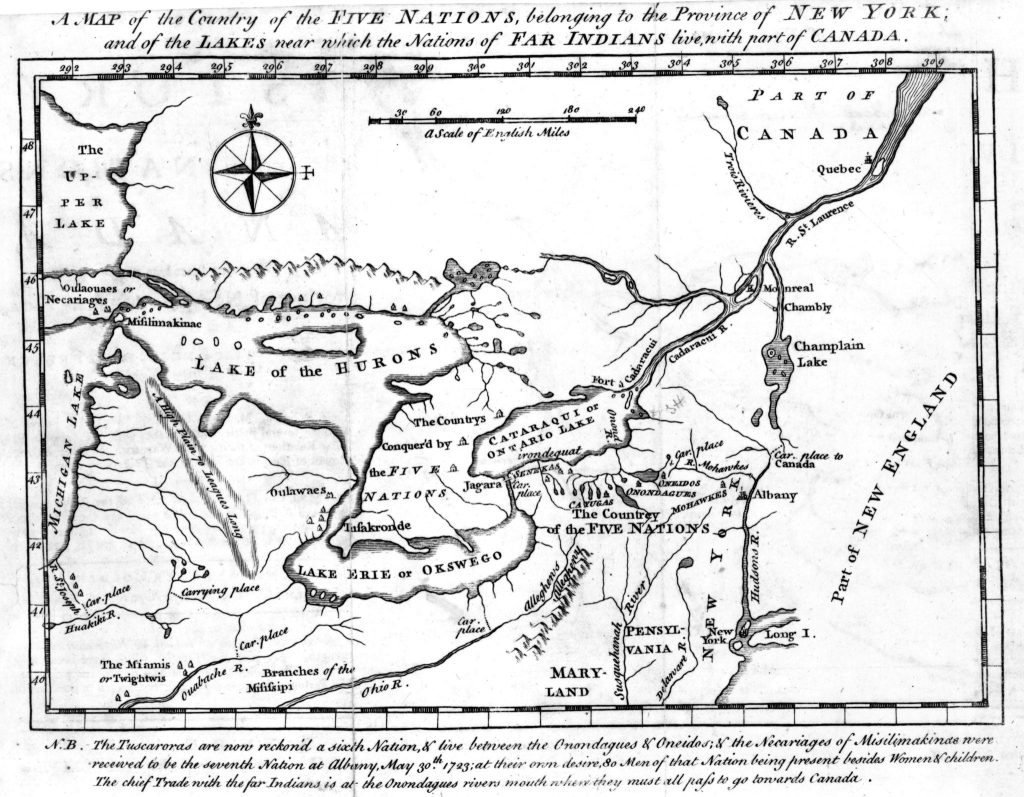
Before the confederation formed, the five Iroquoian-speaking nations were independent societies that sometimes fought among themselves. Each nation had its own territory, leaders, and villages, yet they shared similar languages, cultural traditions, and social structures.
The Mohawk occupied the easternmost territory along the Mohawk River valley. Because of their position, they often served as the first point of contact with peoples from the Atlantic coast. The Mohawk were known as skilled warriors and traders and later became famous as the “Keepers of the Eastern Door.”
The Oneida, living west of the Mohawk, inhabited an area of rolling hills and lakes. Their villages were smaller than those of some neighboring nations, but they played an important role within the confederation.
The Onondaga lived near the geographic center of the confederacy. This central location made them the symbolic heart of the alliance. The Onondaga hosted the confederation’s grand council and maintained the sacred council fire where leaders gathered to discuss matters affecting the entire league.
West of the Onondaga lived the Cayuga, whose territory included lakes and fertile farmland. Like the other nations, they relied on a mixed economy of farming, hunting, and fishing.
Farthest west were the Seneca, the largest and often most powerful nation in the confederation. Their territory extended toward the Great Lakes, and they were known as the “Keepers of the Western Door.”
Together these five nations formed the original Haudenosaunee Confederacy. In the early eighteenth century, the Tuscarora, a people originally from the Carolinas who migrated north after conflict with English colonists, were adopted into the league, creating the Six Nations. But the confederation itself had been established long before European contact.
The Founding of the Confederation
The origin story of the Iroquois Confederation is preserved in oral tradition and centers on three key figures: Deganawida, known as the Peacemaker; Hiawatha, his spokesman; and Jigonhsasee, a respected woman leader.
According to Haudenosaunee tradition, the five nations once lived in a state of frequent conflict. Warfare and revenge killings created a cycle of violence that threatened the survival of their communities. Deganawida, a spiritual leader from the north, brought a vision of unity and peace. His message was simple but powerful: the nations should bury their weapons beneath a symbolic tree and live under a common law that promoted harmony.
Deganawida traveled among the nations spreading this message, but he relied on Hiawatha—renowned for his oratory—to help communicate the vision. One by one, the nations accepted the proposal for peace. The story tells that the weapons of war were buried beneath the Tree of Peace, whose roots spread in the four directions to invite others into the alliance.
While historians debate the exact date of the confederation’s founding, many scholars believe it emerged sometime between the 12th and 15th centuries, well before European arrival in the region.
The founding story highlights an important aspect of Haudenosaunee political philosophy: peace was not simply the absence of war. It required cooperation, shared responsibility, and a system of law that encouraged consensus.
The Great Law of Peace
At the heart of the Iroquois Confederation was a political system known as the Great Law of Peace. This body of law established the rules governing relations among the member nations and laid out the procedures for decision-making.
Unlike written constitutions in European societies, the Great Law of Peace was transmitted orally. It was memorized and recited by designated leaders who preserved the traditions of the confederation. Special belts of wampum—strings of shell beads woven into patterns—helped record important agreements and served as mnemonic devices during council meetings.
The Great Law emphasized several key principles.
First was unity among the nations. Each nation retained autonomy over its own villages and local affairs, but matters affecting the entire confederacy were decided collectively.
Second was consensus decision-making. Rather than relying on majority vote, leaders worked toward agreement acceptable to all nations. Discussions could take time, but the goal was to maintain harmony and avoid forcing decisions on reluctant members.
Third was responsibility to future generations. Haudenosaunee leaders were encouraged to consider the long-term consequences of their decisions. This principle, sometimes described as thinking for the “seventh generation,” reflected a worldview that valued sustainability and continuity.
Finally, the Great Law established a clear structure of leadership, with specific roles for chiefs, clan mothers, and councils.
Governance and Leadership
The political structure of the Iroquois Confederation combined local autonomy with a shared federal system. Each nation had its own council composed of sachems, or chiefs, who represented different clans.
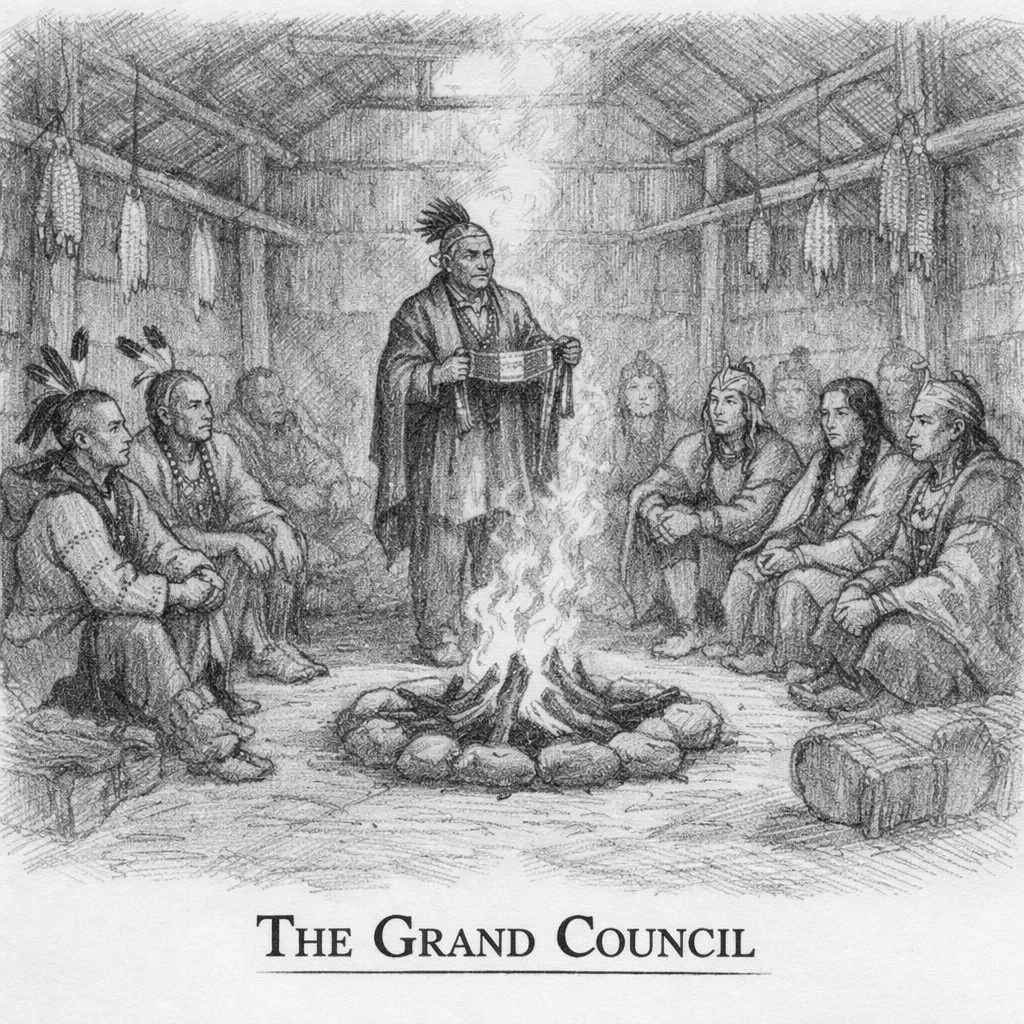
In total, the confederation recognized fifty hereditary sachem titles, distributed among the five nations. These leaders met in a Grand Council to discuss issues affecting the entire confederacy, including diplomacy, warfare, and relations with other peoples.
An important and sometimes overlooked feature of Haudenosaunee governance was the role of women, particularly the clan mothers. Iroquois society was matrilineal, meaning that clan membership and inheritance passed through the mother’s line. Clan mothers held the authority to appoint or remove chiefs and ensured that leaders acted in the interests of the people.
This balance between male political leadership and female authority created a system of checks and accountability. Chiefs were expected to lead with patience, wisdom, and humility. If a chief failed to uphold these standards, the clan mother could remove him from office.
Decision-making in the Grand Council followed a structured process. The Mohawk and Seneca, representing the eastern and western doors, considered proposals first. The Oneida and Cayuga then reviewed the discussion. Finally, the Onondaga, as keepers of the council fire, announced the consensus decision.
This method reinforced the idea that leadership was a collective responsibility rather than a concentration of power in a single individual.
Village Life and Social Organization
Daily life among the Haudenosaunee revolved around the village community. Villages were typically composed of longhouses built from wooden frames covered with sheets of elm bark. These structures could extend over one hundred feet in length and housed several related families belonging to the same clan.
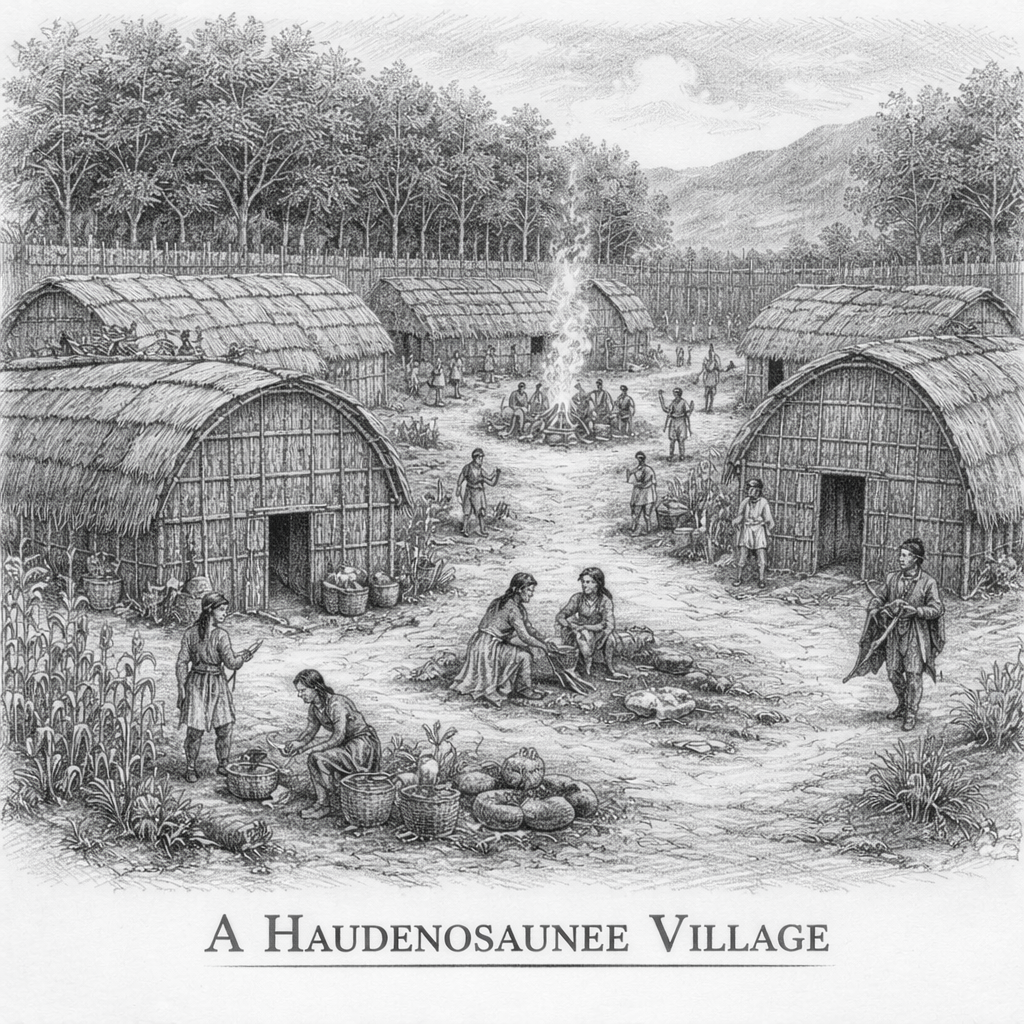
Inside the longhouse, each family maintained its own living space, while central hearths provided heat and cooking areas. Smoke from these fires escaped through openings in the roof.
Villages were often surrounded by wooden palisades—tall fences made of sharpened logs—for protection. Within these fortified settlements, people shared resources and cooperated in agricultural and hunting activities.
The clan system was central to social organization. Clans—often named after animals such as Wolf, Bear, or Turtle—extended across the different nations of the confederacy. Members of the same clan considered one another relatives, even if they lived in different villages.
This network of kinship helped strengthen unity across the confederation. Because clan members were spread among multiple nations, disputes between communities often involved relatives on both sides, encouraging diplomacy rather than conflict.
Agriculture and the “Three Sisters”
One of the foundations of Haudenosaunee life was agriculture. The Iroquois were skilled farmers who cultivated crops in clearings within the forest. Their most important agricultural system revolved around three crops known collectively as the “Three Sisters”: corn, beans, and squash.
These plants were grown together because they supported one another biologically. Corn stalks provided natural poles for beans to climb. Beans enriched the soil by adding nitrogen, helping the corn grow stronger. Squash spread across the ground, shading the soil and reducing weeds.
Women were primarily responsible for farming, and their work sustained the community. Corn, in particular, held deep cultural significance and appeared in ceremonies and spiritual traditions.
In addition to farming, the Haudenosaunee hunted deer and other animals, fished in rivers and lakes, and gathered wild plants, nuts, and berries. This combination of agriculture and foraging created a stable food supply that supported relatively large villages.
Trade and Regional Influence
Even before European arrival, the Iroquois Confederation was part of a wide network of trade connecting different regions of North America.
The Haudenosaunee exchanged goods such as furs, pottery, corn, and crafted tools with neighboring peoples. Trade routes extended north toward the St. Lawrence River, west toward the Great Lakes, and south into the Appalachian region.
These connections helped spread cultural ideas and technologies across the continent. They also strengthened the confederation’s influence in the Northeast. Because the Iroquois controlled important travel corridors between the Atlantic coast and the interior, they played a key role in regional diplomacy.
The confederation’s unity allowed it to present a coordinated presence when dealing with neighboring nations. This political cohesion gave the Haudenosaunee significant strategic advantages.
Warfare and Defense
Although the confederation was founded on principles of peace, warfare still existed in the pre-Columbian Northeast. Conflicts sometimes arose with neighboring groups over territory, trade routes, or longstanding rivalries.
War parties were typically composed of small groups of warriors who conducted raids rather than large pitched battles. Captives taken during these conflicts could sometimes be adopted into Iroquois communities, a practice that helped replace population losses and integrate outsiders into society.
The confederation’s political unity allowed its member nations to coordinate defense when necessary. At the same time, the Great Law of Peace worked to reduce internal warfare among the Haudenosaunee themselves.
By ending cycles of conflict between the five nations, the confederation strengthened the region’s most powerful Indigenous alliance.
Cultural and Spiritual Life
Haudenosaunee culture was deeply connected to the natural world. Spiritual traditions emphasized balance, gratitude, and respect for the environment.
Ceremonies marked seasonal changes and agricultural cycles. The Green Corn Festival, for example, celebrated the ripening of the corn harvest and offered thanks for the year’s bounty.
Stories and oral traditions played an essential role in preserving cultural knowledge. Elders passed down legends, moral teachings, and historical narratives to younger generations. These stories helped reinforce community values and collective identity.
Music, dance, and ritual were also important elements of communal life. Social dances brought villages together and strengthened bonds among community members.
The Confederation on the Eve of European Contact
By the late fifteenth century, the Haudenosaunee Confederacy had already established itself as a stable and influential political system in northeastern North America.
Its member nations maintained organized villages, practiced productive agriculture, and participated in regional trade networks. The confederation’s council system enabled leaders to coordinate policies and resolve disputes peacefully.
This political structure helped the Iroquois adapt quickly to new challenges when Europeans began arriving in the region during the sixteenth century. Although the coming centuries would bring dramatic changes—including new trade opportunities, disease epidemics, and colonial conflicts—the foundations of the confederacy had already been laid long before contact.
Legacy of the Pre-Columbian Confederation
The pre-Columbian Iroquois Confederation stands as one of the most remarkable political achievements in Indigenous North America. Through diplomacy, shared law, and cooperative governance, the Haudenosaunee created a durable alliance that lasted for centuries.
Their system demonstrated that complex political institutions existed in North America long before European colonization. The confederation balanced unity with independence, allowing individual nations to maintain their identities while participating in a broader political community.
Today, the Haudenosaunee Confederacy continues to exist. Its traditions, ceremonies, and political principles remain central to the identity of its people. The Great Law of Peace still guides the councils of the Six Nations, preserving a legacy that stretches back hundreds of years.
Studying the pre-Columbian Iroquois Confederation reminds us that North America’s history did not begin with European exploration. Long before ships crossed the Atlantic, Indigenous nations had already built sophisticated societies rooted in cooperation, law, and cultural resilience.
The Haudenosaunee story is, at its heart, a story about the power of unity—about how communities once divided by conflict chose to come together under a shared vision of peace.