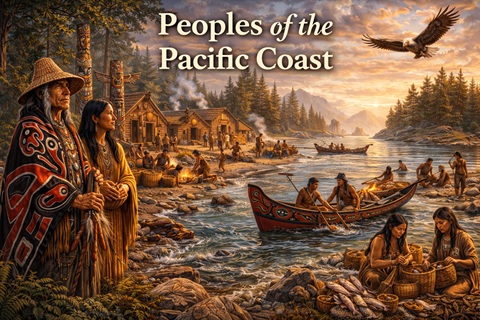
The Pacific Coast of North America, stretching from present-day California to Alaska, was home to Indigenous peoples who developed rich and complex societies supported by abundant natural resources. With access to the ocean, forests, and rivers, these groups built permanent villages and created vibrant cultures centered on fishing, trade, and art. In this lesson, students will explore how geography shaped life along the Pacific Coast and how these societies organized their communities and traditions.
What You Will Learn
- How the Pacific Coast environment supported large, settled communities
- The importance of fishing, especially salmon, to daily life
- How art, trade, and social structure shaped Pacific Coast cultures
A Land of Abundance
The Pacific Coast region is known for its mild climate, dense forests, and rich waterways. The ocean and rivers provided a steady supply of fish, especially salmon, which became a central part of life for many groups. Forests of cedar trees offered materials for building homes, canoes, and tools.
Because resources were plentiful, many Pacific Coast peoples were able to build permanent villages rather than move frequently. This stability allowed populations to grow and communities to develop more complex social systems. People could spend time not only on survival but also on art, ceremony, and trade.
Daily Life and Social Structure
Peoples in the Pacific Coast region often built large wooden plank houses made from cedar. These homes, built to last for many years, could shelter extended families. Villages were typically located near rivers or coastlines to take advantage of fishing opportunities.
Society was often divided into social groups or classes, including leaders, skilled workers, and others within the community. Leadership roles were often inherited, and status could be shown through wealth and generosity. Community life emphasized cooperation, with people working together to gather food, build structures, and prepare for seasonal changes.
Culture, Trade, and Ceremony
Pacific Coast peoples are well known for their artistic traditions, including carving, weaving, and the creation of totem poles. Totem poles often told stories about families, history, or important events and were a way of preserving cultural identity.
Trade networks connected different groups along the coast and even inland. People exchanged goods such as dried fish, shells, baskets, and crafted items. Ceremonies like the potlatch were important social events where families would give away goods to show generosity and strengthen community ties. These traditions reflected values of sharing, respect, and cultural pride.
Conclusion
The peoples of the Pacific Coast developed thriving societies supported by the natural abundance of their environment. Their ability to build permanent communities, create complex social structures, and produce rich artistic traditions shows the diversity of Indigenous cultures in North America. By studying these societies, we gain a better understanding of the close connection between environment and culture.
Key Terms
- Totem Pole: A carved wooden pole that represents family history, beliefs, or important events.
- Potlatch: A ceremonial gathering where wealth is shared or given away to strengthen social bonds and display generosity.
Review Questions
- How did the environment of the Pacific Coast support permanent settlements?
- What role did salmon play in daily life?
- Why were ceremonies like the potlatch important to these societies?
Think Further
Extension Activity: Create a Cultural Symbol and Explanation
Objective:
Students will demonstrate their understanding of Pacific Coast cultures by using symbols to represent identity and storytelling.
Instructions:
Students will design their own symbolic “totem” on paper, representing their family, values, or personal story using symbols and images. Then, they will write a short explanation (1–2 paragraphs) describing what each part of their design represents and how it tells a story.
From Indigenous North America to European Colonization
Indigenous North America Before 1500
The European Age of Exploration
From Revolution to the Eve of Civil War
The Early Republic
The Jacksonian Era
Westward Expansion
The Late 19th Century
The American Civil War
Reconstruction
The Gilded Age
The Early 20th Century
The Progressive Era
World War I
The Roaring 20s and the Great Depression
Modern America Emerges
World War II
The Cold War
Post Cold War America
Modern America