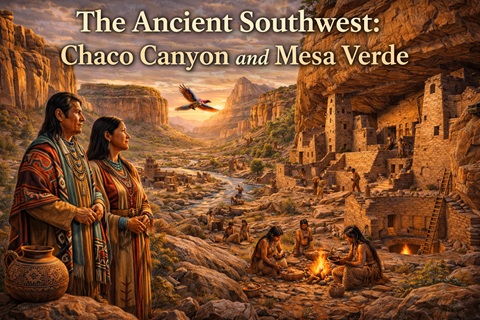
If you travel today through the dry desert lands of the American Southwest, you might think it would be a difficult place for people to live. Much of the land is rocky and dry. Rainfall is limited. Summers can be extremely hot, and winters can be cold. At first glance, it might seem like a region where few people could survive.
Yet more than a thousand years ago, this landscape was home to thriving communities. Skilled builders constructed large stone villages. Farmers grew corn, beans, and squash in the desert soil. Roads stretched across the land connecting distant settlements. Trade routes carried turquoise, pottery, and other valuable goods across hundreds of miles.
Two of the most remarkable centers of this ancient civilization were Chaco Canyon, located in what is now northwestern New Mexico, and Mesa Verde, in present-day southwestern Colorado. These places were home to the ancestors of the modern Pueblo peoples, including the Hopi, Zuni, and many Pueblo communities of New Mexico.
Today, the ruins of Chaco Canyon and Mesa Verde stand as powerful reminders of the creativity, intelligence, and resilience of the Indigenous peoples who lived in the Southwest long before European explorers arrived.
The Land of the Ancient Southwest
The ancient Southwest includes parts of what are now Arizona, New Mexico, Colorado, and Utah. Much of this region lies on a high plateau called the Colorado Plateau, where mesas, canyons, and desert valleys stretch across the landscape.
Rainfall in this region is unpredictable. Some years bring enough rain to support crops, while other years bring drought. For this reason, ancient farmers had to learn how to manage water carefully.
The people who lived here developed many clever techniques to survive in this challenging environment. They built irrigation canals to guide water from streams into their fields and planted crops in areas where rainfall would collect naturally. They also built small stone walls called check dams that slowed the flow of rainwater and helped soak it into the soil.
These strategies allowed them to grow important crops such as:
- Corn (maize)
- Beans
- Squash
- Cotton
Corn was especially important. It became the main food crop for many Southwestern cultures and was often connected to religious ceremonies and traditions.
The Ancestral Pueblo People
The people who built the great settlements of Chaco Canyon and Mesa Verde are often called the Ancestral Puebloans. In older books, they were sometimes referred to as the “Anasazi,” but many Indigenous communities prefer the term Ancestral Pueblo because it reflects their connection to the modern Pueblo peoples.
The Ancestral Pueblo people developed their culture over many centuries. Early communities began as small villages of farmers living in simple pit houses—homes partially dug into the ground for warmth and protection.
Over time, their villages grew larger and more complex. By around 800 CE, they had begun building large stone structures that archaeologists call pueblos. These were multi-story buildings made of carefully fitted stones and mud mortar.
Some pueblos contained dozens or even hundreds of rooms. Families lived in these rooms, stored food in them, and used them for various daily activities.
Two of the greatest centers of this culture were Chaco Canyon and Mesa Verde.
Chaco Canyon: A Desert Center of Culture and Trade

Around 850 CE, a remarkable settlement began to grow in Chaco Canyon. Over the next three centuries, it became one of the most important cultural centers in the entire Southwest.
The canyon itself lies in a remote desert region. Even today it feels isolated and quiet. Yet long ago it was a place filled with activity.
The Great Houses
The most famous buildings in Chaco Canyon are known as Great Houses.
These massive structures were built with stone walls several feet thick. Some rose four or five stories high. Inside were hundreds of rooms arranged around large courtyards.
One of the most famous Great Houses is Pueblo Bonito, which contained more than 600 rooms.
Archaeologists believe these buildings served several purposes:
- Homes for important families or leaders
- Storage areas for food and trade goods
- Religious and ceremonial centers
- Gathering places for community events
The construction of these buildings required careful planning and cooperation. Thousands of stones had to be cut, carried, and placed with great precision.
The Great Kivas
Many Chaco buildings included large circular rooms called kivas.
Kivas were used for ceremonies, meetings, and religious rituals. They were often built partly underground and had special features such as:
- Fire pits
- Ventilation shafts
- Benches around the walls
- Ladders leading down through the roof
Some of the kivas in Chaco Canyon were enormous. These Great Kivas could hold large groups of people and were likely used for major ceremonies.
Roads Across the Desert
One of the most surprising discoveries about Chaco Canyon is its road system.

Archaeologists have found wide, carefully constructed roads leading away from the canyon in several directions. Some of these roads stretch for dozens of miles across the desert.
These roads connected Chaco Canyon with smaller settlements throughout the region. They helped people travel, trade, and stay connected with one another.
A Center of Trade
Chaco Canyon was also an important trading center.
Archaeologists have discovered objects from far-away places in the ruins of Chaco buildings, including:
- Turquoise from nearby mines
- Seashells from the Pacific Ocean
- Parrot feathers from Mexico
- Copper bells and other items from distant regions
These discoveries show that Chaco Canyon was part of a large network of trade that stretched across the Southwest and into Mexico.
Mesa Verde: Villages in the Cliffs
While Chaco Canyon was developing in New Mexico, another remarkable community was growing farther north in what is now Colorado.
This place is called Mesa Verde, which means “green table” in Spanish. The name refers to the high plateau covered with forests and grasslands.
The most famous structures at Mesa Verde are its cliff dwellings—villages built into natural alcoves in the canyon walls.
Early Mesa Verde Villages
At first, the people of Mesa Verde lived in small farming villages on top of the mesas. Like other Southwestern peoples, they grew corn, beans, and squash.
Over time, their communities grew larger. By the late 1100s and 1200s, many families began building homes within the sheltered cliffs of the canyon walls.
Life in the Cliff Dwellings
The cliff dwellings were built from carefully shaped sandstone blocks held together with mud mortar. The builders also used wooden beams from nearby forests.
Some cliff villages contained dozens or even hundreds of rooms.
The most famous cliff dwelling is Cliff Palace, which has more than 150 rooms and 20 kivas.
These cliff communities were carefully designed. Ladders allowed people to move between different levels. Storage rooms protected food supplies. Kivas provided places for ceremonies and gatherings.
Living in the cliffs offered several advantages:
- Protection from enemies
- Shelter from wind and weather
- Good sunlight during winter months
Daily Life in the Ancient Southwest
Despite the impressive buildings at Chaco Canyon and Mesa Verde, daily life for most people centered around farming, family, and community.
Farming and Food
Corn was the most important crop. Farmers planted it in small fields using digging sticks.
They often planted beans and squash alongside corn. These crops helped support each other in the soil.
People also gathered wild foods such as:
- Nuts
- Seeds
- Wild fruits
- Edible plants
Hunting provided meat. Common animals included deer, rabbits, and wild turkeys.
Homes and Families
Most families lived in small rooms within larger pueblos. These rooms were used for sleeping, cooking, and storing food.
Families likely shared work responsibilities such as farming, gathering food, and making tools.
Tightly connected communities helped one another during planting seasons, building projects, and ceremonies.
Tools and Crafts
The skilled craftspeople of the ancient Southwest created:
- Beautiful painted pottery
- Woven baskets
- Cotton textiles
- Stone tools and weapons
- Jewelry made from turquoise and shells
They traded many of these objects traded with other communities.
Religion and Ceremonies
Religion played an important role in the lives of the Ancestral Pueblo people.
Many ceremonies focused on nature and the seasons, especially the growth of crops.
The kivas found in Chaco Canyon and Mesa Verde were important religious spaces. Ceremonies held in these rooms likely included:
- Songs
- Dances
- Storytelling
- Offerings
Many modern Pueblo communities still practice traditions that connect them to these ancient beliefs.
Why Were These Cities Abandoned?
By the late 1200s, both Chaco Canyon and Mesa Verde were largely abandoned.
For many years, archaeologists wondered why these once-thriving communities disappeared.
Today, most researchers believe several factors likely played a role.
Drought
Tree-ring studies show that the Southwest experienced severe droughts during the late 1200s.
Without reliable rainfall, farming became extremely difficult.
Environmental Strain
Large populations placed pressure on local forests and farmland. Over time, resources may have become harder to find.
Social Changes
People may have chosen to move to new areas where farming conditions were better or where communities could reorganize.
Rather than disappearing completely, the people migrated.
Many moved south into the Rio Grande Valley and other regions where their descendants still live today.
The Legacy of Chaco Canyon and Mesa Verde
Although the great settlements of Chaco Canyon and Mesa Verde were eventually abandoned, their influence did not disappear.
Modern Pueblo communities—including the Hopi, Zuni, and many Pueblo tribes of New Mexico—trace their heritage back to the Ancestral Pueblo people.
Their traditions, stories, and ceremonies continue to reflect deep connections to the land and to the ancient communities of the Southwest.
Today, both Chaco Canyon and Mesa Verde are protected as national parks and important archaeological sites. Visitors from around the world travel there to see the remarkable buildings created by the Indigenous peoples of North America long before European contact.
These ruins remind us that the history of North America did not begin with European exploration. For thousands of years before that time, Native peoples built complex societies, developed advanced farming techniques, and created cultures rich with knowledge and tradition.
The stone walls of Chaco Canyon and the cliff dwellings of Mesa Verde stand as powerful symbols of that long and fascinating history.