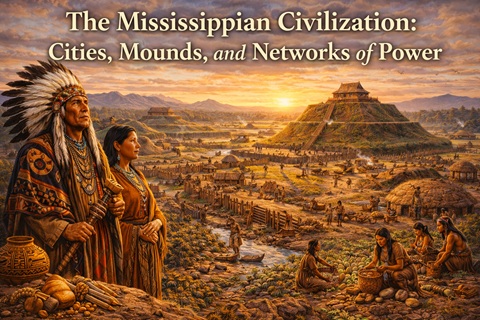
The Mississippian Civilization: Cities, Mounds, and Networks of Power in Pre-Columbian North America

When people think of great ancient civilizations, their minds often travel to places like Egypt, Greece, or the Maya cities of Central America. Far fewer realize that complex societies also flourished in North America long before Europeans arrived. One of the most impressive of these was the Mississippian civilization, a network of agricultural societies that spread across much of the eastern half of the continent between about 800 and 1500 CE.

At its height, the Mississippian world stretched from the Great Lakes to the Gulf of Mexico, and from the Rocky Mountains to the Atlantic coast. It included dozens—perhaps hundreds—of towns and ceremonial centers connected by trade, shared religious ideas, and similar cultural traditions. The people of this world built enormous earthen mounds, organized complex political systems, and supported large populations through agriculture.

The greatest of these centers was Cahokia, located near present-day St. Louis. Around the year 1100, Cahokia was larger than London at the time and may have been home to 20,000 or more people. Its massive mounds and planned layout reveal a society capable of coordinating large labor forces and organizing urban life on a scale rarely associated with ancient North America.

Understanding the Mississippian civilization challenges an old and outdated stereotype—that the peoples of North America lived only in small, scattered tribes without large-scale social organization. The archaeological evidence tells a different story. Mississippian societies were complex, politically organized, economically interconnected, and deeply spiritual communities that shaped the cultural landscape of the continent for centuries.

To appreciate this civilization, we need to look at several key elements: the mound-building cultures, the rise of Cahokia, systems of political leadership, extensive trade networks, and the role of religious and ceremonial centers.


The Rise of the Mound Builders

Depiction of mound building as part of Mississippian civilization

The Mississippian civilization did not appear suddenly out of nowhere. It developed gradually from earlier cultures that had been building earthen mounds for thousands of years.

As early as 3500 BCE, the people of the Archaic period were constructing large earthworks. One of the most famous examples is Poverty Point in present-day Louisiana. Later cultures, such as the Adena and Hopewell traditions of the Ohio River Valley (roughly 800 BCE to 500 CE), expanded mound-building dramatically. These societies constructed burial mounds, geometric earthworks, and ceremonial landscapes.

However, the Mississippian period, beginning around 800–900 CE, marked a significant shift.

Several key developments defined this new era:

  • Maize agriculture became dominant, allowing larger and more stable populations.
  • Permanent towns and cities emerged, often organized around central plazas.
  • Platform mounds replaced burial mounds, supporting temples, elite residences, and council buildings.
  • Political authority became more centralized, with powerful leaders directing labor and resources.

Unlike earlier mound-building cultures, Mississippian societies were clearly organized around chiefdoms—political systems in which hereditary leaders controlled economic production, religious ceremonies, and political authority.

These developments created the foundation for large regional centers that could coordinate surrounding villages and farming communities.


Cahokia: The Greatest City of Ancient North America

Cahokia mound, a remnant of Mississippian civilization

Monks Mound at Cahokia in present-day Illinois. The largest earthen mound in North America, it rises about 100 feet high and served as the political and ceremonial center of the city. At its height around 1100 CE, Cahokia may have supported 15,000–20,000 inhabitants.

The most spectacular example of Mississippian civilization was Cahokia, located along the Mississippi River floodplain near modern-day St. Louis, Missouri.

At its height around 1050–1200 CE, Cahokia covered more than six square miles and contained over 120 earthen mounds. The city was carefully planned, with neighborhoods, plazas, defensive structures, and monumental architecture.

Monks Mound

The largest structure at Cahokia is Monks Mound, the biggest earthen mound in North America. Rising about 100 feet high and covering roughly 14 acres at its base, it required millions of baskets of earth to construct.

At the top once stood a large building—likely the residence or temple of Cahokia’s ruling elite.

Monks Mound symbolized both political power and sacred authority. The elevated platform physically placed leaders above the population while also linking them to the spiritual world.

The Grand Plaza

In front of Monks Mound lay a vast central plaza, a flat open space used for gatherings, ceremonies, markets, and public events. Thousands of people could assemble there at once.

Plazas were a defining feature of Mississippian towns. They served as the heart of civic life, where political decisions were announced, religious ceremonies were held, and community identity was reinforced.

Woodhenge

One of the most fascinating discoveries at Cahokia is a circular arrangement of wooden posts known today as “Woodhenge.”

Archaeologists believe this structure functioned as a solar calendar, marking the rising sun during the solstices and equinoxes. From certain positions in the circle, the sun rises directly over Monks Mound during important seasonal events.

This alignment suggests a strong connection between astronomy, religion, and political authority.

Population and Urban Life

At its peak, Cahokia may have supported 15,000 to 20,000 residents, making it the largest city north of Mexico at the time.

The city included:

  • Residential neighborhoods
  • Artisan workshops
  • Storage buildings
  • Religious structures
  • Defensive palisades

Such an urban center required careful planning and coordination. Food had to be grown in surrounding villages and transported into the city. Labor had to be organized to build mounds and maintain infrastructure.

Cahokia was not simply a large village—it was a true urban center.


Political Organization

A representation of the political structure of Mississippian civilization

Mississippian societies were typically organized into chiefdoms, a form of political structure more complex than tribes but less centralized than full states.

In a chiefdom, power is concentrated in the hands of a hereditary leader, often referred to as a chief. This leader and his family formed an elite class that controlled political decision-making and oversaw religious ceremonies.

The Paramount Chief

At major centers like Cahokia, a paramount chief ruled over multiple communities.

This leader’s authority likely included:

  • Directing the construction of mounds and public works
  • Organizing large religious ceremonies
  • Managing trade relationships
  • Resolving disputes among communities
  • Collecting tribute in food, goods, or labor

Authority was often reinforced by religious symbolism. Chiefs were not merely political leaders—they were also seen as intermediaries between the human world and the spiritual realm.

Social Hierarchy

Mississippian societies were clearly stratified, meaning that people held different social ranks.

Archaeologists have identified at least three major levels:

  1. Elite class — chiefs, priests, and noble families
  2. Commoners — farmers, hunters, and artisans
  3. Servants or laborers

Evidence for these social distinctions comes largely from burial sites. Some individuals were buried with elaborate grave goods—such as copper ornaments, shell beads, and ceremonial objects—while others had very simple burials.

This difference indicates that status and power were inherited and carefully maintained.

Regional Networks of Authority

Major centers like Cahokia likely controlled a network of smaller towns and villages.

These subordinate communities may have sent:

  • Food surpluses
  • Craft goods
  • Labor for construction projects

In return, they received protection, religious leadership, and access to trade networks.

Such arrangements created a hierarchical regional system, with large ceremonial centers serving as political capitals.


Trade Networks Across the Continent

Map of the trade network of Mississippian civilization

Map showing the distribution of Mississippian cultural centers across eastern North America. Rivers such as the Mississippi, Ohio, and Tennessee served as major transportation routes, enabling long-distance trade in copper, shells, stone tools, and ceremonial goods.

Mississippian civilization was not isolated. Instead, it formed part of a vast interconnected trade system that stretched across North America.

Archaeologists have found materials at Mississippian sites that originated hundreds or even thousands of miles away.

Some examples include:

  • Copper from the Great Lakes region
  • Marine shells from the Gulf Coast
  • Mica from the Appalachian Mountains
  • Obsidian from the Rocky Mountains
  • Stone tools from distant quarries

These materials were often transformed into decorative or ceremonial objects.

The Mississippi River System

The Mississippi River and its tributaries formed the highway system of the Mississippian world.

Using dugout canoes, traders could travel long distances along rivers that connected vast portions of the continent.

These waterways allowed:

  • Movement of goods
  • Exchange of cultural ideas
  • Diplomatic contact between chiefdoms

The river system helped create what scholars sometimes call the Mississippian Interaction Sphere, a network of communities sharing artistic styles, religious beliefs, and political structures.

Prestige Goods

Many traded items were prestige goods—objects that symbolized status rather than serving practical purposes.

Examples include:

  • Copper plates engraved with symbolic designs
  • Shell gorgets (decorative neck ornaments)
  • Stone ceremonial axes
  • Elaborate bead necklaces

Possession of such items helped reinforce the authority of chiefs and religious leaders.


Religion and Ceremonial Life

Woodhenge at sunrise, a reproduction of an ancient spiritual component of Mississippian civilization

The reconstructed “Woodhenge” at Cahokia. This circle of wooden posts functioned as a solar calendar marking solstices and equinoxes, illustrating the important connection between astronomy, religion, and ceremonial life in Mississippian society.

Religion played a central role in Mississippian society. Many towns were designed around ceremonial landscapes, where temples, plazas, and mounds formed the stage for public rituals.

Archaeologists often refer to a shared religious system known as the Southeastern Ceremonial Complex (sometimes called the Southern Cult).

This system included:

  • Sacred symbols
  • Mythological figures
  • Ritual objects
  • Ceremonial dances and festivals

The Symbolism of the Mounds

Platform mounds were not merely architectural achievements—they were sacred structures.

Buildings placed on top of mounds likely served as:

  • Temples
  • Residences of chiefs
  • Council houses
  • Ceremonial spaces

The elevation of these structures may have symbolized a connection between earth and sky, linking the human world with the realm of spirits and ancestors.

Religious Symbols and Art

Mississippian art frequently featured powerful symbolic imagery.

Common motifs included:

  • Birdman figures, representing warriors or mythological beings
  • Falcons and eagles, associated with the upper world
  • Serpents, connected to the underworld
  • Sun imagery, representing cosmic power

These symbols appeared on shell carvings, copper plates, pottery, and stone sculptures.

Such artwork suggests a cosmology in which the universe was divided into three realms:

  1. The Upper World (sky and celestial beings)
  2. The Middle World (humans and animals)
  3. The Underworld (water, serpents, and spirits)

Ceremonies likely sought to maintain balance among these realms.

Public Ceremonies and Festivals

Large gatherings in central plazas probably included:

  • Ritual dances
  • Feasts
  • Political announcements
  • Seasonal celebrations

These events reinforced social bonds and affirmed the authority of leaders.

Religion and politics were deeply intertwined. Participation in ceremonies helped unify communities and strengthen the legitimacy of chiefs.


The Decline of Cahokia and the Mississippian World

Despite its remarkable achievements, Cahokia began to decline after about 1200 CE.

By the 1300s, much of the city had been abandoned.

Archaeologists continue to debate the causes of this decline, but several factors likely played a role:

Environmental Stress

Large populations may have placed pressure on local forests and farmland.

Deforestation, soil depletion, and flooding from the Mississippi River could have made it difficult to sustain the city’s population.

Climate Change

Around this time, North America experienced climatic shifts associated with the Little Ice Age, bringing cooler and less predictable weather.

Agricultural production may have suffered as a result.

Political Instability

As populations grew and resources became strained, conflicts may have emerged between rival groups or competing leaders.

Evidence of defensive palisades and signs of violence suggest periods of unrest.

Migration and Reorganization

Even as Cahokia declined, Mississippian culture continued in other regions.

Large mound centers developed across the Southeast, including sites in present-day:

  • Alabama
  • Georgia
  • Tennessee
  • Mississippi
  • Arkansas

When Europeans first entered the Southeast in the 1500s, they encountered powerful chiefdoms such as Coosa, Etowah, and Moundville, which carried many Mississippian traditions.


Legacy of the Mississippian Civilization

Although many Mississippian cities had declined before sustained European contact, their cultural legacy endured.

Many Native American groups—including the Choctaw, Chickasaw, Creek, and Cherokee—preserved traditions rooted in the Mississippian world.

Archaeological sites across the eastern United States still reveal the scale and sophistication of this civilization.

Today, places like Cahokia remind us that North America had its own monumental cultures, capable of building cities, organizing complex societies, and maintaining long-distance trade networks.

These societies were not isolated or primitive. They were dynamic, innovative communities that shaped the history of the continent long before European colonization.


Conclusion

The story of the Mississippian civilization reshapes our understanding of North American history.

Beginning around 800 CE, agricultural communities across the Mississippi River basin developed into a network of complex societies characterized by mound-building architecture, organized political systems, extensive trade networks, and rich religious traditions.

At the center of this world stood Cahokia, one of the greatest cities of the ancient Americas. Its enormous mounds, carefully planned layout, and massive population demonstrate a level of organization and cooperation that rivals many ancient civilizations elsewhere in the world.

Mississippian societies were governed by powerful chiefs who coordinated labor, maintained social hierarchies, and oversaw religious ceremonies that unified their communities. Through river-based trade routes, they connected distant regions of the continent and exchanged valuable goods that symbolized prestige and authority.

Religion shaped the physical landscape of their cities, from towering platform mounds to vast ceremonial plazas aligned with astronomical events. These sacred spaces reinforced both spiritual beliefs and political power.

Although environmental pressures, social tensions, and climatic changes eventually led to the decline of major centers like Cahokia, the cultural traditions of the Mississippian world continued through later Native American societies.

Most importantly, the Mississippian civilization reminds us that complex civilizations existed in North America long before European contact. Far from being a sparsely populated wilderness, the continent was home to vibrant cultures capable of urban planning, large-scale construction, and sophisticated political organization.

By studying places like Cahokia and the broader Mississippian world, we gain a deeper appreciation for the diversity and richness of Indigenous history—and a clearer understanding that the story of civilization in North America began long before the arrival of Europeans.

Leave a Comment