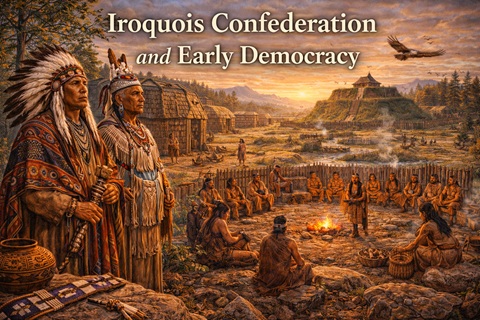
Long before the formation of the United States, the Iroquois Confederation—also known as the Haudenosaunee, or “People of the Longhouse”—created a powerful alliance of nations in northeastern North America. This confederation brought together several groups under a shared system of governance that emphasized unity, peace, and cooperation. In this lesson, students will explore how the Iroquois Confederation was formed, how it was governed, and why it remains an important example of early democracy and political organization.
What You Will Learn
- How and why the Iroquois Confederation was formed
- The structure of its government and decision-making process
- The role of unity and cooperation in maintaining peace
The Formation of the Confederation
Before the Iroquois Confederation was formed, the nations of the region often fought with one another. According to tradition, a leader known as the Great Peacemaker, along with a speaker named Hiawatha, helped bring these groups together. They encouraged the nations to set aside conflict and unite under a common goal of peace.
The original confederation included five nations: the Mohawk, Oneida, Onondaga, Cayuga, and Seneca. Later, the Tuscarora joined, making it six nations. By forming this alliance, the Iroquois created a system that allowed them to work together while still maintaining their individual identities.
Government and the Great Law of Peace
The Iroquois Confederation was governed by a system known as the Great Law of Peace. This set of rules outlined how decisions were made and how leaders were chosen. Each nation selected representatives, called sachems, who met in a council to discuss and decide important matters.
Decisions were often made through discussion and agreement rather than voting, showing the importance of consensus. Women played a key role in this system, as clan mothers had the authority to choose and remove leaders. This balance of power helped maintain fairness and stability within the confederation.
Unity, Culture, and Influence
The strength of the Iroquois Confederation came from its emphasis on unity and cooperation. The symbol of the “Longhouse” represented how the nations lived together under one roof, each with its own space but sharing a common purpose.
The confederation not only brought peace among its members but also made them stronger in dealing with outside groups. Their system of governance has been studied as an early example of democratic principles, influencing later ideas about government. Cultural traditions, ceremonies, and storytelling helped maintain unity and pass on the values of the confederation.
Conclusion
The Iroquois Confederation stands as a powerful example of cooperation, diplomacy, and organized government in pre-Columbian North America. By creating a system based on peace and shared decision-making, the Haudenosaunee built a lasting alliance that influenced both Indigenous and later American political thought. Their legacy continues to demonstrate the importance of unity and respect in building strong communities.
Key Terms
- Haudenosaunee: The name the Iroquois people use for themselves, meaning “People of the Longhouse.”
- Great Law of Peace: The system of government and rules that guided the Iroquois Confederation.
Review Questions
- Why was the Iroquois Confederation formed?
- How were decisions made within the confederation?
- What role did women play in the Iroquois government?
Think Further
Extension Activity: Create a Confederation Council Simulation
Objective:
Students will demonstrate their understanding of the Iroquois Confederation by practicing consensus-based decision-making in a simulated council.
Instructions:
Students will participate in a classroom simulation of an Iroquois council. Assign students to represent different nations and discuss a shared issue (such as resource use or community safety). Students must work toward a consensus decision rather than a simple majority vote.
From Indigenous North America to European Colonization
Indigenous North America Before 1500
The European Age of Exploration
From Revolution to the Eve of Civil War
The Early Republic
The Jacksonian Era
Westward Expansion
The Late 19th Century
The American Civil War
Reconstruction
The Gilded Age
The Early 20th Century
The Progressive Era
World War I
The Roaring 20s and the Great Depression
Modern America Emerges
World War II
The Cold War
Post Cold War America
Modern America