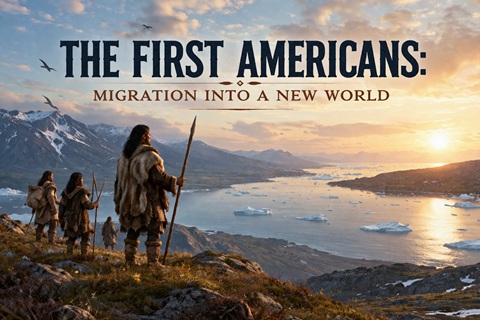
Long before the rise of cities, agriculture, or written history in the Americas, the ancestors of Native American peoples undertook one of the most remarkable journeys in human history. Over thousands of years, small groups of hunter-gatherers migrated from northeast Asia into an entirely new continent. Their descendants eventually populated nearly every corner of North and South America—from the Arctic tundra to tropical rainforests and high mountain valleys.
Understanding how the first Americans arrived is a fascinating story that blends archaeology, geology, genetics, and climate science. It is also a story that has evolved dramatically over the past century. Early theories once suggested a single migration of big-game hunters crossing a land bridge around 13,000 years ago. Today, scholars believe the process was more complex: multiple waves of migration, different routes into the continent, and a timeline stretching back thousands of years earlier than once thought.
What remains clear is that the peopling of the Americas was not a single event but a long process of exploration, adaptation, and survival. The people who made this journey became the ancestors of the diverse Indigenous cultures that would later flourish across the Western Hemisphere.
Ice Age Conditions and the Bering Land Bridge

To understand how the first Americans arrived, we need to begin with the Ice Age.
During the last Ice Age—known as the Late Pleistocene, which lasted until roughly 11,700 years ago—vast ice sheets covered large portions of the Northern Hemisphere. These glaciers locked up enormous amounts of the world’s water. As a result, global sea levels dropped dramatically, exposing land that is now underwater.
One of the most important exposed regions was Beringia, a broad land bridge that once connected Siberia in Asia with Alaska in North America. Today, the Bering Strait separates the two continents by about fifty miles of water. During the Ice Age, however, that water was replaced by hundreds of miles of dry land.

Beringia was not just a narrow crossing point. At its height, the region was a massive subcontinent stretching nearly a thousand miles from north to south. It was covered not with glaciers but with a cold, grassy ecosystem known as the mammoth steppe, home to large animals such as mammoths, bison, horses, musk oxen, and woolly rhinoceroses.
For human hunters living in northeastern Asia, this landscape would have been familiar territory. Over generations, groups of people gradually moved eastward across Beringia while following migrating herds of animals.
Importantly, these early travelers probably did not think of themselves as entering a new continent. From their perspective, they were simply moving across a continuous landscape in search of food and resources.
The Earliest Migrations from Asia
Most researchers believe that the ancestors of Native Americans originally came from populations in Siberia and northeast Asia. Genetic studies of modern Indigenous peoples show clear connections to these regions, particularly to ancient populations living around Lake Baikal and eastern Siberia.
The timing of the migration, however, remains a topic of debate.

For many years, scholars believed the first Americans arrived around 13,000 years ago, based largely on the archaeological evidence of the Clovis culture, a group of hunters known for distinctive stone spear points found across North America.
But in recent decades, discoveries of older archaeological sites have pushed the timeline much further back. Today, many researchers believe humans may have reached the Americas at least 15,000 to 20,000 years ago, and possibly even earlier.
Some of the most important early sites include:
- Monte Verde in southern Chile, dated to about 14,500 years ago
- Paisley Caves in Oregon, with evidence of human presence around 14,000 years ago
- Bluefish Caves in Canada’s Yukon, where some evidence suggests human activity possibly over 20,000 years ago
If these dates are correct, people must have entered the Americas earlier than once thought—well before the famous Clovis hunters.
The Beringian Standstill Hypothesis
One intriguing idea proposed by geneticists is known as the Beringian Standstill Hypothesis.
According to this theory, the ancestors of Native Americans may have moved into Beringia from Siberia around 25,000 years ago but remained isolated there for thousands of years. During the height of the Ice Age, enormous glaciers blocked access into the rest of North America.
To the east lay the Laurentide Ice Sheet, which covered most of Canada and parts of the northern United States. To the west lay the Cordilleran Ice Sheet, stretching along the Pacific coast.
These massive glaciers effectively sealed off entry into the rest of the continent.
As a result, early human populations may have lived in Beringia for several millennia, adapting to its harsh but resource-rich environment. During this time, their genetic identity began to diverge from their Asian ancestors.
Only when the glaciers began to retreat—around 16,000 to 14,000 years ago—did migration into the Americas become possible.
Two Possible Routes into the Americas
Once people were able to leave Beringia, they likely entered the Americas by one of two major routes: the interior ice-free corridor or the Pacific coastal route.
The Interior Ice-Free Corridor
For much of the twentieth century, archaeologists believed the first Americans traveled south through an opening between the Laurentide and Cordilleran ice sheets. This route, known as the ice-free corridor, eventually connected Alaska with the Great Plains of North America.
According to this model, groups of big-game hunters moved through the corridor while following herds of mammoths, bison, and other animals. These hunters were associated with the Clovis culture, which appeared around 13,000 years ago.
The Clovis people produced finely crafted stone tools, particularly their distinctive fluted spear points. Archaeological evidence of Clovis sites has been found across much of North America, suggesting rapid expansion across the continent.
For decades, the “Clovis-first” model dominated scholarly thinking. But new discoveries have complicated the picture.
Recent geological research suggests the ice-free corridor may not have been fully passable until around 13,000 years ago—possibly too late to explain older sites like Monte Verde.
The Pacific Coastal Route
Because of this problem, many researchers now believe that the earliest migrants traveled along the Pacific coastline.
In this scenario, people moved south from Alaska using small boats or traveling along beaches and coastal environments. The Pacific coast would have offered rich food resources such as fish, shellfish, sea mammals, and seabirds.

This coastal migration may have begun as early as 16,000 years ago, when parts of the coastline became free of glaciers.
One challenge with this theory is that many ancient coastal sites are now underwater. Since sea levels rose dramatically after the Ice Age, early settlements along the shoreline may lie hundreds of feet below modern sea level.
Nevertheless, archaeological discoveries along the Pacific coast—from Alaska to Chile—continue to strengthen the case for an early coastal migration.
Adapting to New Environments
Once humans entered the Americas, they spread across the continents with remarkable speed.
Within a few thousand years, human populations had reached:
- The forests of eastern North America
- The deserts of the American Southwest
- The high Andes Mountains
- The Amazon rainforest
- The southern tip of South America
This rapid expansion required extraordinary adaptability.
Early Americans encountered environments very different from those of Siberia and Beringia. In some regions they hunted large Ice Age animals such as mammoths, mastodons, giant sloths, and ancient horses. In other areas they relied on fishing, gathering plants, or hunting smaller game.
Stone tools from this period show tremendous diversity, suggesting that different groups developed their own technologies suited to local conditions.
The ability to adapt to varied climates—from Arctic tundra to tropical jungles—was a hallmark of early American societies.
The Megafauna and the End of the Ice Age
The arrival of humans in the Americas coincided with the extinction of many large Ice Age animals.
Between about 13,000 and 10,000 years ago, species such as mammoths, mastodons, giant ground sloths, saber-toothed cats, and American lions disappeared.
Scholars have long debated the causes of these extinctions. Two main explanations are often discussed.

One possibility is overhunting by humans, sometimes called the “overkill hypothesis.” According to this theory, newly arrived hunters may have hunted large animals faster than they could reproduce.
Another possibility involves climate change. As the Ice Age ended, warming temperatures transformed ecosystems across the Americas. Grasslands gave way to forests in many areas, and animals adapted to cold climates struggled to survive.
Most researchers now believe the extinctions were likely caused by a combination of both human activity and environmental change.
Whatever the exact causes, the disappearance of large animals forced human societies to adapt once again, shifting toward new hunting strategies and increasingly diverse diets.
The Rise of Regional Cultures
By around 10,000 years ago, the Americas were home to many distinct regional cultures.
These groups shared common ancestry but developed unique traditions, technologies, and ways of life depending on their environments.
In the Arctic, ancestors of Inuit and other northern peoples developed sophisticated technologies for surviving in extremely cold conditions, including specialized hunting tools and shelters.
In the Great Plains, hunter-gatherer societies followed herds of bison across wide grasslands.
In the forests of eastern North America, people relied heavily on gathering nuts, seeds, and wild plants.
In Mesoamerica and the Andes, some societies eventually began experimenting with agriculture, domesticating crops such as maize, beans, squash, potatoes, and quinoa.
Over thousands of years, these developments would lead to the rise of complex civilizations, including the Olmec, Maya, Aztec, and Inca. But those developments came much later. The earliest Americans lived primarily as mobile hunter-gatherers for thousands of years.
What Genetics Reveals
Modern genetic research has added powerful new tools to the study of early American migration.
DNA analysis shows that most Indigenous peoples of the Americas share ancestry from a common founding population that separated from Asian populations roughly 25,000 years ago.
This evidence supports the idea that early migrants spent a long period isolated in Beringia before expanding into the Americas.
Genetic studies also suggest that migration into the Americas occurred in several waves. While most Native American populations descend from the first major migration, later migrations contributed ancestry to Arctic peoples such as the Inuit and Aleut.
These genetic findings complement archaeological and linguistic evidence, helping researchers reconstruct the deep history of human movement into the New World.
Oral Traditions and Indigenous Perspectives
While scientific research provides one perspective on early migration, Indigenous oral traditions offer another.
Many Native American cultures possess stories about their origins and migrations that have been passed down for generations. Some describe journeys from distant lands; others speak of emergence from the earth or creation within the lands they now inhabit.
These traditions reflect cultural, spiritual, and historical understandings of identity and place. In recent years, scholars have increasingly recognized the importance of respecting Indigenous perspectives alongside scientific research.
In some cases, oral traditions may even preserve memories of ancient environmental changes or migrations that occurred thousands of years ago.
A Continuing Mystery
Despite decades of research, the story of the first Americans is still unfolding.
New archaeological discoveries appear regularly, sometimes challenging long-held assumptions. Advances in DNA analysis, climate science, and underwater archaeology continue to refine our understanding of how and when people first arrived in the Americas.
What once seemed like a simple story—hunters crossing a land bridge 13,000 years ago—has evolved into a far richer and more complex narrative involving multiple migrations, different routes, and thousands of years of adaptation.
Yet one thing remains certain: the settlement of the Americas stands as one of humanity’s greatest achievements.
Small groups of explorers entered a vast and unknown landscape. Over generations they spread across two continents, adapting to deserts, forests, mountains, and coasts. Their descendants would eventually build the diverse Indigenous cultures that shaped the history of the Americas long before the arrival of Europeans.
The journey of the first Americans reminds us that human history is, at its core, a story of movement, curiosity, and resilience. Long before written records or organized states, people were already exploring new worlds, forging new societies, and laying the foundations for the civilizations that would follow.
And even today, thousands of years later, researchers continue to uncover new pieces of that remarkable story.