Overview
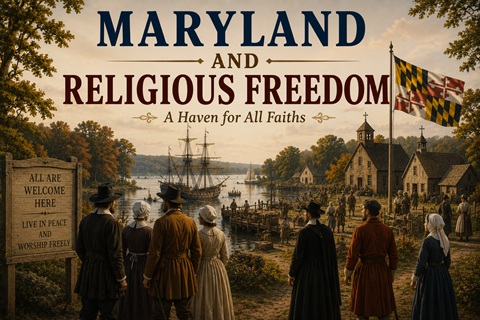
The colony of Maryland was founded in 1634 as a refuge for English Catholics who faced discrimination in England. Established by Cecil Calvert, also known as Lord Baltimore, Maryland offered an opportunity for Catholics to practice their faith while also creating a profitable colony. Over time, Maryland became known for its efforts to promote religious tolerance, although conflicts between different religious groups still occurred. The colony’s history demonstrates both the challenges and the importance of religious freedom in Colonial America. This lesson follows the lesson plan outline provided in the uploaded document.
What You Will Learn
- Explain why Maryland was founded and who established the colony.
- Describe the role of religion in Maryland’s early history.
- Understand the significance of Maryland’s efforts to promote religious freedom.
The Founding of Maryland
Maryland was founded by Cecil Calvert, the second Lord Baltimore, who received a charter from King Charles I in 1632. The colony was named in honor of Queen Henrietta Maria, the wife of the king. Lord Baltimore hoped that Maryland would serve as a safe place for English Catholics, who often faced discrimination and restrictions in Protestant England.
In 1634, the first settlers arrived and established the settlement of St. Mary’s City. Although Maryland was intended to provide a refuge for Catholics, Protestants were also encouraged to settle there. As a result, the colony quickly developed a mixed population with people from different religious backgrounds. This diversity would shape Maryland’s history for many years.
Religion in Early Maryland
Religion played a central role in the colony’s development. Catholics initially held positions of influence within the government, but they remained a minority of the population. As more Protestant settlers arrived, tensions sometimes arose between the two groups. Leaders recognized that religious conflict could threaten the colony’s stability and growth.
To reduce these tensions, Maryland passed the Act of Toleration in 1649. This law granted freedom of worship to all Christians who believed in the Holy Trinity. While the law did not provide complete religious freedom by modern standards, it was an important step toward religious tolerance in the colonies. It represented one of the earliest attempts in English North America to protect the rights of people with different Christian beliefs.
The Legacy of Religious Freedom
Maryland’s efforts to encourage religious tolerance helped attract settlers and contributed to the colony’s growth. Farmers cultivated tobacco as a profitable cash crop, and trade expanded throughout the region. The colony’s economy became closely tied to agriculture, helping Maryland prosper alongside neighboring Virginia.
Despite its commitment to tolerance, Maryland continued to experience religious and political conflicts. Control of the government shifted between Catholic and Protestant leaders at different times, and religious freedoms were not always protected equally. Nevertheless, Maryland’s experiment with tolerance influenced later discussions about religious liberty in America. The colony helped demonstrate that people of different faiths could live and work together within the same society.
Conclusion
Maryland was founded as a refuge for Catholics but grew into a colony with a diverse religious population. Through measures such as the Act of Toleration, Maryland became an early example of efforts to promote religious freedom in Colonial America. Although challenges remained, the colony’s history contributed to the development of ideas about religious liberty that would later become important principles in the United States.
Key Terms
- Act of Toleration – A 1649 Maryland law that granted freedom of worship to most Christians in the colony.
- Religious Tolerance – The acceptance of people who hold different religious beliefs and practices.
Review Questions
- Why was Maryland founded, and who established the colony?
- What was the purpose of the Act of Toleration?
- How did Maryland contribute to the development of religious freedom in Colonial America?
Extension Activity
Debate Religious Freedom in Colonial Maryland
Objective
Examine the challenges of religious tolerance by analyzing different viewpoints within colonial Maryland.
Instructions
- Research the founding of Maryland and the reasons it became a refuge for Catholics.
- Study the Act of Toleration and its impact on the colony.
- Create two perspectives: one supporting religious tolerance and one opposing it.
- Write a debate script or conduct a classroom debate presenting arguments from both sides.
- Use historical evidence to support each position.
- Conclude with a written reflection explaining whether Maryland’s approach to religious freedom was successful and how it influenced later American ideas about religious liberty.
From Indigenous North America to European Colonization
Indigenous North America Before 1500
The European Age of Exploration
From Revolution to the Eve of Civil War
The Early Republic
The Jacksonian Era
Westward Expansion
The Late 19th Century
The American Civil War
Reconstruction
The Gilded Age
The Early 20th Century
The Progressive Era
World War I
The Roaring 20s and the Great Depression
Modern America Emerges
World War II
The Cold War
Post Cold War America
Modern America