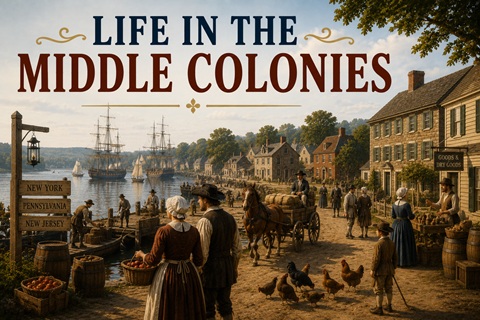
Overview
The Middle Colonies occupied the region between New England and the Southern Colonies and included New York, New Jersey, Pennsylvania, and Delaware. These colonies became known for their fertile farmland, diverse populations, and thriving trade networks. People from many different countries and religious backgrounds settled there, creating communities that were often more tolerant than those found in other colonies. Life in the Middle Colonies combined agriculture, commerce, and cultural diversity, making the region one of the most prosperous areas in Colonial America. This lesson follows the lesson plan outline provided in the uploaded document.
What You Will Learn
- Describe the geography and economy of the Middle Colonies.
- Explain how diversity shaped life in the Middle Colonies.
- Understand what daily life was like for people living in the region.
Geography and Economy of the Middle Colonies
The Middle Colonies benefited from fertile soil, moderate climates, and plentiful rivers. These natural advantages made farming easier than in New England, where rocky soil limited agriculture. Farmers in the Middle Colonies produced large amounts of wheat, barley, oats, and other crops. Because of their success in growing grain, the region became known as the “Breadbasket Colonies.”
Agriculture was not the only source of prosperity. Major ports such as New York City and Philadelphia became important centers of trade. Merchants shipped farm products, manufactured goods, and imported items throughout the colonies and across the Atlantic Ocean. The combination of farming and commerce helped create a strong and growing economy.
A Diverse Population
One of the most distinctive features of the Middle Colonies was their diversity. Settlers came from England, the Netherlands, Germany, Scotland, Ireland, Sweden, and many other parts of Europe. These groups brought different languages, customs, foods, and traditions, creating a rich cultural mix.
Religious diversity was also common in the region. Quakers, Lutherans, Presbyterians, Catholics, Jews, and other religious groups often lived side by side. While disagreements sometimes occurred, many communities practiced a greater degree of religious tolerance than was found elsewhere in the colonies. This diversity helped attract even more settlers and contributed to the growth of the region.
Daily Life in the Middle Colonies
Most people in the Middle Colonies lived on farms, where families worked together to plant crops, care for animals, and maintain their homes. Farm families produced much of their own food and goods, but they also participated in local markets where they could buy and sell products. Children often helped with chores and learned skills needed for adult life.
Life in towns and cities differed from life on farms. Merchants, craftsmen, shopkeepers, and laborers worked in growing urban centers such as Philadelphia and New York City. Schools, churches, and community organizations played important roles in daily life. Because people from many backgrounds lived together, residents were exposed to a variety of cultures and ideas, making the Middle Colonies some of the most dynamic places in Colonial America.
Conclusion
The Middle Colonies were known for their fertile farmland, successful trade, and diverse populations. Their strong economy and culture of relative tolerance attracted settlers from many backgrounds and helped the region prosper. By combining agriculture, commerce, and cultural diversity, the Middle Colonies became an important part of Colonial America and contributed significantly to the development of the future United States.
Key Terms
- Breadbasket Colonies – A nickname for the Middle Colonies because they produced large quantities of grain and other crops.
- Diversity – The presence of people from different backgrounds, cultures, religions, or traditions within a community.
Review Questions
- Why were the Middle Colonies called the “Breadbasket Colonies”?
- How did diversity influence life in the Middle Colonies?
- What were some differences between life on farms and life in colonial cities?
Extension Activity
Create a Middle Colonies Community Profile
Objective
Develop a detailed profile of a fictional town in the Middle Colonies that reflects the region’s economy, diversity, and daily life.
Instructions
- Choose a location within one of the Middle Colonies and create a name for your town.
- Draw a map showing important features such as farms, markets, homes, churches, schools, and waterways.
- Describe the different cultural and religious groups that live in your community.
- Explain how residents earn a living and participate in trade.
- Create short biographies for at least three fictional residents from different backgrounds.
- Conclude with a paragraph explaining why your town represents life in the Middle Colonies.
From Indigenous North America to European Colonization
Indigenous North America Before 1500
The European Age of Exploration
From Revolution to the Eve of Civil War
The Early Republic
The Jacksonian Era
Westward Expansion
The Late 19th Century
The American Civil War
Reconstruction
The Gilded Age
The Early 20th Century
The Progressive Era
World War I
The Roaring 20s and the Great Depression
Modern America Emerges
World War II
The Cold War
Post Cold War America
Modern America