
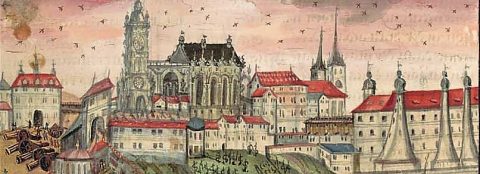

On a gray morning in May 1618, a small group of angry noblemen climbed the stairs of a castle in Prague. They were not generals, and they did not command armies. They carried no grand strategy for Europe, no vision of a continent remade by war. What they carried instead was a grievance—deep, specific, and local—and the belief that the rules protecting them had quietly stopped working.
Within minutes, two royal officials would be hurled from a window.
By the end of the day, no one would be dead; by the end of the year, Central Europe would be at war; by the end of thirty years, millions would be gone, entire regions ruined, and Europe fundamentally transformed.
The Thirty Years’ War did not begin with inevitability. It began with a moment when political trust collapsed—and when a window, once opened, could never be closed again.
A Fragile Peace in the Heart of Europe
To understand why the events of 1618 mattered so much, you have to begin with the uneasy peace that preceded them. The early seventeenth century in Central Europe was not a time of calm so much as a time of suspended conflict. The religious upheavals of the sixteenth century—the Reformation and the wars it unleashed—had not been resolved. They had been managed, postponed, and papered over with compromise.

At the center of this precarious order stood the Holy Roman Empire, a vast, decentralized political structure that stretched across modern Germany, Austria, the Czech lands, and beyond. The emperor ruled, but his power was constrained by hundreds of princes, bishops, city councils, and noble estates. Authority was shared, negotiated, and endlessly contested.
Religion was the most volatile of these negotiations. The Peace of Augsburg in 1555 had attempted to bring stability by allowing rulers to choose between Catholicism and Lutheranism for their territories. It was a pragmatic solution—but it excluded Calvinism, froze religious boundaries in time, and offered little protection to religious minorities living under hostile rulers.
By 1618, Augsburg’s compromises were fraying. Confessional identities had hardened. Political distrust had deepened. What remained was a system that functioned only as long as everyone pretended not to test it.
Bohemia: Where the Fault Lines Met
No territory embodied this fragility more than Bohemia. Rich, strategically located, and religiously diverse, Bohemia had long enjoyed a tradition of relative autonomy within the empire. Its nobles—many of them Protestant—had secured formal guarantees of religious freedom through documents like the Letter of Majesty issued in 1609.
These guarantees mattered. They were not abstract ideals. They governed who could build churches, who could worship publicly, and who controlled education and local government. For the Bohemian estates, religious liberty was inseparable from political privilege.
But in 1617, the balance shifted. Ferdinand of Styria, a devout Catholic with a reputation for religious intolerance, was elected king of Bohemia. A year later, he would become emperor.
To his supporters, Ferdinand II was a restorer of order and faith. To Bohemia’s Protestant nobility, he represented something far more threatening: a ruler who believed that religious unity justified political force.
Almost immediately, tensions rose. Protestant churches built on royal lands were closed. Appeals to imperial authorities went unanswered. Legal protections seemed suddenly hollow.
The Bohemian nobles were not radicals. They did not seek revolution. What they wanted was enforcement of the rules they believed already existed. And when enforcement failed, they turned to spectacle.
The Defenestration of Prague
On May 23, 1618, a delegation of Protestant nobles confronted two Catholic royal governors at Prague Castle. The meeting quickly escalated into accusation and outrage. The nobles charged the governors with violating Bohemia’s religious guarantees.
Then, abandoning debate, they seized the men and threw them out of a window.
The act—later known as the Defenestration of Prague—was shocking, theatrical, and deeply symbolic. Windows, in early modern politics, were thresholds between authority and the public. To defenestrate an official was to declare that he had forfeited his right to rule.
Miraculously, the men survived the fall, landing in a heap below. Catholics would later claim divine intervention. Protestants would insist the landing was purely fortunate. But survival was beside the point. The message had been delivered.
This was no longer a legal dispute. It was an open challenge to royal authority.
From Protest to Rebellion
In the weeks that followed, the Bohemian estates moved quickly. They formed a provisional government, raised troops, and framed their actions not as rebellion but as self-defense. They insisted they were protecting ancient rights against unlawful encroachment.
For a moment, their confidence seemed justified. The Habsburg position was weak. Imperial finances were strained. Allies were uncertain. And across the empire, Protestant rulers watched events in Bohemia with interest—and sympathy.
Yet this was the moment when the conflict crossed its first invisible threshold. By raising arms, the Bohemians transformed a constitutional dispute into a military one. And once soldiers entered the equation, compromise became harder with every passing day.
The stakes rose further in 1619, when the Bohemians formally deposed Ferdinand and elected a Protestant king in his place. What had begun as resistance now became defiance.
For Ferdinand, the challenge was existential. If Bohemia could reject him, so could others. The integrity of imperial authority itself was at risk.
The Emperor Strikes Back
Ferdinand’s election as Holy Roman Emperor later that year strengthened his position dramatically. He now commanded not only dynastic legitimacy but the symbolic weight of imperial tradition. More importantly, he gained access to allies who shared his alarm.
Catholic princes rallied to his cause. Spain, ruled by another branch of the Habsburg family, offered support. The Catholic League, a powerful alliance within the empire, mobilized its forces.
The resulting confrontation was swift and decisive. In November 1620, imperial armies met the Bohemian rebels outside Prague at the Battle of White Mountain. The battle itself was short. The outcome was not.
The imperial armies crushed Bohemia.
In the aftermath, Ferdinand moved with ruthless clarity. He executed rebel leaders, exiled Protestant nobles, and confiscated lands were, which he redistributed to loyal Catholics. In effect, Ferdinand transformed Bohemia’s religious landscape by force.
From the emperor’s perspective, he restored order; from the perspective of Europe, something far more dangerous had occurred.
A Victory That Changed the War
The suppression of the Bohemian revolt might have ended the conflict. Instead, it reshaped it.
Ferdinand’s policies sent a chilling message across the Holy Roman Empire. Religious guarantees, it seemed, could be revoked. Political autonomy could be erased. The balance between emperor and princes had shifted decisively toward coercion.
Even rulers who shared Ferdinand’s faith began to worry. If imperial authority could be used so aggressively in Bohemia, where would it stop?
At the same time, Protestant states elsewhere saw in Bohemia’s defeat not a warning to submit, but a warning to prepare. Alliances hardened. Armies expanded. The logic of prevention replaced the hope of peace.
What had begun as a Bohemian crisis became a German one—and then a European one.
Why 1618 Mattered
The onset of the Thirty Years’ War was not the result of ancient hatreds suddenly erupting. It was the result of a political system that depended on restraint, mutual trust, and compromise—losing all three at once.
The Defenestration of Prague mattered not because of the violence it involved, but because of what it revealed. It exposed how little confidence remained in legal processes. It showed how quickly symbolic acts could escalate into armed confrontation. And it demonstrated how local grievances could trigger systemic collapse.
Once war began, it fed on its own momentum. Victories created fear. Fear created alliances. Alliances created larger wars. However, by the time the wider European powers intervened, the original causes were almost beside the point.
The Window That Could Not Be Closed
Looking back, it is tempting to treat 1618 as inevitable—as the opening chapter of a story that could only end in catastrophe. However, inevitability is a comforting illusion. The people involved believed they were acting defensively, rationally, even conservatively.
The Bohemian nobles thought they were protecting established rights. Ferdinand believed he was restoring lawful order. Each step made sense in isolation.
What no one fully grasped was how fragile the system had become—or how unforgiving it would be once violence replaced negotiation.
The window in Prague was open only for a moment, but through it fell an entire continent.