A New Age of Exploration Begins
In the early 1400s, Europe was on the edge of something new. For centuries, most Europeans had stayed close to home, traveling only by land or along familiar coastlines. The oceans were mysterious and often feared. Sailors told stories of sea monsters, boiling waters, and ships falling off the edge of the Earth. While we know today that these stories were not true, they show how little people understood about the wider world.
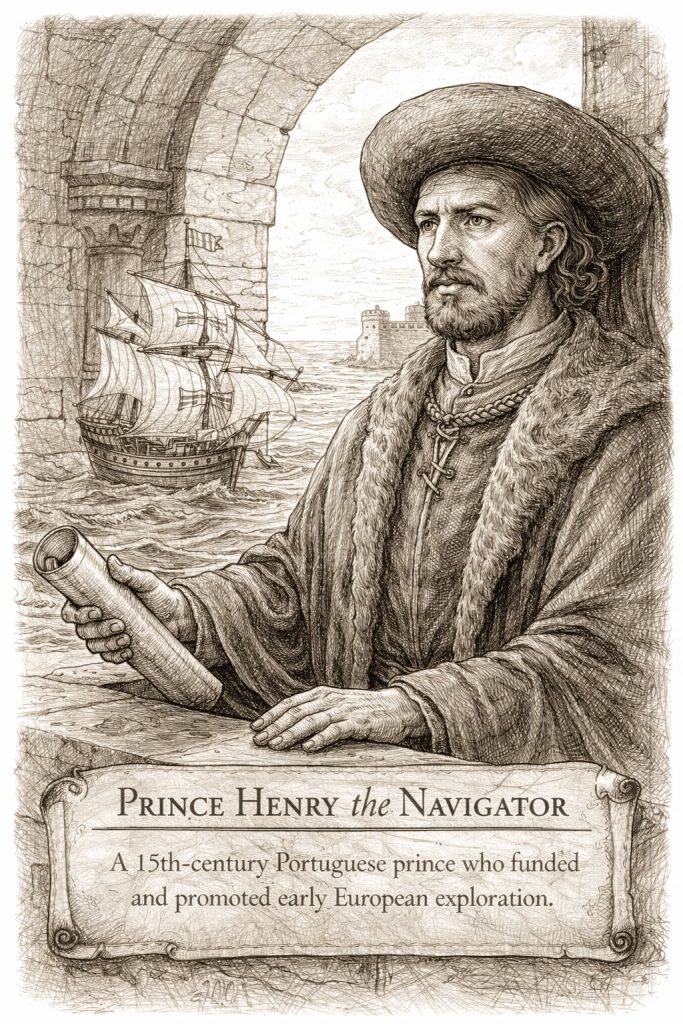
Yet in one small country on the western edge of Europe, something remarkable was beginning. That country was Portugal. And at the center of this change was a man known as Prince Henry the Navigator.
Even though Prince Henry himself did not make many long ocean voyages, he played a key role in encouraging others to explore. Through his leadership, Portugal became the first European nation to seriously explore the Atlantic Ocean and the west coast of Africa. His efforts helped open the door to the Age of Exploration—a time when Europeans would sail across the globe.
This essay will explore three key parts of Prince Henry’s work:
- His creation of a center for learning and exploration at Sagres
- The mapping of the African coastline
- The search for gold and new trade routes
Together, these efforts made Portugal the pioneer of ocean exploration.
Prince Henry: A Man with a Vision
Prince Henry was born in 1394, the son of the king of Portugal. As a young man, he took part in a military expedition to North Africa. In 1415, Portuguese forces captured the city of Ceuta, located on the northern coast of Africa.
This event changed Henry’s life.
In Ceuta, Henry learned about the rich trade networks that brought gold, spices, and other valuable goods from deep inside Africa. He also heard stories about lands further south—places that Europeans had never seen.
These discoveries sparked his imagination. Henry began to ask questions:
- Where did this gold come from?
- Could Portuguese sailors reach these places by sea?
- Could Portugal trade directly with African kingdoms instead of relying on middlemen?
From that moment on, Prince Henry became deeply interested in exploration.
The Exploration Center at Sagres
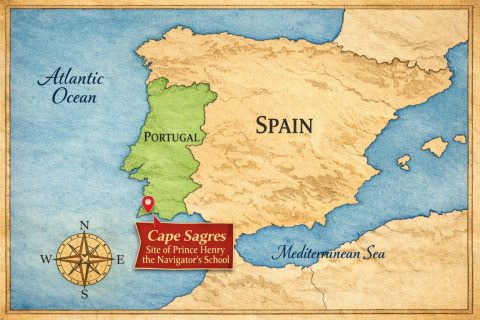
Prince Henry chose a remote location in southern Portugal called Sagres as the base for his work. Sagres sits on a rugged coastline where the Atlantic Ocean stretches endlessly westward. It was a fitting place for a man looking toward the unknown.
Although historians today debate whether Sagres was a formal “school,” it is clear that Henry gathered some of the best minds of his time there. These included:
- Sailors and ship captains
- Mapmakers (called cartographers)
- Astronomers who studied the stars
- Shipbuilders and craftsmen
Together, these experts worked to improve navigation and ship design.
What Made Sagres Important?
Sagres was not a classroom like a modern school. Instead, it was more like a workshop of ideas. People shared knowledge and experimented with new techniques.
Some important developments included:
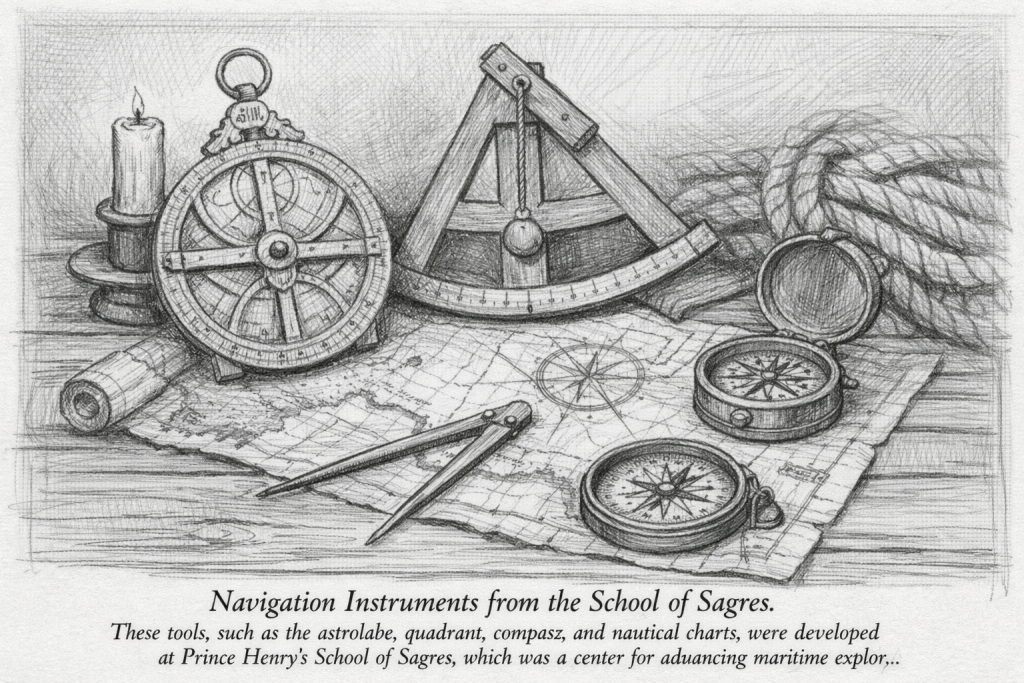
1. Better Navigation Tools
Sailors began using instruments like the astrolabe and the compass more effectively. These tools helped them determine their position at sea, even when land was not visible.
2. Improved Maps
Cartographers collected information from each voyage and updated their maps. Over time, these maps became more accurate.
3. The Caravel Ship
One of the most important innovations was the development of the caravel. This was a small, fast, and maneuverable ship with triangular sails. Unlike earlier ships, caravels could sail against the wind, making them perfect for exploring unknown coasts.
Why Sagres Mattered
By bringing together knowledge and experience, Prince Henry created an environment where exploration could succeed. Sailors were no longer guessing—they were learning, testing, and improving.
Sagres became the starting point for a new kind of exploration: careful, planned, and scientific.
Mapping the African Coast
At the beginning of the 1400s, Europeans knew very little about Africa beyond its northern coast. Much of the continent was a mystery.
Prince Henry set out to change that.
The Challenge of Cape Bojador
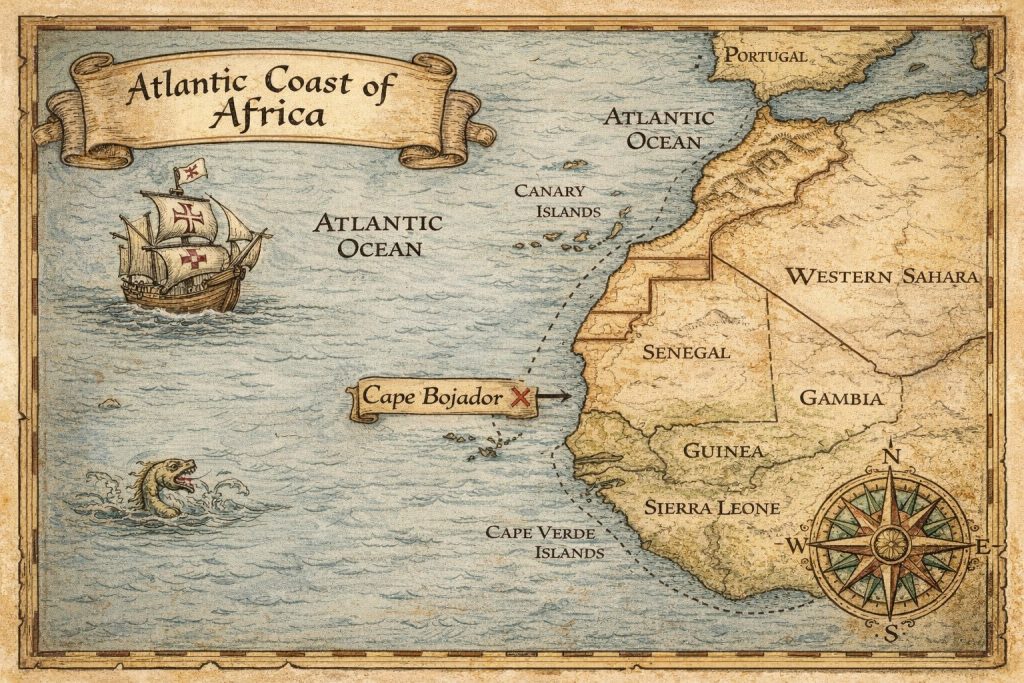
One of the biggest obstacles was a place called Cape Bojador, located on the northwest coast of Africa. Sailors believed it was extremely dangerous. Stories claimed that the seas there were filled with monsters or that the sun was so hot it would burn ships.
For years, no one dared to sail past it.
Finally, in 1434, a Portuguese captain named Gil Eanes successfully sailed beyond Cape Bojador and returned safely. This was a major breakthrough. It proved that the fears were unfounded.
After that, exploration began to move forward more quickly.
Step-by-Step Exploration
Instead of attempting long, risky voyages, Portuguese explorers used a careful method:
- Sail a little farther down the coast
- Return home safely
- Record what they saw
- Update maps
- Plan the next journey
Each voyage built on the last.

Over time, they discovered:
- New rivers and coastlines
- Fishing grounds
- Local African communities
Building Knowledge
Every journey added to Europe’s understanding of Africa. Cartographers used this information to create detailed maps.
These maps were extremely valuable. They allowed future sailors to travel farther and more safely.
By the time of Prince Henry’s death in 1460, Portuguese explorers had mapped much of the west coast of Africa.
The Search for Gold and Trade Routes
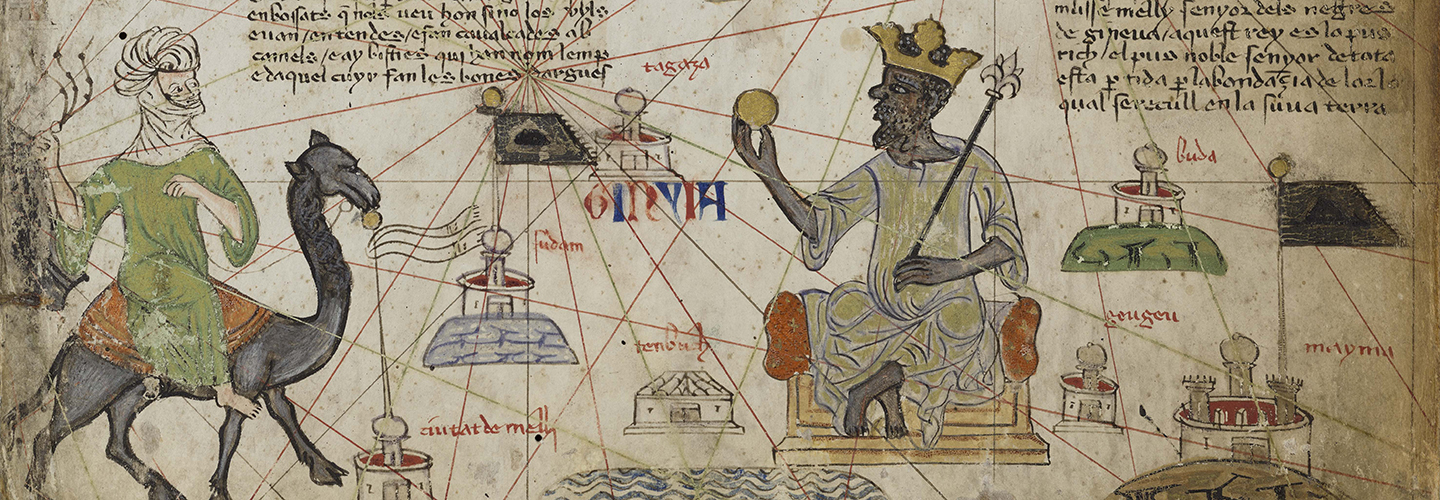
Exploration was not just about curiosity. It was also about wealth and opportunity.
Prince Henry and the Portuguese crown were especially interested in two things:
- Gold
- New trade routes
Why Gold Was Important
Gold was one of the most valuable resources in the world at that time. It was used to make coins, jewelry, and decorations.
Much of Europe’s gold came from Africa, but it usually traveled through long overland trade routes controlled by Muslim traders. By the time it reached Europe, it was very expensive.
Prince Henry hoped that Portuguese sailors could find a direct sea route to the source of this gold.
Trading Along the Coast
As Portuguese explorers moved down the African coast, they began to establish trading relationships with local communities.
They traded goods such as:
- Cloth
- Metal tools
- Weapons
In return, they received:
- Gold
- Ivory
- Other valuable products
Over time, Portugal set up small trading posts along the coast. These became important centers for commerce.
A New Trade Network
By using sea routes instead of land routes, Portugal gained a major advantage. They could trade more directly and often more cheaply.
This helped Portugal grow richer and more powerful.
It also encouraged further exploration, as sailors searched for even more valuable goods and new markets.
Portugal Leads the Way
By the mid-1400s, Portugal had become the leading nation in ocean exploration.
This was not an accident. It was the result of careful planning, innovation, and determination—much of it inspired by Prince Henry.
What Made Portugal Successful?
Several factors contributed to Portugal’s success:
1. Strong Leadership
Prince Henry provided vision and support for exploration.
2. Investment in Technology
New ships and tools made longer voyages possible.
3. Systematic Exploration
Instead of random journeys, Portugal followed a clear plan.
4. Economic Motivation
The search for gold and trade routes provided strong incentives.
A Lasting Impact
Although Prince Henry died in 1460, his work continued to influence future explorers.
Later Portuguese sailors would:
- Sail around the southern tip of Africa
- Reach India by sea
- Establish a global trading empire
All of this began with the early efforts to explore the African coast.
Understanding the Bigger Picture
It is important to understand that this period of exploration had both positive and negative effects.
Positive Outcomes
- Increased knowledge of the world
- Advances in navigation and mapmaking
- New trade connections
Negative Consequences
- Exploitation of African resources
- The beginning of the transatlantic slave trade
- Conflict between Europeans and local populations
These outcomes remind us that history is complex. Exploration brought opportunity, but it also caused harm.
Conclusion: A Pioneer of Exploration
Prince Henry the Navigator may not have been a great sailor himself, but he was something just as important—a visionary.
Through his efforts at Sagres, he helped create a center of learning and innovation. By supporting voyages along the African coast, he encouraged careful exploration and mapmaking. And by seeking gold and new trade routes, he gave Portugal a powerful reason to continue exploring.
Because of these achievements, Portugal became the first European nation to truly explore the open ocean.
Prince Henry’s work laid the foundation for the Age of Exploration, a time that would change the world forever.
For middle school students studying history, his story is an important reminder: sometimes the people who change the world are not the ones who travel the farthest, but the ones who help others see what is possible.
And in that way, Prince Henry the Navigator helped open the door to a new world.
