Overview
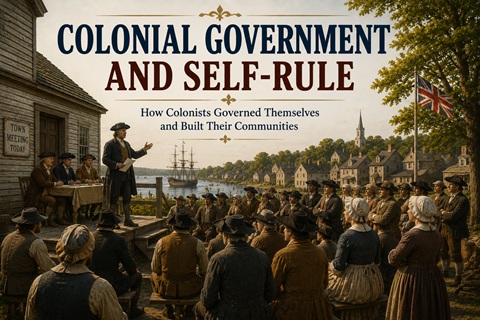
Although the American colonies were controlled by England, colonists gradually developed their own systems of government. Colonial assemblies, town meetings, and local courts allowed settlers to participate in making decisions that affected their communities. Over time, many colonists became accustomed to governing themselves and protecting their rights. These experiences with self-rule helped shape the political traditions of Colonial America and later influenced the movement for independence. This lesson follows the lesson plan outline provided in the uploaded document.
What You Will Learn
- Explain how colonial governments were organized.
- Describe the role of representative government and local participation in the colonies.
- Understand how self-rule influenced the development of American political ideas.
The Structure of Colonial Government
The English colonies were ultimately under the authority of the king and the English government. Most colonies had a governor who represented the interests of the Crown or the colony’s owners. Governors were responsible for enforcing laws, overseeing colonial affairs, and maintaining order. However, governors often depended on colonial assemblies for support and funding.
In addition to governors, many colonies had elected assemblies that represented the colonists. These assemblies helped create local laws, approved taxes, and addressed community concerns. One of the earliest examples was the House of Burgesses in Virginia, established in 1619. This representative body gave colonists a voice in government and became a model for other colonial legislatures.
Representative Government and Local Participation
Colonists actively participated in local government in ways that many people in Europe could not. In New England, town meetings allowed property-owning male citizens to gather and discuss local issues, vote on laws, and make decisions about community affairs. These meetings encouraged civic participation and gave residents experience in self-government.
Across the colonies, elected representatives played important roles in managing local affairs. Colonists voted for assembly members, served on juries, and participated in local courts. While voting rights were limited and many groups were excluded from political participation, these practices allowed many settlers to gain experience with representative government. Colonists increasingly viewed participation in government as an important right.
The Growth of Self-Rule
As the colonies grew, the distance between North America and England allowed colonial governments to operate with a significant degree of independence. Communication with England could take weeks or even months, so colonial leaders often made decisions without waiting for instructions from the king or Parliament. This period of relative independence helped strengthen traditions of self-government.
By the mid-1700s, many colonists believed they had certain rights that should be protected by their governments. They expected to have a say in taxation, lawmaking, and local affairs. These beliefs did not initially lead colonists to seek independence, but they did create expectations about government and representation. When Britain later attempted to exert greater control over the colonies, many colonists resisted because they believed their rights were being threatened.
Conclusion
Colonial governments allowed many settlers to participate in political decision-making through assemblies, town meetings, and local courts. These experiences helped colonists develop traditions of representative government and self-rule. Over time, the colonies became accustomed to managing many of their own affairs, laying the groundwork for the political ideas that would eventually contribute to the American Revolution.
Key Terms
- Representative Government – A system in which citizens elect individuals to make laws and decisions on their behalf.
- House of Burgesses – The first elected legislative assembly in English North America, established in Virginia in 1619.
Review Questions
- How were colonial governments organized in the English colonies?
- What role did town meetings and colonial assemblies play in self-government?
- How did colonial experiences with self-rule influence later American political ideas?
Extension Activity
Create a Colonial Assembly Simulation
Objective
Experience how representative government worked in Colonial America by designing and participating in a mock colonial assembly.
Instructions
- Research the structure and responsibilities of a colonial assembly such as Virginia’s House of Burgesses.
- Create a list of issues that colonists might have debated, such as taxes, defense, trade, or public improvements.
- Assign roles including governor, assembly members, and community representatives.
- Hold a mock assembly meeting where participants discuss and vote on proposed laws.
- Record the debates, arguments, and final decisions made by the assembly.
- Conclude with a written reflection comparing colonial government to government in the United States today.
From Indigenous North America to European Colonization
Indigenous North America Before 1500
The European Age of Exploration
From Revolution to the Eve of Civil War
The Early Republic
The Jacksonian Era
Westward Expansion
The Late 19th Century
The American Civil War
Reconstruction
The Gilded Age
The Early 20th Century
The Progressive Era
World War I
The Roaring 20s and the Great Depression
Modern America Emerges
World War II
The Cold War
Post Cold War America
Modern America