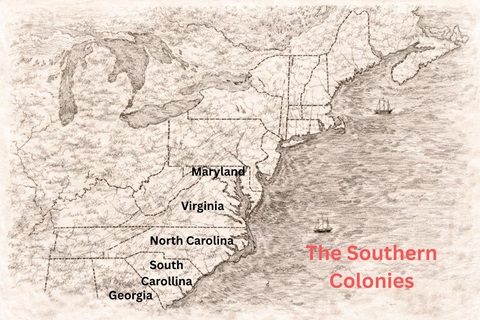
In the 1600s and 1700s, England continued to expand its colonies in North America. South of Virginia, new colonies were established that would become known as the Southern Colonies. Among these were North Carolina, South Carolina, and Georgia. Each of these colonies developed in its own way, but they shared important features, especially the growth of the plantation system and the use of land for large-scale farming.
The Carolinas and Georgia played important roles in shaping colonial America. They were places of opportunity for settlers, but also places where difficult systems, like slavery, took hold and expanded. They were influenced by geography, economics, and the decisions of leaders such as James Oglethorpe. Georgia, in particular, had a special purpose as a “buffer colony,” meant to protect other English settlements.
To understand these colonies, we need to look at how they were founded, how people lived there, and how their economies and societies developed.
The Founding of the Carolinas
The region known as Carolina was originally granted by King Charles II of England in 1663 to a group of eight men known as the Lords Proprietors. The name “Carolina” comes from “Carolus,” the Latin word for Charles.
At first, Carolina was one large colony. However, it soon became clear that the northern and southern parts of the colony were quite different. Because of these differences, Carolina was eventually divided into two separate colonies: North Carolina and South Carolina.
North Carolina developed more slowly. Many settlers moved there from Virginia, often seeking land and independence. The region had fewer large plantations and fewer cities. Life in North Carolina was more rural, and farms were often small.
South Carolina, on the other hand, developed quite differently. It became a center of wealth and trade, with large plantations and a strong connection to international markets. The differences between the two regions were shaped by geography, economy, and the types of crops grown.
The Plantation System Grows
One of the most important features of life in the Carolinas—and later in Georgia—was the plantation system. A plantation was a large farm that focused on growing one main crop for sale, rather than for personal use.
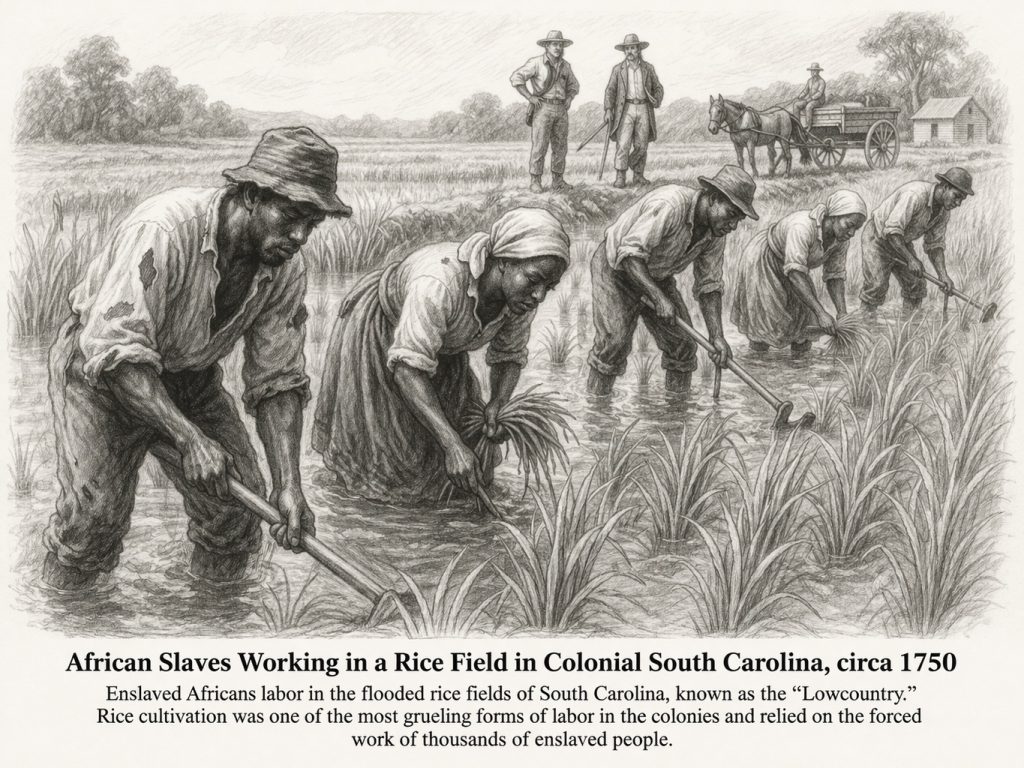
In South Carolina, the plantation system grew quickly. The warm climate and fertile soil made it possible to grow crops like rice and indigo. Rice became especially important. It required specific conditions—wet fields and careful management—but it was very profitable.
Growing rice was hard work. Fields had to be flooded and drained at the right times. This required knowledge and labor. Much of this work was done by enslaved Africans, many of whom had experience growing rice in their homelands. Their skills were used to help build the rice economy in South Carolina.
Indigo, another important crop, was used to make blue dye for clothing. Like rice, it became a valuable export crop.
As plantations grew larger, the demand for labor increased. At first, some workers were indentured servants—people who agreed to work for a set number of years in exchange for passage to America. Over time, however, plantation owners increasingly relied on enslaved Africans.
This led to the growth of slavery in the Southern Colonies. Enslaved people were forced to work under harsh conditions and had very few rights. Their labor helped create wealth for plantation owners, but it came at a great human cost.
In North Carolina, the plantation system existed but was less dominant. Many farmers grew tobacco and other crops on smaller farms. Still, slavery was present there as well, though on a smaller scale than in South Carolina.
Life on Plantations
Life on plantations was very different depending on a person’s role in society.
For wealthy plantation owners, life could be comfortable. They often lived in large homes and had access to goods imported from Europe. They were part of the upper class and had influence in colonial society.
For small farmers, life was more modest. They worked their own land, often with the help of family members. They did not have the same wealth or power as plantation owners, but they valued independence.
For enslaved Africans, life was extremely difficult. They were forced to work long hours in the fields under harsh conditions. They had little control over their lives and were often separated from family members. Despite these hardships, many enslaved people found ways to preserve their culture, traditions, and sense of community.
Plantations were not just farms—they were complex communities where many different people lived and worked, often under unequal conditions.
The Founding of Georgia
Georgia was the last of the original thirteen English colonies to be established. It was founded in 1732 by James Oglethorpe, a British leader who had a different vision for this colony.
Oglethorpe believed that Georgia could serve as a place of opportunity for people in England who were struggling, especially those in debtors’ prisons. At the time, people who owed money could be put in prison, sometimes for years. Oglethorpe wanted to give them a fresh start.
The colony of Georgia was named after King George II. Oglethorpe and a group of trustees were given the responsibility of governing the colony.
The first settlers arrived in 1733 and established the city of Savannah. Oglethorpe carefully planned the layout of the city, including streets, public squares, and land for homes and farms.
Oglethorpe’s Vision for Georgia
James Oglethorpe had a clear idea of what he wanted Georgia to be. He wanted it to be different from other colonies, especially South Carolina.
One of his goals was to create a colony of small farmers rather than large plantation owners. He believed that smaller farms would create a more equal society and prevent the concentration of wealth in the hands of a few people.
Oglethorpe also wanted to limit certain practices. For example, he originally banned slavery in Georgia. He believed that slavery was harmful and that it gave too much power to wealthy landowners.
In addition, he restricted the size of land that settlers could own. This was meant to prevent the development of large plantations.
Oglethorpe also focused on maintaining good relationships with Native American groups. He believed that peaceful cooperation would help the colony succeed.
Georgia as a Buffer Colony
One of the most important reasons for founding Georgia was its role as a buffer colony. A buffer colony is a region created to protect other areas from potential threats.
Georgia was located south of South Carolina and near Spanish Florida. At the time, Spain and England were rivals, and there was concern that Spanish forces might move northward and threaten English colonies.
By establishing Georgia, England created a protective barrier between Spanish Florida and the rest of its colonies. If conflict occurred, Georgia would serve as the first line of defense.
Oglethorpe took this role seriously. He helped build forts and organized defenses to protect the colony. There were even conflicts between English and Spanish forces in the region, including battles in which Oglethorpe played a role.
Georgia’s position as a buffer colony made it strategically important, even though it started as a smaller and less developed colony.
Changes in Georgia
Although Oglethorpe had strong ideas about how Georgia should develop, not all settlers agreed with his plans.
Many settlers wanted to own more land and to grow profitable crops like rice. They also wanted to use enslaved labor, as plantation owners did in South Carolina.
Over time, pressure from settlers led to changes in Georgia’s rules. The ban on slavery was eventually lifted, and large plantations began to develop. This made Georgia more similar to its neighbor, South Carolina.
These changes brought economic growth, but they also meant that Georgia moved away from Oglethorpe’s original vision of a more equal and slavery-free society.
Trade and Economy
The economies of the Carolinas and Georgia were closely tied to agriculture and trade.
In South Carolina and Georgia, crops like rice and indigo were grown for export. These goods were shipped to Europe, where they were sold for profit. Ports such as Charleston and Savannah became important centers of trade.
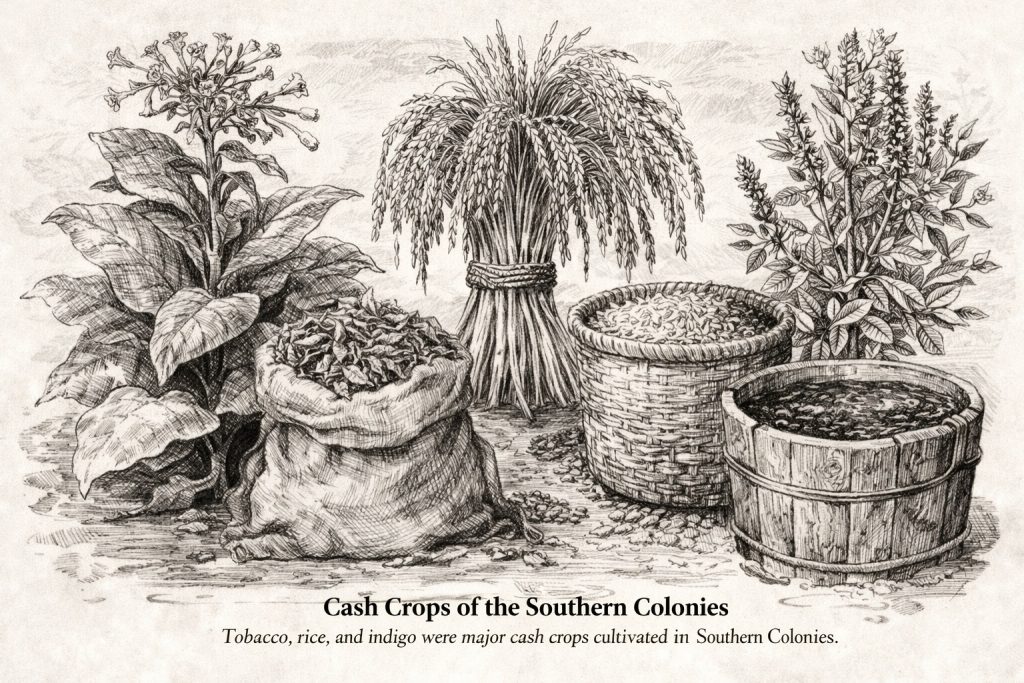
North Carolina’s economy was somewhat different. It focused more on tobacco, timber, and small-scale farming. It had fewer large ports and was less connected to international trade than South Carolina.
Trade helped these colonies grow and connect with the wider world. However, it also tied them to systems like slavery and the global economy, which had both benefits and consequences.
A Complex Legacy
The story of the Carolinas and Georgia is one of growth, opportunity, and challenge.
On one hand, these colonies offered land and new beginnings for settlers. They developed strong agricultural economies and played important roles in trade and defense.
On the other hand, the growth of the plantation system led to the expansion of slavery. Enslaved Africans were forced to work under harsh conditions, and their labor became a key part of the colonial economy.
The story of James Oglethorpe and Georgia also shows how ideas can change over time. His original vision for a more equal society did not fully succeed, but it remains an important part of the colony’s history.
Conclusion
The Carolinas and Georgia were important parts of the Southern Colonies, each with its own story and development. The plantation system shaped life in these colonies, especially in South Carolina and later in Georgia. Crops like rice and indigo brought wealth, but they also led to the growth of slavery.
James Oglethorpe’s founding of Georgia introduced new ideas about opportunity and fairness, even though many of those ideas changed over time. Georgia’s role as a buffer colony also made it an important part of England’s plans for defense in North America.
For middle school students, the story of the Carolinas and Georgia offers an important lesson: history is often a mix of good intentions, hard realities, and difficult choices. By understanding both the successes and the challenges of these colonies, we can gain a clearer picture of how early America developed and the impact it continues to have today.
