
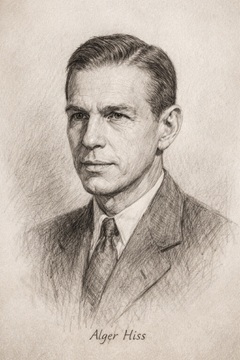
If you want to understand why the Cold War felt so anxious, so personal, and so corrosive to trust, you could do worse than start with Alger Hiss. Few figures better capture the era’s deepest fear: that the enemy wasn’t just out there, but might already be inside.
For decades, Hiss was not merely a name. He was a question. A symbol. A Rorschach test for how Americans understood loyalty, ideology, and truth in the early Cold War. To his defenders, he was a victim of hysteria and political ambition. To his critics, he was proof that Soviet espionage had reached the very heart of American power. And to the broader public, he embodied a far more unsettling possibility—that respectable, educated, seemingly trustworthy people could lead double lives.
The Hiss case did not just expose a man. It exposed a national nerve.
The Perfect Insider
Before Alger Hiss became a household name, he was the definition of establishment success. Harvard-educated. A clerk for Supreme Court Justice Oliver Wendell Holmes. A rising star in the State Department. He moved easily through elite institutions and elite social circles, precisely the spaces Americans liked to think were immune from subversion.
This is important, because the Cold War anxiety surrounding Hiss was never only about espionage. It was about class, credibility, and trust.
Hiss was not an outsider. He wasn’t a shadowy figure slipping through back alleys or meeting handlers in foreign capitals. In fact, he worked in well-lit offices, wore good suits, and spoke the language of law, diplomacy, and governance fluently. He looked like the people running the country—because he was one of them.
And that made the allegations against him far more disturbing.
The Accusation That Wouldn’t Go Away
The man who accused Hiss was Whittaker Chambers, a former Communist Party member who had grown disillusioned with the movement and reinvented himself as an anti-communist witness. Chambers claimed that in the 1930s, Hiss had been part of an underground communist network that passed government documents to Soviet intelligence.
At first, the accusation sounded implausible to many. Hiss denied it calmly and forcefully. He seemed credible. Chambers, by contrast, appeared volatile, emotionally intense, and difficult to pin down. For a time, the case looked like a clash between respectability and instability.
But the Cold War was not a time when accusations faded easily.
As investigations continued—most famously through the House Un-American Activities Committee—the story grew more complex, and more ominous. Documents surfaced. Timelines were contested. Memories were scrutinized with forensic intensity. And the question shifted from Did this happen? to Who should we believe?
That question would haunt American political culture for years.
Espionage or Ideological Sympathies?
One of the reasons the Hiss case remains so controversial is that it sits at the intersection of espionage and ideology. Even critics of Hiss have long debated whether he was a knowing Soviet spy or something more ambiguous: a man whose political sympathies blurred into reckless behavior.
In the 1930s, communism attracted many idealistic Americans, especially those disillusioned by the Great Depression and alarmed by the rise of fascism. Political experimentation did not automatically imply treason. Party membership was not espionage. Radical ideas circulated widely in intellectual circles.
But the Cold War collapsed those distinctions.
By the late 1940s, ideological sympathy itself became suspect. The emerging belief was simple and unforgiving: if you had once been close to communists, you could never fully be trusted again. In that climate, Hiss’s past associations—however explained—became damning.
The Hiss case helped cement the idea that ideology could be evidence.
Why Hiss Mattered So Much
What made Alger Hiss uniquely powerful as a Cold War symbol was not the documents or testimony alone. It was his proximity to power.
Hiss had participated in major diplomatic events, including the founding conference of the United Nations. If he had indeed passed secrets to the Soviets, then espionage had not merely penetrated the U.S. government—it had shaped the postwar world order itself.
This possibility terrified policymakers and the public alike.
The Cold War was already defined by uncertainty. Nuclear weapons had made miscalculation unthinkable. Trust between former allies had evaporated. In that environment, the idea that espionage operated at the highest levels of government felt like confirmation of the worst fears.
Hiss became proof—real or symbolic—that no institution was safe.
The Trial That Defined an Era
Hiss was never convicted of espionage. Instead, he was convicted of perjury—lying under oath about his relationship with Chambers. Legally, this distinction mattered. Politically, it hardly mattered at all.
The public heard one thing: guilty.
The trial unfolded as a kind of national drama, complete with villains, martyrs, and moral lessons. It elevated new political figures, most notably Richard Nixon, whose aggressive pursuit of the case helped launch his career. It also hardened public attitudes toward dissent, skepticism, and political difference.
After Hiss’s conviction, the Cold War acquired sharper edges. Suspicion became institutionalized. Loyalty investigations multiplied. The line between legitimate security concerns and ideological policing grew dangerously thin.
Hiss did not cause McCarthyism—but his case helped make it possible.
Espionage as a Psychological Shock
The deeper impact of the Hiss case was psychological rather than legal. It reshaped how Americans imagined espionage itself.
Before Hiss, spying often felt remote, foreign, and abstract. After Hiss, it felt intimate. Domestic. Personal.
The spy was no longer a caricature. He might be your colleague. Your professor. Your neighbor. Espionage became less about secret agents abroad and more about internal vigilance.
This shift aligned perfectly with Cold War anxieties. The conflict was already being fought in shadows, through information and ideology. The idea that those shadows extended into the heart of American institutions made the war feel endless and inescapable.
Was Alger Hiss Really a Spy?
Decades later, the question still provokes argument. Declassified Soviet materials have strengthened the case that Hiss had some form of covert relationship with Soviet intelligence, though debates continue about its scope and significance. Defenders argue that the evidence remains circumstantial and politically contaminated. Critics argue that the cumulative record is overwhelming.
But focusing too narrowly on guilt or innocence risks missing the larger point.
The Cold War did not need certainty. It thrived on ambiguity.
Hiss mattered not because everyone agreed about what he did, but because no one could fully agree—and because that disagreement itself fueled fear, division, and institutional change.
Hiss and the Culture of Suspicion
After Hiss, the Cold War entered a new phase. Loyalty programs expanded. Background checks deepened. Political beliefs became liabilities. The assumption that “it couldn’t happen here” quietly disappeared.
Espionage was no longer an exception. It was an expectation.
This had consequences far beyond intelligence agencies. Academic freedom suffered. Civil liberties narrowed. Political disagreement was increasingly framed as subversion. The Cold War conversation, once conducted mostly among governments, spilled into everyday life.
Hiss became the case people invoked whenever trust seemed naïve.
A Tragic Figure, Whatever the Truth
There is something undeniably tragic about Alger Hiss, regardless of where one stands. If he was guilty, then his story is one of hubris, secrecy, and self-deception—a man who believed he could navigate history without consequence. If he was innocent, then his life stands as a warning about how fear can consume justice.
Either way, the Cold War used him ruthlessly.
He became less a person than a symbol, less a man than a cautionary tale. His name was invoked to justify policies, careers, and crackdowns that extended far beyond his own actions.
The Cold War did not merely investigate Alger Hiss. It transformed him.
Why Alger Hiss Still Matters
Today, the Hiss case feels distant, almost sepia-toned. But its underlying questions remain disturbingly current.
How much secrecy can a democracy tolerate?
When does vigilance become paranoia?
How do we distinguish dissent from disloyalty?
And how much uncertainty can a political system live with before it turns on itself?
Alger Hiss sits at the center of those questions. He reminds us that espionage is not just about secrets—it is about trust, identity, and fear. He reminds us that Cold War espionage was not only a battle between states, but a struggle within societies to define who belonged and who did not.
In that sense, Hiss was not merely part of Cold War espionage. He helped shape its emotional landscape.
The Long Shadow of a Whispered War
The Cold War was, as I’ve often thought, a long conversation conducted in whispers. Alger Hiss was one of the moments when those whispers grew loud enough for everyone to hear.
His story forces us to confront the uncomfortable truth at the heart of the Cold War: that a conflict fought in shadows inevitably blurs moral lines, corrodes trust, and leaves scars that outlast the war itself.
Whether guilty or innocent, Alger Hiss became one of those scars. And that is why, decades later, his name still echoes whenever we talk about espionage, loyalty, and the hidden costs of living in an age of permanent suspicion.