Overview
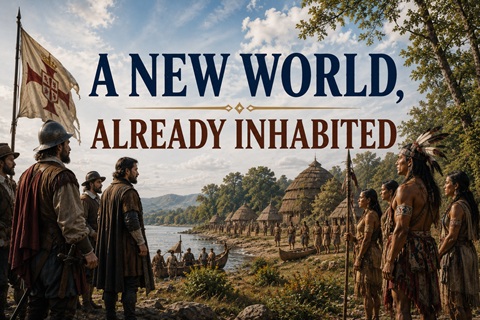
When European explorers arrived in the Americas, they did not discover an empty land. Millions of Indigenous peoples had lived throughout North and South America for thousands of years. These communities had developed diverse cultures, languages, governments, economies, and ways of life that were closely connected to their environments. Understanding the people who already lived in the Americas helps us gain a more accurate picture of history and recognize the rich civilizations that existed long before European arrival. This lesson follows the lesson plan outline provided in the uploaded document.
What You Will Learn
- Identify who the Indigenous peoples of North America were before European arrival.
- Describe the diversity of Indigenous cultures and ways of life.
- Explain how Indigenous peoples were affected by European exploration and settlement.
Indigenous Peoples Before European Arrival
Long before Europeans crossed the Atlantic Ocean, Indigenous peoples lived throughout the Americas. Archaeologists believe that the ancestors of these groups first arrived thousands of years ago and gradually spread across the continents. Over time, they established communities in forests, deserts, grasslands, mountains, and coastal regions. Each group adapted to its environment and developed unique traditions and cultures.
North America alone was home to hundreds of Indigenous nations. These included groups such as the Cherokee in the Southeast, the Iroquois in the Northeast, the Sioux on the Great Plains, and the Pueblo peoples in the Southwest. Each nation had its own language, customs, and government. Although they shared some similarities, Indigenous peoples were not one single group but many distinct societies.
Diverse Cultures and Ways of Life
The Indigenous peoples of North America lived in many different ways depending on where they settled. Some groups farmed crops such as corn, beans, and squash, while others relied on hunting, fishing, or gathering wild plants. Coastal peoples often depended on the sea for food, while Plains peoples followed large herds of bison across the grasslands.
Indigenous communities also developed complex political systems, trade networks, and spiritual beliefs. The Iroquois Confederacy, for example, united several nations under a shared system of government. Trade routes connected distant regions, allowing goods and ideas to travel across vast distances. These societies were highly organized and demonstrated a deep understanding of their environments.
The Impact of European Arrival
When Europeans arrived in the Americas, they encountered Indigenous peoples who had lived on the land for generations. At first, some interactions involved trade and cooperation. Indigenous peoples often helped newcomers survive by sharing knowledge about local crops, hunting techniques, and the environment.
However, European settlement also brought major challenges. Diseases such as smallpox spread rapidly among Indigenous populations, causing devastating losses because Native peoples had no immunity to these illnesses. As European colonies expanded, conflicts over land and resources became more common. Many Indigenous communities were displaced from their homelands or forced to adapt to changing circumstances. These events had lasting effects on Indigenous peoples and the history of North America.
Conclusion
The Americas were already inhabited by millions of Indigenous peoples long before Europeans arrived. These communities developed diverse cultures, governments, and economies that reflected the environments in which they lived. Understanding the history and experiences of Indigenous peoples helps us better understand the complex story of the colonial era and the foundations of American history.
Key Terms
- Indigenous Peoples – The original inhabitants of a region who lived there before the arrival of outside settlers.
- Confederacy – A union of groups or nations that work together under a shared agreement or government.
Review Questions
- Why is it incorrect to describe the Americas as an empty land before European arrival?
- How did geography influence the different ways Indigenous peoples lived?
- What were some of the effects of European exploration and settlement on Indigenous communities?
Extension Activity
Indigenous Nations Research and Presentation Project
Objective
Research an Indigenous nation that lived in North America before European settlement and create a detailed presentation about its culture and history.
Instructions
- Choose an Indigenous nation such as the Cherokee, Iroquois, Sioux, Pueblo, or another group approved by your teacher.
- Research the group’s location, government, economy, housing, traditions, and beliefs.
- Create a visual presentation using slides, a poster, or a digital format.
- Include a map showing where the nation lived.
- Explain how the group’s environment influenced its way of life.
- Conclude with a reflection describing what you learned and why it is important to study Indigenous history.
From Indigenous North America to European Colonization
Indigenous North America Before 1500
The European Age of Exploration
From Revolution to the Eve of Civil War
The Early Republic
The Jacksonian Era
Westward Expansion
The Late 19th Century
The American Civil War
Reconstruction
The Gilded Age
The Early 20th Century
The Progressive Era
World War I
The Roaring 20s and the Great Depression
Modern America Emerges
World War II
The Cold War
Post Cold War America
Modern America