Overview
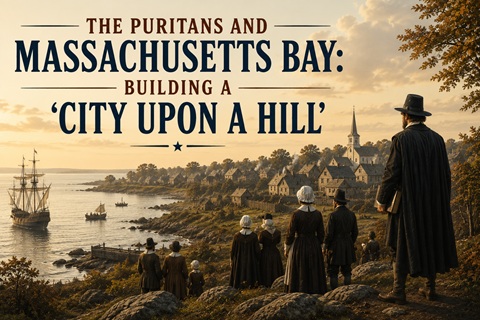
In the 1630s, thousands of Puritans left England and settled in New England, where they founded the Massachusetts Bay Colony. Unlike the Pilgrims, who wanted to separate from the Church of England, the Puritans hoped to reform it by creating a model Christian society. Led by John Winthrop, they believed their colony should serve as an example for others—a “city upon a hill” that would demonstrate the benefits of living according to their religious beliefs. The Massachusetts Bay Colony became one of the most influential settlements in Colonial America and played a major role in shaping the culture and government of New England. This lesson follows the lesson plan outline provided in the uploaded document.
What You Will Learn
- Explain why the Puritans left England and founded the Massachusetts Bay Colony.
- Describe the goals and beliefs of the Puritan community.
- Understand the successes and challenges of building a “city upon a hill.”
Why the Puritans Came to New England
The Puritans were English Protestants who believed that the Church of England still contained too many practices from the Roman Catholic Church. Rather than separating from the church entirely, they hoped to purify and reform it. However, many Puritans faced pressure and discrimination because of their religious views, especially when English rulers demanded religious conformity.
In 1630, a large group of Puritans sailed to North America as part of what became known as the Great Migration. Led by John Winthrop, they established the Massachusetts Bay Colony. Unlike earlier settlements that struggled to survive, Massachusetts Bay arrived with thousands of settlers, supplies, and a clear plan for building a permanent community based on Puritan principles.
Puritan Beliefs and Community Life
The Puritans believed that religion should guide every aspect of life. They worked to create communities centered on faith, family, education, and hard work. Church attendance was expected, and community leaders often enforced laws based on religious teachings. The Puritans believed that a strong moral society would honor God and serve as an example to the rest of the world.
Education was highly valued because Puritans believed that people should be able to read the Bible for themselves. As a result, they established schools throughout the colony. In 1636, they founded Harvard College to train ministers and community leaders. The emphasis on education helped make New England one of the most literate regions in the colonies.
Building a “City Upon a Hill”
Before arriving in America, John Winthrop delivered a famous sermon in which he described the colony as a “city upon a hill.” He believed that people around the world would watch the Puritans and judge whether their experiment succeeded. This idea encouraged colonists to work together and maintain a strong sense of community responsibility.
The Massachusetts Bay Colony achieved many successes. Its population grew rapidly, towns expanded, and farms and businesses prospered. However, the colony also faced challenges. Puritan leaders expected religious unity and often showed little tolerance for dissenting views. Individuals such as Roger Williams and Anne Hutchinson were criticized or banished for challenging colony leaders. These conflicts revealed the difficulties of balancing religious ideals with individual freedom.
Conclusion
The Puritans founded the Massachusetts Bay Colony to create a society based on their religious beliefs and values. Through hard work, education, and strong community ties, they built one of the most successful colonies in North America. At the same time, their efforts to maintain religious unity led to conflicts that highlighted important questions about freedom and government. The legacy of the Puritans continues to influence American history today.
Key Terms
- Puritans – English Protestants who sought to reform and “purify” the Church of England.
- Great Migration – The movement of thousands of Puritans from England to New England during the 1630s.
Review Questions
- Why did the Puritans leave England and settle in Massachusetts Bay?
- How did Puritan beliefs influence daily life in the colony?
- What did John Winthrop mean by the phrase “city upon a hill,” and what challenges did the colony face in achieving that goal?
Extension Activity
Design a Puritan Town Plan
Objective
Create a detailed plan for a new Puritan town in the Massachusetts Bay Colony that reflects the values and goals of the Puritan community.
Instructions
- Research the layout and organization of Puritan towns in New England.
- Draw a map showing important features such as homes, farmland, a meetinghouse, a school, and common land.
- Write descriptions explaining the purpose of each feature and why it was important to Puritan life.
- Include rules or laws that town leaders might establish to maintain order and support religious values.
- Explain how education, religion, and community cooperation would function in your town.
- Conclude with a paragraph evaluating whether your town would successfully serve as a “city upon a hill” and why.
From Indigenous North America to European Colonization
Indigenous North America Before 1500
The European Age of Exploration
From Revolution to the Eve of Civil War
The Early Republic
The Jacksonian Era
Westward Expansion
The Late 19th Century
The American Civil War
Reconstruction
The Gilded Age
The Early 20th Century
The Progressive Era
World War I
The Roaring 20s and the Great Depression
Modern America Emerges
World War II
The Cold War
Post Cold War America
Modern America