Overview
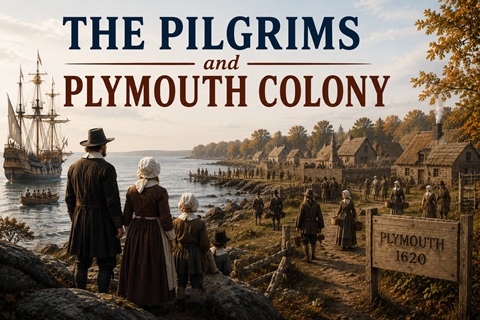
The story of the Pilgrims and Plymouth Colony is one of the most famous chapters in early American history. Seeking the freedom to practice their religion, a group of English settlers known as the Pilgrims sailed across the Atlantic Ocean aboard the Mayflower in 1620. After a difficult journey, they established Plymouth Colony in present-day Massachusetts. Their experiences—including hardship, cooperation with Indigenous peoples, and the struggle to build a new community—became an important part of the history of Colonial America. This lesson follows the lesson plan outline provided in the uploaded document.
What You Will Learn
- Explain why the Pilgrims left England and traveled to North America.
- Describe the founding and early challenges of Plymouth Colony.
- Understand the importance of cooperation between the Pilgrims and Indigenous peoples.
Why the Pilgrims Left England
The Pilgrims were a group of English Christians known as Separatists. They believed that the Church of England needed major reforms and chose to separate from it entirely. Because their religious beliefs differed from those supported by the English government, they faced restrictions and persecution. Hoping to find a place where they could worship freely, many Pilgrims first moved to the Netherlands.
Although they enjoyed greater religious freedom there, the Pilgrims worried that their children were losing their English culture and traditions. They decided to establish a new settlement in North America where they could practice their faith and build their own community. In 1620, about 100 passengers boarded the Mayflower and began the long voyage across the Atlantic Ocean.
The Founding of Plymouth Colony
After more than two months at sea, the Mayflower reached the coast of present-day Massachusetts. Before going ashore, the adult male passengers signed the Mayflower Compact, an agreement to work together and obey laws created for the good of the colony. This document became an early example of self-government in the English colonies.
The first winter at Plymouth was extremely difficult. The settlers arrived late in the year and were unprepared for the harsh conditions. Many suffered from disease, hunger, and exposure to the cold. Nearly half of the colonists died before spring. Despite these hardships, the survivors continued working to establish homes, plant crops, and build a stable community.
Cooperation with Indigenous Peoples
The success of Plymouth Colony depended in part on the assistance of local Indigenous peoples. Members of the Wampanoag nation helped the Pilgrims learn how to grow crops such as corn, catch fish, and survive in their new environment. One important figure was Squanto, who acted as an interpreter and shared valuable knowledge about the region.
The Pilgrims and the Wampanoag formed an alliance that benefited both groups for a time. In the fall of 1621, after a successful harvest, the colonists and members of the Wampanoag community participated in a gathering that is often associated with the first Thanksgiving. While relations between settlers and Indigenous peoples later became more complicated and sometimes hostile, cooperation played a crucial role in the survival of Plymouth Colony.
Conclusion
The Pilgrims came to North America seeking religious freedom and the opportunity to build a new community. Although they faced tremendous challenges, they established Plymouth Colony and helped create one of the earliest successful English settlements in New England. Their experiences, along with the assistance they received from Indigenous peoples, became an important part of the history of Colonial America.
Key Terms
- Pilgrims – English Separatists who traveled to North America in 1620 seeking religious freedom.
- Mayflower Compact – An agreement signed by the Pilgrims that established a system of self-government for Plymouth Colony.
Review Questions
- Why did the Pilgrims leave England and eventually travel to North America?
- What challenges did the settlers face during their first winter at Plymouth?
- How did the Wampanoag people help the Pilgrims survive and establish their colony?
Extension Activity
Create a Plymouth Colony Survival Journal
Objective
Create a historical journal that describes the experiences of a Pilgrim during the first year at Plymouth Colony.
Instructions
- Research the voyage of the Mayflower and the founding of Plymouth Colony.
- Write at least five journal entries from the perspective of a Pilgrim settler.
- Include descriptions of the voyage, arrival in North America, the first winter, and interactions with the Wampanoag.
- Add illustrations, maps, or diagrams that help explain the events described.
- Explain the challenges faced by the settlers and the solutions they used to overcome them.
- Conclude with a reflection describing whether you would have chosen to remain in Plymouth and why.
From Indigenous North America to European Colonization
Indigenous North America Before 1500
The European Age of Exploration
From Revolution to the Eve of Civil War
The Early Republic
The Jacksonian Era
Westward Expansion
The Late 19th Century
The American Civil War
Reconstruction
The Gilded Age
The Early 20th Century
The Progressive Era
World War I
The Roaring 20s and the Great Depression
Modern America Emerges
World War II
The Cold War
Post Cold War America
Modern America