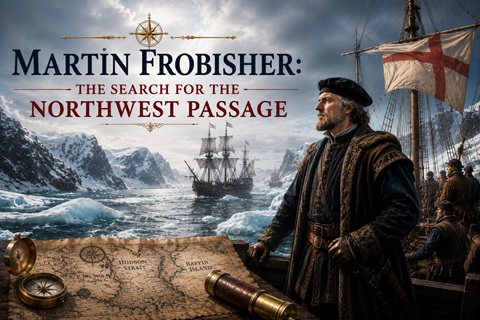
In the late 1500s, English explorer Martin Frobisher set out to find a Northwest Passage—a sea route through North America that would connect the Atlantic Ocean to Asia. Although he never found this passage, his voyages helped expand European knowledge of the Arctic and strengthened England’s role in exploration. Frobisher’s journeys highlight both the determination of explorers and the challenges of navigating unknown and dangerous environments.
What You Will Learn
- Who Martin Frobisher was and what he hoped to achieve
- What happened during his Arctic voyages
- Why the search for the Northwest Passage was important
The Dream of a Northwest Passage
During the Age of Exploration, European nations were eager to find faster routes to Asia. The Northwest Passage was believed to be a shortcut through the northern part of North America, allowing ships to avoid long and dangerous journeys around Africa or South America.
England, in particular, was interested in finding this route to compete with Spain and Portugal. Explorers like Martin Frobisher were sent on expeditions to search for this passage, hoping to bring wealth and trade opportunities back to England.
Frobisher’s Voyages
Martin Frobisher made three voyages to the Arctic between 1576 and 1578. On his first voyage, he reached what is now known as Frobisher Bay in present-day Canada. He believed he had found part of the Northwest Passage, though this was not the case.
During his later voyages, Frobisher returned to the region with larger expeditions. He also brought back rocks he believed contained gold, which turned out to be worthless. Despite these setbacks, his journeys provided valuable information about the geography and conditions of the Arctic.
Challenges and Impact
Frobisher and his crew faced extreme challenges, including freezing temperatures, dangerous ice, and limited supplies. Navigating through icy waters made travel slow and risky, and many explorers struggled to survive these harsh conditions.
Although Frobisher did not find the Northwest Passage, his voyages helped map parts of the Arctic and encouraged further exploration. His efforts showed that while the passage was difficult to find, it remained an important goal for future explorers.
Conclusion
Martin Frobisher’s search for the Northwest Passage was an important chapter in the Age of Exploration. Even though he did not achieve his main goal, his voyages expanded knowledge of the Arctic and helped England continue its exploration efforts. His story reminds us that exploration often involves risk, failure, and learning from experience.
Key Terms
- Northwest Passage: A sea route through the Arctic connecting the Atlantic and Pacific Oceans.
- Arctic: The region around the North Pole, known for its cold climate and icy conditions.
Review Questions
- What was the Northwest Passage, and why did explorers want to find it?
- What challenges did Martin Frobisher face during his voyages?
- Why were Frobisher’s journeys important even though he did not find the passage?
Think Further
Extension Activity: Plan an Arctic Expedition
Objective:
To help students understand the difficulties of Arctic exploration and the planning required for such dangerous journeys.
Instructions:
Students will design their own exploration plan to search for the Northwest Passage.
- Draw a map of the Arctic region and plan a possible route.
- List the supplies and equipment needed for survival in cold conditions.
- Write a short paragraph explaining the challenges you might face and how you would prepare for them.
From Indigenous North America to European Colonization
Indigenous North America Before 1500
The European Age of Exploration
From Revolution to the Eve of Civil War
The Early Republic
The Jacksonian Era
Westward Expansion
The Late 19th Century
The American Civil War
Reconstruction
The Gilded Age
The Early 20th Century
The Progressive Era
World War I
The Roaring 20s and the Great Depression
Modern America Emerges
World War II
The Cold War
Post Cold War America
Modern America