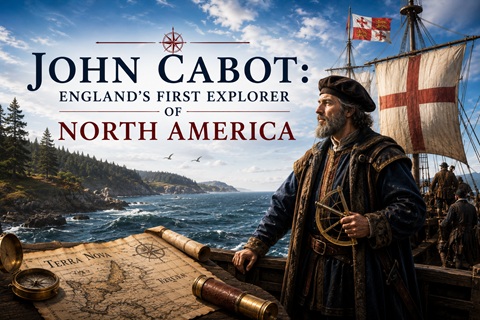
In 1497, John Cabot sailed across the Atlantic Ocean on behalf of England and reached the coast of North America. His voyage helped England claim land in the New World and marked the beginning of its exploration efforts. Although less well-known than some other explorers, Cabot’s journey played an important role in shaping England’s future in the Americas.
What You Will Learn
- Who John Cabot was and why he sailed for England
- What happened during his voyage to North America
- Why his journey was important to England
Who Was John Cabot?
John Cabot was an Italian explorer whose real name was Giovanni Caboto. Like many explorers of his time, he believed there might be a shorter route to Asia by sailing west across the Atlantic Ocean. He offered his ideas to different countries before gaining support from England.
King Henry VII of England agreed to sponsor Cabot’s voyage. England hoped to find new lands, trade routes, and valuable resources. Cabot’s journey would become one of England’s first steps into global exploration.
The Voyage of 1497
In 1497, Cabot set sail from England aboard a small ship called the Matthew. After crossing the Atlantic, he reached land, most likely along the coast of present-day Canada, such as Newfoundland. He believed he had reached Asia, but like other explorers of his time, he had actually arrived in the Americas.
Cabot explored the coastline and claimed the land for England. His reports described rich fishing waters and new opportunities for trade. Although he did not establish a permanent settlement, his voyage provided valuable information for future explorers.
Why Cabot’s Voyage Matters
John Cabot’s journey gave England a claim to parts of North America. This claim would later support England’s efforts to establish colonies in the New World. His discovery also encouraged further exploration by English sailors.
In addition, Cabot’s reports of abundant fish led to increased fishing activity in the North Atlantic. This became an important economic resource for England. While his voyage was small compared to later expeditions, its impact on England’s future was significant.
Conclusion
John Cabot’s voyage in 1497 was an important milestone in the Age of Exploration. By reaching North America and claiming land for England, he helped set the stage for future exploration and colonization. His journey shows how even a single expedition can have lasting effects on history.
Key Terms
- Exploration: The act of traveling to unknown places to learn more about them.
- Claim (land claim): To declare land as belonging to a country or ruler.
Review Questions
- Why did John Cabot sail for England instead of Italy?
- What did Cabot discover during his 1497 voyage?
- Why was Cabot’s journey important for England’s future?
Think Further
Extension Activity: Explorer Comparison Chart
Objective:
To help students analyze similarities and differences between explorers and understand their historical significance.
Instructions:
Students will compare John Cabot with another explorer.
- Choose another explorer, such as Christopher Columbus.
- Create a chart comparing their goals, routes, discoveries, and impacts.
- Write a short paragraph explaining which explorer you think had a greater impact and why.
From Indigenous North America to European Colonization
Indigenous North America Before 1500
The European Age of Exploration
From Revolution to the Eve of Civil War
The Early Republic
The Jacksonian Era
Westward Expansion
The Late 19th Century
The American Civil War
Reconstruction
The Gilded Age
The Early 20th Century
The Progressive Era
World War I
The Roaring 20s and the Great Depression
Modern America Emerges
World War II
The Cold War
Post Cold War America
Modern America