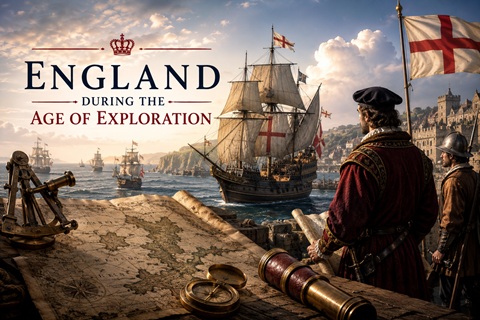
During the Age of Exploration, England emerged as an important seafaring nation, challenging the dominance of Spain and Portugal. Under the leadership of Queen Elizabeth I, England supported voyages, encouraged trade, and expanded its influence overseas. Explorers like Sir Francis Drake and John Cabot helped England explore new lands and establish a presence in the Americas. These efforts laid the foundation for England’s future empire.
What You Will Learn
- Why England joined the Age of Exploration
- Who England’s key explorers were
- How exploration helped England grow in power
Why England Began Exploring
In the late 1400s and 1500s, England wanted to compete with powerful nations like Spain and Portugal. These countries were gaining wealth and influence through exploration and trade, especially in the Americas and Asia. England did not want to be left behind.
Economic opportunities were a major motivation. England hoped to find new trade routes, valuable resources, and land for settlement. Religious and political competition also played a role, especially as tensions grew between Protestant England and Catholic Spain.
English Explorers and Their Voyages
One of the earliest explorers to sail for England was John Cabot, who reached parts of North America in 1497. His voyage gave England a claim to land in the New World.
Later, Sir Francis Drake became famous for his circumnavigation of the globe and his attacks on Spanish ships. Known as a privateer, Drake was officially allowed by England to raid enemy ships. These actions weakened Spain and brought wealth back to England.
The Growth of English Power
England’s success at sea grew stronger over time. The defeat of the Spanish Armada in 1588 was a major turning point, showing that England could challenge Spain’s naval power. This victory increased confidence and encouraged further exploration.
England also began establishing colonies in North America. Although early attempts were difficult, these efforts eventually led to successful settlements. Exploration helped England expand its trade, influence, and power, setting the stage for the British Empire.
Conclusion
England’s role in the Age of Exploration helped transform it into a powerful global nation. Through exploration, trade, and naval strength, England expanded its influence and laid the groundwork for future colonization. While these efforts brought growth and opportunity, they also contributed to conflict and the displacement of Indigenous peoples. Understanding England’s role helps us see how exploration shaped the modern world.
Key Terms
- Privateer: A sailor authorized by a government to attack enemy ships.
- Colony: A settlement established by people from another country in a new land.
Review Questions
- Why did England decide to join the Age of Exploration?
- What contributions did John Cabot and Francis Drake make?
- How did exploration help England become more powerful?
Think Further
Extension Activity: Plan and English Expedition
Objective:
To help students think like explorers and understand the planning and risks involved in exploration.
Instructions:
- Choose a destination (North America, Africa, or Asia).
- Describe your goals (trade, settlement, exploration).
- List the supplies, crew, and ships you would need.
- Write a short paragraph explaining what challenges you might face and how you would overcome them.
From Indigenous North America to European Colonization
Indigenous North America Before 1500
The European Age of Exploration
From Revolution to the Eve of Civil War
The Early Republic
The Jacksonian Era
Westward Expansion
The Late 19th Century
The American Civil War
Reconstruction
The Gilded Age
The Early 20th Century
The Progressive Era
World War I
The Roaring 20s and the Great Depression
Modern America Emerges
World War II
The Cold War
Post Cold War America
Modern America
📘 Get A Free Unit Resource Pack
Save hours of prep time with our unit packs: ready-to-use lessons, activities, and assessments designed for middle school history.
25-30 Reproduceable Pages (including a DBQ!)