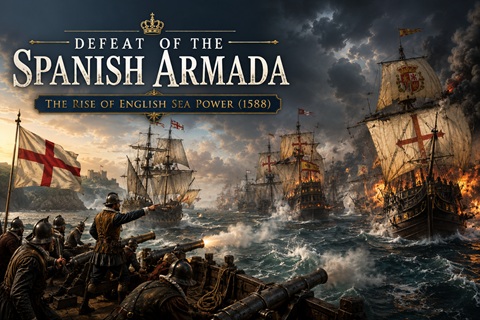
In 1588, a powerful Spanish fleet known as the Armada attempted to invade England but was defeated by the English navy. This event marked a turning point in European history, weakening Spain’s dominance and helping England rise as a major naval power. Leaders like Queen Elizabeth I and King Philip II of Spain played central roles in this conflict. The defeat of the Armada showed the importance of naval strength, strategy, and even weather in shaping history.
What You Will Learn
- Why Spain sent the Armada to invade England
- How England defeated the Spanish fleet
- Why this event was important in world history
Why Did Spain Attack England
In the late 1500s, Spain was one of the most powerful nations in the world. Under King Philip II of Spain, Spain was a strong Catholic nation. England, led by Queen Elizabeth I, was Protestant. Religious differences created tension between the two countries.
There were also political and economic reasons for conflict. England supported Spanish enemies in Europe and allowed English sailors to raid Spanish ships carrying treasure from the Americas. Philip II decided to send the Spanish Armada to invade England, overthrow Elizabeth, and restore Catholic rule.
The Battle and England’s Strategy
The Spanish Armada was a large fleet of ships designed to transport soldiers to England. However, the English navy had smaller, faster ships that were easier to maneuver. English commanders used speed and long-range cannons to attack the Spanish fleet from a distance.
One key moment came when the English sent fire ships—boats filled with burning materials—into the Spanish fleet. This caused confusion and forced the Spanish ships to scatter. As the Armada retreated, powerful storms in the North Atlantic further damaged the fleet. Many ships were lost before they could return to Spain.
The Impact of the Armada’s Defeat
The defeat of the Spanish Armada weakened Spain’s control of the seas and marked the beginning of England’s rise as a naval power. Although Spain remained strong, it no longer had the same level of dominance.
For England, the victory boosted national pride and confidence. It also encouraged further exploration and expansion, eventually leading to the establishment of English colonies in the Americas. The event showed how naval power could shape the future of nations.
Conclusion
The defeat of the Spanish Armada in 1588 was a major turning point in history. It showed that even the most powerful nations could be challenged with the right strategy and determination. England’s victory helped pave the way for its rise as a global naval power, while Spain’s influence began to decline. This event highlights the importance of leadership, innovation, and even natural forces in shaping history.
Key Terms
- Armada: A large fleet of warships.
- Naval Power: The strength of a nation’s navy and its ability to control the seas.
Review Questions
- Why did King Philip II send the Spanish Armada to England?
- What strategies did the English navy use to defeat the Armada?
- Why was the defeat of the Armada important for England’s future?
Think Further
Extension Activity: Strategy and Simulation
Objective:
To help students understand how strategy, technology, and environmental factors influenced the outcome of the Spanish Armada.
Instructions:
Students will explore naval strategy by designing their own fleet plan.
Part 1: Heading title
- Draw two simple fleets: one representing Spain and one representing England.
- Label ship types and describe their strengths (size, speed, weapons).
- Write a short paragraph explaining how you would plan a battle if you were an English commander.
- Optional: Recreate the battle using paper ships and simulate different outcomes.
From Indigenous North America to European Colonization
Indigenous North America Before 1500
The European Age of Exploration
From Revolution to the Eve of Civil War
The Early Republic
The Jacksonian Era
Westward Expansion
The Late 19th Century
The American Civil War
Reconstruction
The Gilded Age
The Early 20th Century
The Progressive Era
World War I
The Roaring 20s and the Great Depression
Modern America Emerges
World War II
The Cold War
Post Cold War America
Modern America
📘 Get A Free Unit Resource Pack
Save hours of prep time with our unit packs: ready-to-use lessons, activities, and assessments designed for middle school history.
25-30 Reproduceable Pages (including a DBQ!)