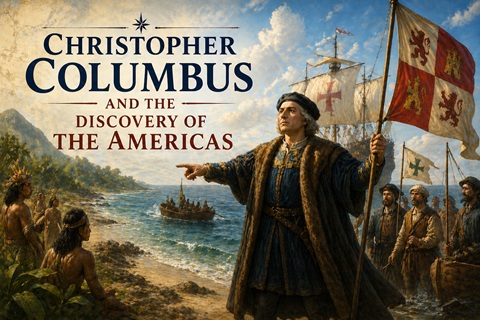
A World Ready for Exploration
In 1492, Christopher Columbus set sail across the Atlantic Ocean, hoping to find a new route to Asia. Instead, he reached lands that were previously unknown to Europeans, which later became known as the Americas. His voyages marked the beginning of lasting contact between Europe and the New World. While his journey led to exploration and exchange, it also brought major challenges and hardships for Indigenous peoples.
What You Will Learn
- Why Christopher Columbus set out on his voyage
- What happened during his journey across the Atlantic
- The effects of his voyages on the world
Why Did Columbus Sail?
During the late 1400s, European nations were searching for new trade routes to Asia. Goods like spices, silk, and gold were in high demand, but existing routes were difficult and controlled by other powers. Columbus believed he could reach Asia more quickly by sailing west across the Atlantic Ocean.
Columbus presented his idea to several monarchs before finally receiving support from Spain. King Ferdinand and Queen Isabella agreed to fund his expedition. They hoped that Columbus would find a faster route to Asia and bring wealth and power to Spain.
The Voyage of 1492
In August 1492, Columbus set sail with three ships: the Niña, the Pinta, and the Santa María. After weeks of traveling across the Atlantic, his crew grew worried, fearing they might never reach land. Finally, in October, they arrived at an island in the Caribbean.
Columbus believed he had reached Asia, but he had actually landed in the Americas. He explored several islands and met Indigenous peoples, whom he called “Indians.” Although he made multiple voyages, Columbus never realized that he had discovered a new continent unknown to Europeans.
Impact of Columbus’ Voyages
Columbus’s voyages led to increased exploration and the beginning of European colonization in the Americas. His journeys opened the door for other explorers to follow, leading to the exchange of goods, ideas, and cultures between continents. This exchange is known as the Columbian Exchange.
However, the impact on Indigenous peoples was devastating. Diseases brought by Europeans spread rapidly, and many Indigenous communities were forced into labor or lost their land. Columbus’s voyages are remembered both for their role in connecting the world and for the harm that followed.
Conclusion
Christopher Columbus’s journey in 1492 was a turning point in history. It connected Europe and the Americas in ways that changed the world forever. While his voyages led to exploration and new opportunities, they also caused great suffering for Indigenous peoples. Understanding both sides of this history helps us better understand the lasting effects of exploration.
Key Terms
- Columbian Exchange: The movement of plants, animals, people, and diseases between Europe and the Americas after Columbus’s voyages.
- Colonization: The act of settling people in a new land and establishing control over it.
Review Questions
- Why did Columbus believe he could reach Asia by sailing west?
- What happened during Columbus’s first voyage in 1492?
- What were some positive and negative effects of his voyages?
Think Further
Extension Activity: Columbus Debate or Reflection Essay
Objective:
To encourage critical thinking by examining multiple perspectives on a major historical figure and event.
Students will explore different perspectives on Columbus’s voyages.
- Write a short essay (1–2 paragraphs) answering the question: Should Christopher Columbus be remembered as a hero, a villain, or both?
- Use evidence from the lesson to support your answer.
- Optional: Turn this into a classroom debate where students present and defend their viewpoints.
From Indigenous North America to European Colonization
Indigenous North America Before 1500
The European Age of Exploration
From Revolution to the Eve of Civil War
The Early Republic
The Jacksonian Era
Westward Expansion
The Late 19th Century
The American Civil War
Reconstruction
The Gilded Age
The Early 20th Century
The Progressive Era
World War I
The Roaring 20s and the Great Depression
Modern America Emerges
World War II
The Cold War
Post Cold War America
Modern America