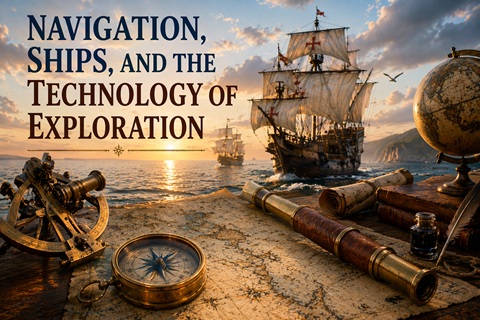
How Did New Tools Made the Age of Exploration Possible? Technology in the Age of Exploration
During the late 1400s and early 1500s, European sailors began traveling farther across the oceans than ever before. These voyages led to the discovery of new lands, new trade routes, and new connections between continents. Historians often call this time the Age of Exploration.
But these long journeys did not happen by accident. For thousands of years before this period, most sailors stayed close to shore. Traveling across the open ocean was extremely dangerous. Ships could easily become lost, run out of food, or be blown far off course by storms.
So what changed?
The answer is technology. New kinds of ships, better sails, improved maps, and new navigation tools made it possible for sailors to travel much farther and with greater confidence. Without these inventions, explorers such as Christopher Columbus, Vasco da Gama, and Ferdinand Magellan would never have been able to cross the oceans.
In this article, we will explore the important tools and technologies that made the Age of Exploration possible: the caravel, the compass, the astrolabe, portolan charts, and lateen sails.
Why Exploration Was Difficult Before the 1400s
Before we examine the new technologies, it helps to understand why earlier exploration was so difficult.
For much of history, sailors traveled mainly along coastlines. This type of sailing is called coastal navigation. If sailors stayed near land, they could use familiar landmarks—mountains, cliffs, or rivers—to help guide them.
But once a ship sailed far out into the open ocean, those landmarks disappeared. Sailors faced several serious problems:
- They could easily lose their direction.
- Storms could push ships far off course.
- Maps were often inaccurate.
- Ships were not designed for long ocean voyages.
Because of these dangers, most captains preferred to avoid the open sea whenever possible.
However, during the 1400s European nations became increasingly interested in reaching Asia by sea. Trade with Asia brought valuable goods such as silk, spices, and precious stones. If European sailors could find a direct sea route to Asia, they could become rich through trade.
To solve this challenge, sailors and shipbuilders began developing better tools and ships.
The Caravel: A Ship Built for Exploration
One of the most important inventions of the Age of Exploration was the caravel.

The caravel was a small but highly advanced ship developed by Portuguese shipbuilders in the 1400s. It quickly became the favorite vessel of early explorers.
What Made the Caravel Special?
Earlier ships used mostly square sails, which worked well when the wind blew from behind the ship. But if the wind blew from the side or the front, these ships had trouble moving.
The caravel was different.
It had several features that made it ideal for exploration:
1. Small and Maneuverable
Caravels were smaller than many earlier ships. This made them easier to steer and control, especially near unknown coastlines.
2. Strong Hull
The ship’s body, called the hull, was strong enough to handle rough ocean waves.
3. Combination of Sail Types
Caravels often used both square sails and triangular sails, allowing them to travel in many different wind conditions.
Because of these advantages, caravels were perfect for long-distance voyages.
For example, the ships used by Christopher Columbus during his 1492 voyage included vessels designed with similar technology. Portuguese explorers also relied heavily on caravels when exploring the coast of Africa.
Lateen Sails: Harnessing the Wind
One of the key features that made the caravel so useful was its lateen sail.
A lateen sail is a triangular sail attached to a long diagonal pole called a yard. Unlike square sails, lateen sails could catch the wind from different angles.

Sailing Against the Wind
Lateen sails allowed ships to perform a technique called tacking. Tacking means sailing in a zigzag pattern that allows a ship to move against the wind.
Imagine trying to walk straight into a strong wind. It would be difficult. But if you walked diagonally and changed direction occasionally, you might still reach your destination.
Ships used the same idea.
With lateen sails, sailors could travel in directions that earlier ships could not. This gave explorers much more freedom to navigate the oceans.
Borrowed from Other Cultures
Interestingly, lateen sails were not originally a European invention. Similar sails had been used for centuries by sailors in the Mediterranean Sea and the Indian Ocean.
European shipbuilders adopted this design and combined it with their own shipbuilding traditions. The result was a new kind of vessel perfectly suited for exploration.
The Compass: Finding Direction at Sea
Knowing which direction a ship was traveling was extremely important for explorers. One of the most important tools that helped sailors navigate was the magnetic compass.

How the Compass Works
A compass contains a small magnetized needle that floats or pivots freely. The needle always points toward the north because of the Earth’s magnetic field.
This allowed sailors to determine direction even when:
- The sky was cloudy
- The coastline was out of sight
- The sun or stars were hidden
An Invention from China
The compass was first invented in China more than a thousand years ago. Chinese sailors and scholars used early versions of the compass for navigation and other purposes.
Over time, knowledge of the compass spread westward through trade routes. By the 1200s and 1300s, European sailors had begun using it regularly.
Why the Compass Was So Important
Before the compass, sailors depended heavily on the sun, stars, and landmarks to determine direction.
But storms or cloudy skies could hide these guides. A compass gave sailors a reliable way to maintain their course even when they could not see the sky.
This made long ocean voyages much safer.
The Astrolabe: Measuring Position by the Stars
Another important navigation tool was the astrolabe.

The astrolabe was originally developed by ancient Greek astronomers and later improved by Islamic scholars. European sailors adapted a special version called the mariner’s astrolabe for use at sea.
What Did the Astrolabe Do?
The astrolabe helped sailors determine their latitude, which is their position north or south of the equator.
To do this, sailors measured the angle between the horizon and a star—often the North Star (Polaris).
By comparing this measurement with mathematical tables, sailors could estimate how far north or south they had traveled.
Why Latitude Matters
Latitude helped sailors answer an important question:
“How far north or south am I?”
Once sailors knew their latitude, they could try to stay along a particular line across the ocean.
For example, if a captain wanted to sail west at the same latitude as Spain, he could use the astrolabe to stay on that path.
Although the astrolabe did not solve every navigation problem, it greatly improved sailors’ ability to travel across the open ocean.
Portolan Charts: Better Maps for Sailors
Another important improvement during this time was the development of portolan charts.

Portolan charts were highly detailed nautical maps used by sailors in the Mediterranean beginning in the 1200s.
What Made Portolan Charts Different?
Earlier maps were often symbolic or decorative. They might show cities, animals, or religious symbols, but they were not always useful for navigation.
Portolan charts were different because they were designed specifically for sailors.
These maps included:
- Accurate coastlines
- Important harbors
- Compass directions
- Network lines showing sailing routes
These lines, called rhumb lines, showed the directions between different ports.
How Sailors Used Them
A sailor could look at a portolan chart, follow the rhumb lines, and determine the direction needed to reach a destination.
When used together with a compass, these maps became powerful navigation tools.
Although portolan charts were most accurate for the Mediterranean Sea, the mapping techniques used to create them helped later mapmakers improve charts of the Atlantic Ocean.
Combining Technology for Exploration
Each of these inventions was useful on its own. But the real power came when sailors used them together.
Consider what an explorer could do with these technologies:
- Caravels provided strong and maneuverable ships.
- Lateen sails allowed ships to sail in many wind conditions.
- Compasses helped sailors maintain direction.
- Astrolabes helped determine latitude.
- Portolan charts provided improved maps of coastlines and ports.
Together, these tools gave sailors much greater control over ocean travel.
Exploration was still dangerous, but it became possible in ways it had never been before.
The Role of Portugal and Spain
Many of the early improvements in navigation came from sailors working for Portugal and Spain.

Portugal was especially important. Portuguese explorers spent decades studying ocean currents, winds, and navigation techniques.
Under the leadership of Prince Henry the Navigator, Portuguese sailors explored the west coast of Africa and improved ship design and navigation methods.
These discoveries helped later explorers travel much farther across the oceans.
Spain soon followed Portugal’s example by sponsoring voyages across the Atlantic. This led to the famous expedition of Christopher Columbus in 1492.
The Beginning of Global Exploration
With better ships and better navigation tools, European explorers were able to travel to places they had never reached before.
During the Age of Exploration, sailors:
- Crossed the Atlantic Ocean
- Reached India by sea
- Traveled around the southern tip of Africa
- Eventually sailed around the entire world
One of the most famous expeditions was led by Ferdinand Magellan. Although Magellan himself died during the journey, members of his crew completed the first trip around the globe in 1522.
This voyage proved that the Earth could be circled by ship.
Exploration Still Required Courage
Even with improved technology, exploration was still extremely risky.
Ships could still face:
- Powerful storms
- Disease and hunger
- Mutiny among sailors
- Shipwrecks on unknown shores
Many sailors never returned home.
But the new tools of navigation gave explorers enough confidence to attempt these dangerous journeys.
Conclusion: Technology Opened the Oceans
The Age of Exploration was not caused by a single invention. Instead, it was the result of many improvements working together.
Shipbuilders created better vessels like the caravel. Sailmakers improved ships with lateen sails. Navigators used the compass and astrolabe to guide their journeys. Mapmakers produced better charts such as portolan maps.
Together, these innovations transformed ocean travel.
For the first time in history, sailors could travel far across the open sea with some confidence that they could find their way home.
These technologies helped launch a period of exploration that connected continents, expanded knowledge of the world, and changed history forever.
The oceans that once seemed impossible to cross had finally become pathways linking the peoples of the Earth.