Why Did Europeans Begin Exploring the World?
During the late Middle Ages and the early years of the Renaissance, something remarkable began to happen in Europe. Sailors, merchants, and kings started sending ships far beyond the familiar waters of the Mediterranean Sea. These explorers crossed dangerous oceans, sailed along unknown coasts, and searched for new lands and trade routes. Their journeys eventually connected Europe, Africa, Asia, and the Americas in ways that had never happened before.
Historians call this period the Age of Exploration, and it began in the 1400s. But an important question remains: Why did Europeans suddenly begin exploring the wider world?
The answer involves several important forces working together. European nations wanted access to valuable trade goods from Asia. They hoped to obtain spices, silk, and luxury items more easily and cheaply. The fall of the great city of Constantinople in 1453 disrupted older trade routes and forced Europeans to search for new ones. At the same time, the ideas of the Renaissance encouraged curiosity about the world. Finally, new technologies in navigation and shipbuilding made long ocean voyages safer and more practical.
Together, these forces pushed Europeans out onto the oceans and changed world history forever.
Trade with Asia
For many centuries before the Age of Exploration, Europeans had traded with Asia. Asian merchants sold goods that Europeans could not easily produce themselves. These included silk from China, spices from Southeast Asia and India, fine carpets from Persia, and many other luxury items.
These goods traveled along a network of land and sea routes known as the Silk Road. Caravans of merchants carried goods across deserts and mountains through Central Asia and the Middle East. From there, the goods were transported to Mediterranean ports, where European traders purchased them and carried them back to cities such as Venice and Genoa.

By the time these products reached Europe, however, they were extremely expensive. Each group of traders along the route added their own profit. As a result, spices and silk were often affordable only to wealthy nobles or rich merchants.
Still, the demand for Asian goods remained very strong. European rulers and merchants knew that if they could find a direct route to Asia, they might become extremely wealthy. They would be able to buy goods directly from Asian markets instead of paying many middlemen along the way.
This desire for direct trade became one of the strongest motivations behind European exploration.
The Desire for Spices and Luxury Goods
One of the most important trade goods Europeans wanted from Asia was spices.
Today, spices such as pepper, cinnamon, nutmeg, and cloves are easy to find in grocery stores. In the Middle Ages, however, they were rare and expensive. Many spices came from distant islands in Southeast Asia known as the Spice Islands (today part of Indonesia). Because these islands were so far away, spices had to travel thousands of miles before reaching Europe.
Spices were valuable for several reasons.
First, they improved the flavor of food. In a time before refrigeration, meat could spoil quickly. Spices helped make preserved food taste better. Pepper, for example, was sometimes so valuable that it was used almost like money.
Second, spices were believed to have medical benefits. Medieval doctors used spices to treat illnesses, improve digestion, and strengthen the body.
Third, spices were symbols of wealth and status. Serving food flavored with rare spices showed that a family was rich and powerful.
Europeans also desired other luxury goods from Asia. These included silk cloth, porcelain dishes, perfumes, precious stones, and fine metalwork. Such items were admired for their beauty and craftsmanship.
Because these goods were so valuable, European merchants dreamed of finding faster and cheaper routes to Asia. If they could sail directly to the sources of spices and luxury goods, they could make enormous profits.
This dream helped inspire many voyages of exploration.
The Fall of Constantinople (1453)
Another important event that encouraged European exploration was the fall of Constantinople in 1453.

Constantinople was a great city located between Europe and Asia. For more than a thousand years, it had been the capital of the Byzantine Empire. The city sat along major trade routes that connected Europe with the riches of Asia.
In 1453, the city was captured by the Ottoman Turks, a powerful empire that was expanding across the eastern Mediterranean. When the Ottomans took control of Constantinople, they also gained control over many of the trade routes between Europe and Asia.
European merchants were still able to trade with Asia after 1453, but the situation became more difficult. Taxes and restrictions made trade more expensive. Political tensions between Christian Europe and the Muslim Ottoman Empire also made travel less certain.
Because of these problems, many Europeans began searching for alternative routes to Asia.
If they could sail around Africa or cross the Atlantic Ocean, they might reach Asia without having to pass through lands controlled by the Ottomans. Finding such routes would give European nations greater independence in trade.
The fall of Constantinople did not completely stop trade with Asia, but it helped convince Europeans that they needed new ways to reach the East.
The Curiosity of the Renaissance
The Age of Exploration also grew out of a major cultural movement called the Renaissance.
The Renaissance began in Italy during the 1300s and spread across Europe over the next two centuries. The word “Renaissance” means rebirth, because people during this time rediscovered many ideas from ancient Greece and Rome.
Renaissance thinkers believed that human beings should study the world carefully and learn as much as possible about it. Scholars studied geography, astronomy, mathematics, and other subjects. Artists painted detailed pictures of landscapes and distant places. Writers described the customs and traditions of different cultures.

This spirit of curiosity encouraged Europeans to ask new questions:
- What lands existed beyond the known world?
- Could ships sail safely across the Atlantic Ocean?
- How large was the Earth?
- What peoples and civilizations lived in distant regions?
Many educated Europeans believed the world was larger and more complex than medieval maps suggested.
Books about travel also inspired curiosity. One famous example was the writings of the Venetian traveler Marco Polo, who had journeyed to China during the 1200s. His stories described the wealth and splendor of Asian cities. Readers in Europe were fascinated by these descriptions.
Renaissance scholars also improved maps and studied ancient Greek writings about geography. For example, the Greek scholar Ptolemy had written about the shape of the Earth more than a thousand years earlier. When his works were rediscovered, they helped Europeans think more carefully about world geography.
All of these ideas created a climate in which exploration seemed exciting and worthwhile. People wanted to learn more about the world and their place in it.
Improvements in Navigation
Even if Europeans wanted to explore, they needed the tools and knowledge to travel safely across the ocean. During the 1400s, several important improvements in navigation made long voyages more possible.

Navigation is the science of determining a ship’s position and direction while traveling.
One important tool was the magnetic compass. This device uses a magnetized needle that always points north. With a compass, sailors could maintain a steady course even when clouds hid the stars.
Another useful instrument was the astrolabe. Sailors used the astrolabe to measure the angle of the sun or stars above the horizon. By doing this, they could estimate how far north or south they had traveled.
Better maps, known as portolan charts, also became available. These maps showed coastlines, harbors, and important landmarks with greater accuracy than earlier maps.
Sailors also gained improved knowledge of winds and ocean currents. For example, Portuguese sailors learned about wind patterns in the Atlantic Ocean that could help ships travel faster and return safely home.
All of these improvements gave sailors greater confidence that they could navigate across unknown waters and find their way back again.
Improvements in Shipbuilding
In addition to better navigation tools, Europeans also developed new types of ships that were well suited for long ocean voyages.
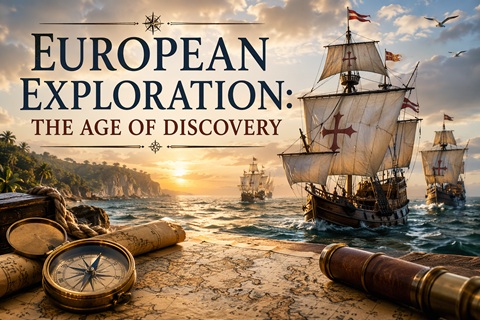
One of the most important was the caravel.

The caravel was a relatively small but highly maneuverable ship developed by the Portuguese. It had several features that made it ideal for exploration.
First, it used lateen sails, which were triangular sails that allowed ships to sail effectively even when the wind was blowing from the side. This made it easier to travel along coastlines and explore unfamiliar waters.
Second, caravels were light and fast. They could travel more quickly than many earlier ships and required smaller crews.
Third, they had a strong hull, which allowed them to withstand rough ocean conditions.
Later ships, such as the carrack, were larger and could carry more cargo and supplies. This made it possible to travel greater distances and remain at sea for longer periods.
With stronger ships and better sailing technology, European explorers were finally capable of crossing vast oceans.
The Role of European Kingdoms
Exploration required not only brave sailors but also financial support.
Ocean voyages were expensive. Ships had to be built and supplied with food, water, tools, and trade goods. Crews had to be paid, and there was always the risk that a voyage might fail.
Because of this, many explorations were sponsored by kings and queens.

Rulers hoped that successful voyages would bring wealth and power to their kingdoms. If explorers discovered new trade routes, valuable resources, or new lands, the sponsoring nation could gain great advantages.
Portugal was one of the earliest countries to support exploration. Portuguese sailors gradually explored the western coast of Africa, searching for a sea route to India.
Spain soon joined the competition. In 1492, the Spanish monarchs Ferdinand and Isabella sponsored the voyage of Christopher Columbus, who hoped to reach Asia by sailing west across the Atlantic Ocean.
Other European countries, including England, France, and the Netherlands, eventually followed.
This competition between nations helped accelerate the Age of Exploration.
A Combination of Forces
The Age of Exploration did not begin because of a single cause. Instead, it grew out of many different forces working together.
Europeans wanted direct access to valuable goods from Asia, especially spices and luxury items. The fall of Constantinople made older trade routes more difficult and encouraged the search for alternatives. The ideas of the Renaissance inspired curiosity about the wider world. New technologies in navigation and shipbuilding made long-distance voyages possible. Finally, European rulers were willing to invest money in exploration in the hope of gaining wealth and power.
These forces combined to push Europeans out onto the oceans during the 1400s and 1500s.
The Beginning of a Global Age
The voyages that followed would change the world forever.
Portuguese explorers sailed around Africa and eventually reached India. Spanish explorers crossed the Atlantic and encountered the Americas. English, French, and Dutch sailors later joined the search for new lands and trade routes.
These explorations led to increased trade, the exchange of ideas and cultures, and the spread of European influence across the globe. At the same time, they also brought conflict, colonization, and dramatic changes for many indigenous peoples.
Historians often describe this period as the beginning of a global age, when the continents of the world became more closely connected than ever before.
Conclusion
The Age of Exploration began because Europeans were driven by a powerful mixture of economic desires, political changes, cultural curiosity, and technological innovation.
They wanted spices, silk, and other valuable goods from Asia. They searched for new trade routes after the fall of Constantinople disrupted older ones. The ideas of the Renaissance encouraged people to explore and learn about the world. Improvements in navigation and shipbuilding made long ocean voyages possible.
Together, these forces inspired Europeans to venture into unknown waters. Their journeys opened new connections between continents and reshaped world history in ways that still affect us today.
Understanding why Europeans began exploring helps us understand how the modern, interconnected world first began to take shape.