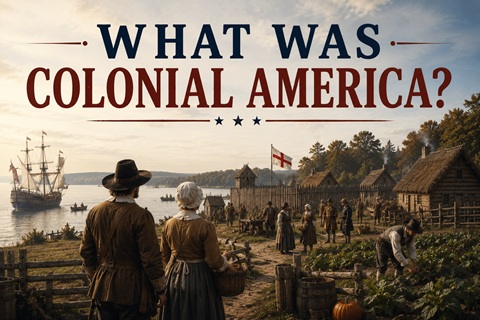
Overview
Colonial America refers to the period when England established and governed colonies along the eastern coast of North America. Beginning with the founding of Jamestown in 1607 and continuing until the American Revolution, the English colonies grew from small settlements into thriving communities. Colonists built farms, towns, and businesses while developing their own traditions and systems of government. Understanding Colonial America helps us learn how the colonies developed and how they eventually became the foundation of the United States. This lesson follows the lesson plan outline provided in the uploaded document.
What You Will Learn
- Identify what Colonial America was and how the English colonies were established.
- Describe the different regions of the English colonies and their characteristics.
- Explain how colonial life helped shape the future United States.
The Establishment of the English Colonies
Colonial America began when England established permanent settlements in North America. The first successful English colony was Jamestown, founded in Virginia in 1607. Over time, additional colonies were established along the Atlantic coast. Some colonies were founded to earn profits, while others were created by people seeking religious freedom or new opportunities.
By the early 1700s, thirteen English colonies stretched from New Hampshire in the north to Georgia in the south. Although these colonies remained under English control, many colonists managed their own local affairs. Colonial governments, elected assemblies, and town meetings allowed settlers to participate in decisions that affected their communities. These experiences helped colonists develop ideas about self-government and individual rights.
The Three Colonial Regions
The thirteen colonies are often divided into three regions: New England, the Middle Colonies, and the Southern Colonies. Each region developed differently because of its geography, climate, and natural resources. New England colonies, such as Massachusetts and Connecticut, had rocky soil and long winters. Their economies depended on fishing, shipbuilding, trade, and small farms.
The Middle Colonies, including New York and Pennsylvania, had fertile farmland and became important centers for agriculture and commerce. The Southern Colonies, such as Virginia and South Carolina, benefited from a warm climate and long growing seasons. Large plantations produced crops like tobacco, rice, and indigo. Despite their differences, all three regions contributed to the growth and success of Colonial America.
Life in Colonial America
Daily life in the colonies depended on where people lived and what work they performed. Most colonists lived on farms and worked to provide food and necessities for their families. Children often helped with household chores and farm work, while communities relied on cooperation to survive and prosper.
Colonial society included people from many backgrounds, including English settlers, immigrants from other European countries, enslaved Africans, and Indigenous peoples. Towns and cities grew as trade expanded, and schools, churches, and local governments became important parts of community life. Over time, colonists developed a unique identity that combined English traditions with experiences gained in North America.
Conclusion
Colonial America was the period when England established and governed colonies in North America. The thirteen colonies developed into diverse and successful communities that differed by region but shared important experiences. Through self-government, economic growth, and daily life in the colonies, Americans began developing ideas and traditions that would eventually lead to the creation of a new nation.
Key Terms
- Colony – A settlement established and governed by a country in another region.
- Plantation – A large farm that grows cash crops for sale and profit.
Review Questions
- What was Colonial America, and when did it begin?
- How did the New England, Middle, and Southern Colonies differ from one another?
- In what ways did colonial life help prepare the colonies for independence?
Extension Activity
Design a Colonial America Travel Guide
Objective
Create a travel guide that introduces newcomers to life in one of the three colonial regions of North America.
Instructions
- Choose either New England, the Middle Colonies, or the Southern Colonies.
- Research the geography, economy, major settlements, and daily life of the region.
- Create a travel guide that includes maps, illustrations, and descriptions of important features.
- Include sections explaining jobs, housing, food, education, and government in the region.
- Write a persuasive paragraph encouraging settlers to move there.
- Conclude with a comparison explaining how your chosen region differed from the other colonial regions.
From Indigenous North America to European Colonization
Indigenous North America Before 1500
The European Age of Exploration
From Revolution to the Eve of Civil War
The Early Republic
The Jacksonian Era
Westward Expansion
The Late 19th Century
The American Civil War
Reconstruction
The Gilded Age
The Early 20th Century
The Progressive Era
World War I
The Roaring 20s and the Great Depression
Modern America Emerges
World War II
The Cold War
Post Cold War America
Modern America