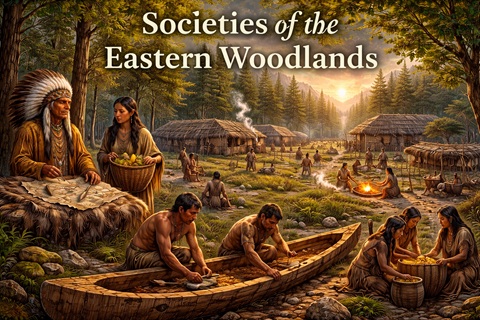
The Eastern Woodlands region of North America was home to many Indigenous societies that developed complex cultures adapted to forests, rivers, and seasonal changes. Stretching from the Atlantic Ocean to the Mississippi River, this region provided abundant natural resources that supported farming, hunting, and trade. In this lesson, students will explore how Eastern Woodlands peoples built villages, organized their societies, and used the environment to thrive.
What You Will Learn
- How geography and natural resources shaped life in the Eastern Woodlands
- The structure and organization of Eastern Woodlands societies
- The importance of farming, trade, and cooperation
Geography and Natural Resources
The Eastern Woodlands region was rich in forests, rivers, and fertile soil. Tall trees such as oak, maple, and hickory provided wood for building homes, tools, and canoes. Rivers and lakes offered fish and served as important transportation routes, connecting different communities.
Because of this environment, Indigenous peoples of the Eastern Woodlands developed a balanced lifestyle that included farming, hunting, and gathering. They grew crops like corn, beans, and squash—often called the “Three Sisters”—which worked together to enrich the soil and provide a steady food supply. This combination of resources allowed communities to settle in one place for longer periods.
Village Life and Social Organization
Eastern Woodlands societies often lived in permanent or semi-permanent villages. Homes varied by region but commonly included longhouses or wigwams made from wooden frames covered with bark or reeds. These structures were well-suited to the climate and could house multiple families.
Social organization was based on family and clan relationships. Many groups were matrilineal, meaning family identity was passed through the mother’s line. Leaders, often called chiefs or sachems, were chosen based on respect and leadership ability rather than force. Councils made important decisions, showing that cooperation and discussion were key parts of governance.
Trade, Cooperation, and Culture
Trade was an important part of life in the Eastern Woodlands. Groups exchanged goods such as furs, tools, pottery, and food with neighboring communities. Rivers and trails made travel and trade easier, helping to spread ideas and cultural practices.
Cooperation also extended to alliances between groups. One well-known example is the Iroquois Confederacy, a союn of nations that worked together for peace and mutual support. Cultural traditions, including storytelling, ceremonies, and seasonal festivals, helped strengthen community bonds and pass down important knowledge from one generation to the next.
Conclusion
The societies of the Eastern Woodlands were shaped by their environment, but they also showed creativity, cooperation, and strong social organization. By developing farming techniques, building lasting communities, and forming alliances, these groups created stable and thriving societies. Understanding their way of life helps us appreciate the diversity and complexity of Indigenous cultures in North America.
Key Terms
- Three Sisters: The three main crops—corn, beans, and squash—grown together by many Indigenous peoples because they support each other’s growth.
- Matrilineal: A system in which family lineage and inheritance are passed through the mother’s side.
Review Questions
- How did the environment of the Eastern Woodlands influence how people lived?
- What role did clans and councils play in these societies?
- Why was trade important to Eastern Woodlands communities?
Think Further
Extension Activity: Build an Eastern Woodlands Village Plan
Objective:
Students will demonstrate their understanding of Eastern Woodlands societies by designing a village that reflects environmental adaptation and social organization.
Instructions:
Students will design a model or drawing of an Eastern Woodlands village. The plan should include homes (longhouses or wigwams), farmland for the Three Sisters, nearby water sources, and common gathering areas. Students will also write a short explanation (1–2 paragraphs) describing how the environment influenced their village design and how the community would function.
From Indigenous North America to European Colonization
Indigenous North America Before 1500
The European Age of Exploration
From Revolution to the Eve of Civil War
The Early Republic
The Jacksonian Era
Westward Expansion
The Late 19th Century
The American Civil War
Reconstruction
The Gilded Age
The Early 20th Century
The Progressive Era
World War I
The Roaring 20s and the Great Depression
Modern America Emerges
World War II
The Cold War
Post Cold War America
Modern America