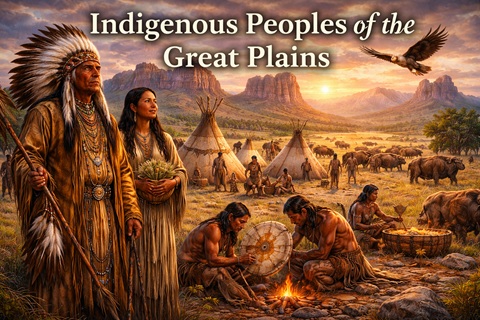
The Great Plains region of North America is a vast area of grasslands stretching from the Mississippi River to the Rocky Mountains. Indigenous peoples of this region developed ways of life that were closely tied to the land, especially the movement of buffalo herds. Over time, these societies adapted to changing conditions, including the introduction of the horse. In this lesson, students will explore how Great Plains peoples lived, organized their communities, and used the resources around them.
What You Will Learn
- How the environment of the Great Plains shaped daily life
- The importance of the buffalo to Plains societies
- How the introduction of the horse transformed Plains cultures
Life on the Grasslands
The Great Plains is a region of wide-open grasslands with few trees and extreme weather, including hot summers and cold winters. Because of this environment, Indigenous peoples needed to be flexible and mobile. Instead of building permanent homes, many groups lived in portable structures called tipis, which could be quickly assembled and taken down as they followed migrating animals.
Survival depended on understanding the land and its patterns. People learned where to find water, how to track animals, and how to use natural resources wisely. This deep knowledge allowed Plains societies to thrive in what might seem like a challenging environment.
The Central Role of the Buffalo
The buffalo (or American bison) was the most important resource for many Great Plains peoples. It provided food, clothing, shelter, and tools. Every part of the animal was used—meat for eating, hides for clothing and tipis, bones for tools, and sinew for sewing.
Buffalo hunts were carefully organized and often involved the entire community. These hunts required skill, cooperation, and planning. The importance of the buffalo was not just practical but also spiritual. Many Plains groups believed the buffalo was a sacred gift and showed respect through ceremonies and rituals.
The Impact of the Horse
The introduction of the horse, brought to North America by Europeans, had a major impact on life in the Great Plains. Horses made travel faster and hunting more efficient, allowing groups to follow buffalo herds over longer distances. This increased mobility changed many aspects of daily life.
With horses, Plains societies could expand their territory, trade more widely, and develop new cultural practices. However, the horse also led to increased competition and conflict between groups over land and resources. Even so, the horse became an important part of Plains culture and identity.
Conclusion
Indigenous peoples of the Great Plains developed a way of life that was closely connected to the land and the animals they depended on. Their mobility, resourcefulness, and strong community cooperation allowed them to thrive in a challenging environment. The importance of the buffalo and the transformative role of the horse highlight how these societies adapted and evolved over time.
Key Terms
- Tipi: A portable, cone-shaped home made from wooden poles and animal hides, used by many Plains peoples.
- Bison (Buffalo): A large animal that was central to the survival and culture of many Great Plains Indigenous groups.
Review Questions
- Why did many Great Plains peoples live in portable homes like tipis?
- How did the buffalo support daily life in the Plains?
- In what ways did the horse change life for Indigenous peoples of the Great Plains?
Think Further
Extension Activity: Design a Plains Survival Guide
Objective:
Students will demonstrate their understanding of Plains life by creating a guide that connects environment, resources, and cultural practices.
Instructions:
Students will create a “survival guide” for someone traveling to the Great Plains during the time of Indigenous societies. The guide should include sections on shelter, food, transportation, and community life. Students should explain how each part of the guide reflects the environment and resources of the Plains.
From Indigenous North America to European Colonization
Indigenous North America Before 1500
The European Age of Exploration
From Revolution to the Eve of Civil War
The Early Republic
The Jacksonian Era
Westward Expansion
The Late 19th Century
The American Civil War
Reconstruction
The Gilded Age
The Early 20th Century
The Progressive Era
World War I
The Roaring 20s and the Great Depression
Modern America Emerges
World War II
The Cold War
Post Cold War America
Modern America