
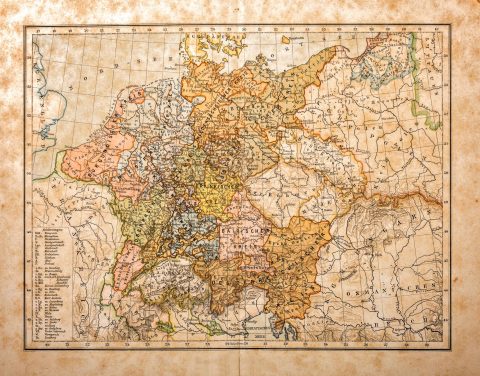
1618: A Window Opens, a Continent Slides Toward War

The war begins not with armies, but with an argument over rights. In Prague, Protestant nobles fear that the Catholic Habsburg ruler of Bohemia intends to roll back the religious freedoms guaranteed to them. Their response is dramatic and symbolic: two imperial officials are thrown from a castle window. They survive the fall, but the political order does not.
At this moment, the conflict is still narrow. It is a Bohemian revolt, rooted in religion and local autonomy. Few imagine that it will consume Europe for a generation.
1619–1620: Rebellion Meets Empire
When Ferdinand II becomes Holy Roman Emperor, compromise vanishes. He is determined to restore Catholic unity and imperial authority. Bohemian rebels elect their own Protestant king, openly defying the emperor.
The showdown comes in 1620 at the Battle of White Mountain. Imperial forces crush the rebels in a single, decisive engagement. Executions, exiles, and forced conversions follow. Bohemia is transformed almost overnight from a religiously plural society into a Catholic stronghold.
The revolt is over—but the war has only begun.
1621–1629: Victory Without Restraint
Flush with success, the Habsburgs push outward. What might have ended as a contained rebellion becomes a campaign to reshape the Holy Roman Empire itself. Protestant territories are pressured, occupied, or coerced.
Denmark’s king intervenes in the mid-1620s, hoping to protect Protestant interests in northern Germany. He fails. Imperial armies, now professionalized and increasingly autonomous under commanders like Wallenstein, defeat him decisively.
In 1629, Emperor Ferdinand II issues the Edict of Restitution, ordering the return of vast amounts of church land to Catholic control. This is the war’s first great miscalculation. By attempting to reverse nearly a century of religious compromise, the emperor alarms not only Protestants but Catholic princes who fear unchecked imperial power.
1630–1632: The War Is Reborn
Into this moment steps Sweden. Its king, Gustavus Adolphus, lands in northern Germany in 1630, bringing with him a disciplined army and a vision of Protestant survival. The following year, at Breitenfeld, Swedish forces smash an imperial army and shatter the aura of Habsburg invincibility.
For the first time since 1620, Protestant states believe they can win. Cities change sides. Alliances multiply. The war expands geographically and intensifies in scale.
Then, in 1632, Gustavus Adolphus is killed at the Battle of Lützen. His army wins the field, but the movement loses its architect. The war continues, but without the clarity of leadership that had briefly given it purpose.
1633–1634: Momentum Breaks
The Protestant coalition begins to fracture. Imperial and Spanish forces regroup and strike back. At Nördlingen in 1634, Swedish and allied armies suffer a devastating defeat. Southern Germany slips from their control.
This moment marks the end of the war as a contest between German religious factions. What follows will be something darker and far more destructive.
1635: Religion Steps Aside
In 1635, Catholic France enters the war against the Catholic Habsburgs. The decision is openly cynical—and openly modern. Cardinal Richelieu, France’s chief minister, cares less about doctrine than about preventing Habsburg encirclement.
From this point on, religion becomes a language rather than a cause. Alliances are built on state interest. Armies march not to defend faith but to weaken rivals.
The Thirty Years’ War becomes a European war.
1635–1643: A War Without Direction
The conflict drags on, increasingly brutal and increasingly pointless. Armies sustain themselves by plunder. Villages vanish. Entire regions of Germany lose a third—or more—of their population to famine, disease, and violence.
Victories occur, but none are decisive. In 1643, France defeats Spain at Rocroi, signaling the decline of Spanish military dominance. Yet the war does not end. By now, no participant can afford victory—and none can afford defeat.
1644–1648: Negotiating Amid Ruins
Peace talks begin years before peace is achieved. Delegations gather in Münster and Osnabrück while fighting continues elsewhere. Diplomacy becomes as complex as the war itself, involving dozens of states, cities, and princes.
What is being negotiated is no longer simply an end to violence, but a new political order—one in which rulers, not empires or churches, define authority.
1648: The World After the War
The Peace of Westphalia ends the conflict formally. The Holy Roman Empire survives, but as a weakened shell. German princes gain the right to conduct their own foreign policy. Catholicism, Lutheranism, and Calvinism are legally recognized.
The deeper legacy is conceptual. Sovereignty replaces religious unity. Diplomacy replaces crusade. Europe emerges from the war scarred, exhausted, and fundamentally changed.
The Thirty Years’ War ends not because its problems are solved, but because Europeans can no longer afford to believe that war can solve them.