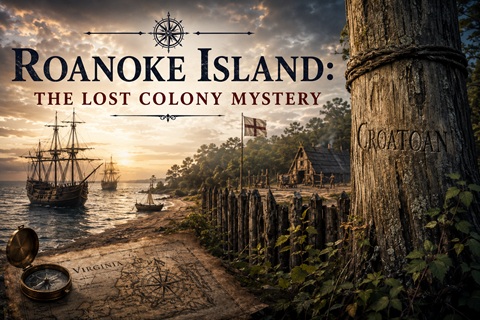
In the late 1500s, England attempted to establish one of its first colonies in North America on Roanoke Island. Led by Sir Walter Raleigh and governed by John White, the settlement mysteriously disappeared. When White returned after a supply trip to England, he found the colony abandoned with only a single clue: the word “CROATOAN.” The mystery of what happened to the settlers has puzzled historians for centuries.
What You Will Learn
- What the Roanoke Colony was and why it was created
- What happened when the colony disappeared
- The theories behind the Lost Colony mystery
The First English Colony Attempts
During the Age of Exploration, England wanted to establish colonies in North America to compete with Spain. Sir Walter Raleigh was given permission by Queen Elizabeth I to create a settlement. Roanoke Island, located off the coast of present-day North Carolina, was chosen as the site.
In 1587, a group of settlers arrived and began building a colony under the leadership of John White. Life was difficult, and the settlers depended on supplies from England. Soon after arriving, White returned to England to gather more supplies for the struggling colony.
The Disappearance
John White’s return to Roanoke was delayed by several years due to war between England and Spain. When he finally came back in 1590, he found the settlement completely empty. There were no signs of a struggle or battle, but all the settlers had vanished.
The only clue left behind was the word “CROATOAN” carved into a wooden post. This may have referred to a nearby island or a Native American group. However, no clear evidence was ever found to explain what happened to the colonists.
Theories and Lasting Mystery
Historians have developed several theories about the fate of the Roanoke settlers. One idea is that they joined nearby Indigenous groups and were absorbed into their communities. Another theory suggests they may have moved to a different location in search of better resources.
There are also more dramatic possibilities, such as conflict, disease, or starvation. Despite many investigations, the mystery has never been fully solved. The Lost Colony of Roanoke remains one of the most famous unsolved mysteries in American history.
Conclusion
The story of Roanoke Island is both fascinating and mysterious. It represents one of England’s earliest attempts at colonization and highlights the challenges settlers faced in the New World. Although we may never know exactly what happened, the Lost Colony continues to capture the imagination and reminds us of the risks and uncertainties of early exploration.
Key Terms
- Colony: A settlement established by people from another country.
- Mystery: Something that is difficult or impossible to explain or understand.
Review Questions
- Why did England want to establish a colony at Roanoke?
- What did John White find when he returned to the colony?
- What are some theories about what happened to the settlers?
Extension Activity
Project: Solve the Mystery
Students will act as historians trying to explain what happened to the Lost Colony.
Instructions:
- Choose one theory about the disappearance of the Roanoke settlers.
- Write a short explanation (1–2 paragraphs) supporting your theory using evidence from the lesson.
- Create a simple illustration or map to support your idea.
- Optional: Present your theory to the class and compare ideas with others.
Goal:
To encourage critical thinking and evidence-based reasoning while exploring a historical mystery.
From Indigenous North America to European Colonization
Indigenous North America Before 1500
The European Age of Exploration
From Revolution to the Eve of Civil War
The Early Republic
The Jacksonian Era
Westward Expansion
The Late 19th Century
The American Civil War
Reconstruction
The Gilded Age
The Early 20th Century
The Progressive Era
World War I
The Roaring 20s and the Great Depression
Modern America Emerges
World War II
The Cold War
Post Cold War America
Modern America