Overview
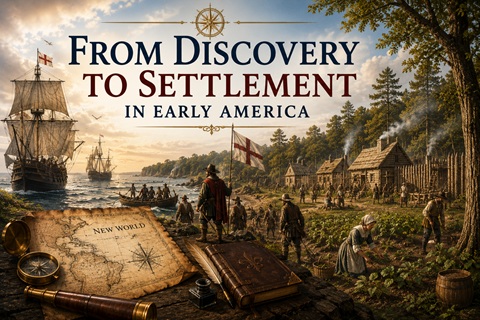
The period from European discovery to permanent settlement in the Americas marked a major turning point in history. Beginning with voyages like those of Christopher Columbus, European nations explored, claimed land, and eventually established colonies. Over time, these efforts shifted from exploration to settlement, as people built communities and created new societies. This transition brought opportunity for some, but also conflict and hardship for Indigenous peoples.
What You Will Learn
- How exploration led to permanent settlement in the Americas
- Why European nations established colonies
- The effects of settlement on different groups of people
The Age of Discovery Begins
European exploration began in the late 1400s, driven by the search for new trade routes and valuable resources. Explorers like Christopher Columbus reached the Americas and opened the door for further exploration. Soon, other nations followed, sending their own expeditions to claim land and seek wealth.
At first, these voyages focused mainly on discovery rather than settlement. Explorers mapped coastlines, gathered information, and returned home with news of new lands. However, as interest grew, countries began to see the potential for establishing permanent colonies.
Why Colonies Were Established
European nations had several reasons for creating colonies in the Americas. Economic opportunities were a major factor. Colonies could provide valuable resources like gold, silver, and crops, as well as new markets for trade.
There were also social and political reasons. Some people sought religious freedom or a chance for a better life. Governments wanted to expand their power and compete with rival nations. These motivations led to the creation of settlements where people lived, worked, and built new communities.
Challenges of Early Settlement
Early colonies faced many difficulties. Settlers often struggled with harsh climates, unfamiliar land, and limited supplies. Some colonies, like the one at Roanoke, failed completely. Others survived only after years of hardship and learning.
The arrival of Europeans also had a major impact on Indigenous peoples. Many suffered from diseases brought by Europeans, as well as conflict and loss of land. Despite these challenges, successful colonies eventually grew and became an important part of the developing New World.
Conclusion
The transition from discovery to settlement in early America was a complex and important process. It involved exploration, risk-taking, and the building of new communities. While it created new opportunities and shaped the future of nations, it also brought serious challenges and lasting consequences. Understanding this period helps us better understand the history of the Americas.
Key Terms
- Settlement: A place where people establish a community.
- Colony: A settlement in a new land established by people from another country.
Review Questions
- How did exploration lead to settlement in the Americas?
- What were the main reasons European nations established colonies?
- What challenges did early settlers face?
Extension Activity
Project: Build a Timeline of Exploration to Settlement
Students will create a timeline showing the transition from discovery to settlement.
Instructions:
- Include key events such as Columbus’s voyage, early exploration, and the establishment of colonies.
- Add short descriptions for each event.
- Include drawings or symbols to represent important moments.
- Write a brief paragraph explaining how these events are connected.
Goal:
To help students understand the sequence of events and how exploration led to permanent settlement in the Americas.
From Indigenous North America to European Colonization
Indigenous North America Before 1500
The European Age of Exploration
From Revolution to the Eve of Civil War
The Early Republic
The Jacksonian Era
Westward Expansion
The Late 19th Century
The American Civil War
Reconstruction
The Gilded Age
The Early 20th Century
The Progressive Era
World War I
The Roaring 20s and the Great Depression
Modern America Emerges
World War II
The Cold War
Post Cold War America
Modern America