William Penn, the Quakers, and a Different Kind of Colony
In the 1600s, most colonies in North America were shaped by strict rules, powerful leaders, and limited freedom for those who disagreed. But one colony was different. Pennsylvania, founded by William Penn, was created as a place where people could live peacefully, practice their religion freely, and be treated fairly.
William Penn called his colony a “Holy Experiment.” He wanted to prove that a society based on fairness, cooperation, and religious tolerance could succeed.
For young people learning about colonial America, Pennsylvania offers an important example of how ideas—especially ideas about freedom and equality—can shape a community in powerful ways.
Who Was William Penn?
A Different Kind of Leader
William Penn was born in England in 1644. His father was a wealthy and important admiral in the English navy. Because of his family’s status, Penn had access to a good education and a comfortable life.
However, Penn chose a very different path.
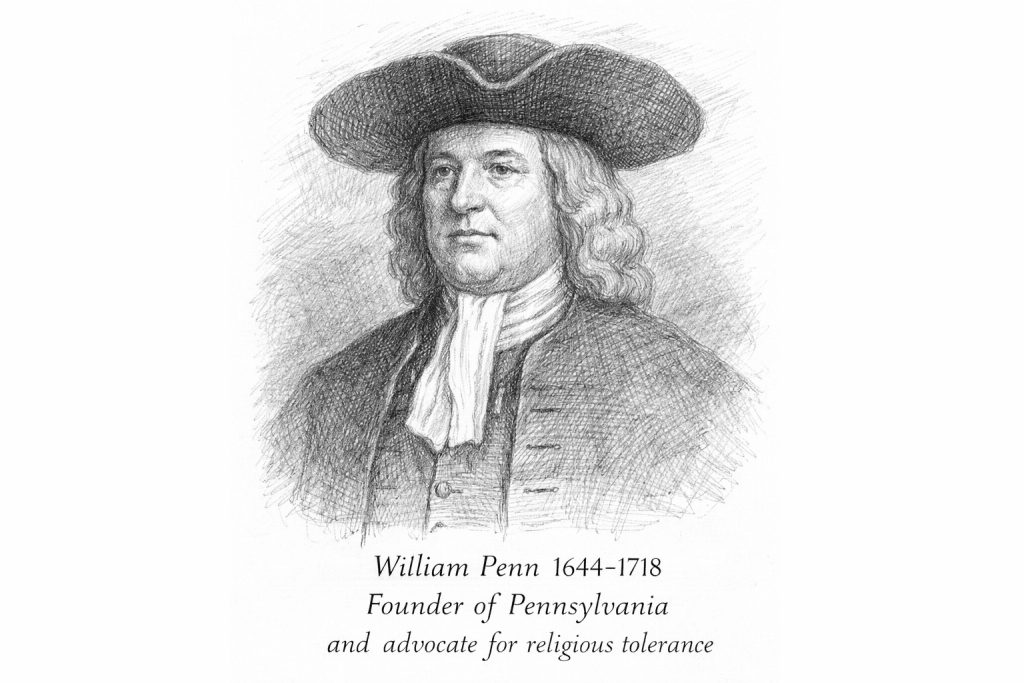
As a young man, he became interested in a religious group known as the Quakers. This decision would change his life—and eventually lead to the founding of Pennsylvania.
The Quakers: Beliefs and Challenges
What Did the Quakers Believe?
The Quakers, also known as the Society of Friends, had beliefs that were very different from most people in England at the time.
They believed that:
- Every person has an “inner light,” or a direct connection to God
- People do not need priests or churches to communicate with God
- All people are equal in the eyes of God
- Violence is wrong (they were pacifists)
- Honesty and simplicity are important
Quakers did not follow many traditional customs. For example, they refused to bow to nobles or remove their hats to show respect, because they believed all people were equal.
Why Were They Persecuted?
Because their beliefs challenged authority, Quakers were often punished in England:
- They were fined or imprisoned
- Their meetings were broken up
- They were seen as troublemakers
Even in some American colonies, such as Massachusetts, Quakers were not welcome.
William Penn himself was arrested several times for his beliefs.
The Idea of a New Colony
A Chance to Start Fresh
William Penn began to dream of a place where Quakers—and others—could live freely without fear of punishment.
In 1681, he was given the opportunity to make that dream a reality.
The King of England owed Penn’s father money. Instead of paying the debt in cash, the king granted William Penn a large piece of land in North America.
Penn named this land Pennsylvania, which means “Penn’s Woods.”
The “Holy Experiment”
What Did Penn Want to Prove?
William Penn did not just want to start another colony. He wanted to test an idea.
His “Holy Experiment” was based on several key principles:
- Religious freedom
People should be able to practice their faith without interference. - Fair government
Laws should be made with the consent of the people. - Peaceful relations
Colonists should treat Native Americans fairly. - Equality and justice
Society should be more fair and less based on strict class differences.
Penn believed that if people were treated fairly and given freedom, they would create a peaceful and successful community.
Founding Pennsylvania
Planning the Colony
Penn carefully planned his colony. He wanted it to be organized and fair.
He designed the city of Philadelphia with:
- Wide streets
- Public squares
- Room for growth
Philadelphia means “City of Brotherly Love,” which reflected Penn’s vision.
Encouraging Settlement
Penn invited people from many different countries and religions to settle in Pennsylvania.
He advertised the colony in Europe, promising:
- Religious freedom
- Cheap land
- Opportunities for a better life
Many people accepted his offer.
A Diverse Population
Who Came to Pennsylvania?
Pennsylvania quickly became one of the most diverse colonies in North America.
Settlers included:
- Quakers from England
- Germans (often called Pennsylvania Dutch, though they were actually German)
- Scots-Irish settlers
- Other European groups
Each group brought its own language, customs, and traditions.
Religious Tolerance
One of the most important features of Pennsylvania was its religious tolerance.
Unlike many other colonies:
- People were not forced to join a specific church
- Different religious groups could live side by side
- There was less conflict over beliefs
This made Pennsylvania a welcoming place for many who had faced persecution elsewhere.
Government in Pennsylvania
A Fairer System
William Penn believed that government should serve the people.
He created a system that included:
- An elected assembly
- Laws that protected basic rights
- Opportunities for landowners to have a voice
While not everyone had equal power (for example, women and non-landowners had limited rights), Pennsylvania was more democratic than many other colonies at the time.
Freedom of Speech and Religion
Pennsylvania allowed people to:
- Speak their opinions more freely
- Practice their religion without fear
These ideas would later become important parts of American democracy.
Fair Treatment of Native Americans
A Different Approach
One of the most remarkable parts of Penn’s “Holy Experiment” was his approach to Native Americans.
Unlike many other colonists, Penn believed that Native Americans should be treated fairly.
Land Agreements
Instead of simply taking land, Penn:
- Negotiated treaties
- Paid Native Americans for their land
- Tried to build peaceful relationships
One famous example is the treaty with the Lenape (Delaware) people.
Respect and Cooperation
Penn encouraged colonists to:
- Respect Native American rights
- Trade fairly
- Avoid violence
As a result, Pennsylvania experienced fewer conflicts with Native Americans—at least during Penn’s lifetime—than many other colonies.
Important Note
While Penn’s approach was more peaceful than others, it is still important to understand that:
- European settlement eventually led to the loss of Native American land
- Not all colonists followed Penn’s example
- Conflicts increased after Penn’s time
Even so, Penn’s efforts stand out as an early attempt at fairness.
Life in Pennsylvania
Farming and Trade
Pennsylvania had fertile soil and a good climate for farming.
Farmers grew crops such as:
- Wheat
- Corn
- Barley
Because of its large grain production, Pennsylvania became known as one of the “bread colonies.”
Trade and Cities
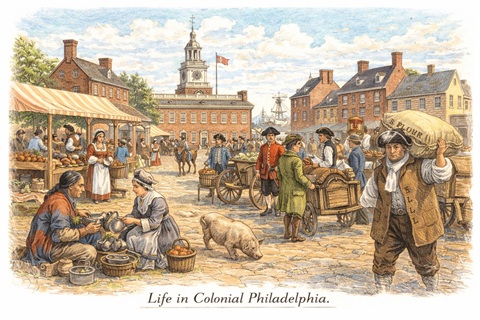
Philadelphia quickly grew into one of the largest cities in the colonies.
It became a center for:
- Trade
- Shipping
- Crafts and businesses
Its location along a river made it easy to transport goods.
The Influence of Quaker Values
Peace and Cooperation
Quaker beliefs influenced daily life in Pennsylvania:
- People tried to resolve conflicts peacefully
- Violence was discouraged
- Cooperation was valued
Equality
Quakers believed that all people were equal in the eyes of God. This led to:
- More respectful treatment of others
- Greater roles for women compared to other colonies
- Early ideas about fairness and justice
Simplicity
Quakers valued simple living. They avoided:
- Fancy clothing
- Extravagant displays of wealth
This created a culture focused more on character than appearance.
Challenges and Limitations
Not a Perfect Colony
While Pennsylvania was more tolerant than many colonies, it was not perfect.
Some challenges included:
- Differences between cultural groups
- Disagreements over land and government
- Tensions that grew after Penn’s leadership
Changes Over Time
After William Penn’s death, some of his ideals became harder to maintain.
Conflicts with Native Americans increased, and the colony became more like others in some ways.
Still, the foundation he created had a lasting impact.
Why Pennsylvania Matters
A Model for Freedom
Pennsylvania showed that a colony could succeed without strict control over religion.
It became an example of how:
- Different groups could live together
- Freedom could lead to growth and success
- Fairness could reduce conflict
Influence on the Future
Many of the ideas tested in Pennsylvania later became part of the United States, including:
- Religious freedom
- Representative government
- Respect for individual rights
William Penn’s “Holy Experiment” helped shape the future of American society.
Comparing Pennsylvania to Other Colonies
Massachusetts
- Very strict religious rules
- Limited tolerance for dissent
- Strong connection between church and government
Virginia
- Focused on farming and profit
- Less emphasis on religious ideas
- Plantation system
Pennsylvania
- Religious freedom
- Diverse population
- Fairer treatment of Native Americans (especially early on)
- More democratic government
This comparison shows how Pennsylvania stood out.
Conclusion
William Penn’s “Holy Experiment” was a bold attempt to create a better kind of society.
He believed that people could live together peacefully if they were given freedom, treated fairly, and allowed to follow their own beliefs. Through Pennsylvania, he tried to prove that these ideas could work in real life.
The colony he founded became a place of diversity, opportunity, and relative tolerance. It attracted people from many backgrounds and allowed them to build a community based on cooperation rather than control.
Although Pennsylvania was not perfect, it offered something new—a vision of a society where fairness and freedom mattered.
For students studying history, this story is an important reminder: ideas can shape the world. And sometimes, one person’s vision—like William Penn’s—can help create lasting change that influences generations to come.
