When people think about early American history, they often imagine small farms, busy ports, and groups of people trying to build new lives in an unfamiliar land. Nowhere was this more true than in the Middle Colonies. Located between the New England Colonies to the north and the Southern Colonies to the south, the Middle Colonies included New York, Pennsylvania, New Jersey, and Delaware. These colonies became known for their rich farmland, growing cities, and a remarkable mix of people, cultures, and beliefs.
Life in the Middle Colonies was different from life in other regions of colonial America. The climate was moderate—not too cold, not too hot. The land was fertile, meaning crops grew well. Rivers and ports made trade easier. Most importantly, people from many different countries and backgrounds lived side by side, bringing their traditions with them. Because of these features, the Middle Colonies played an important role in shaping early American society.
Farming in the Middle Colonies
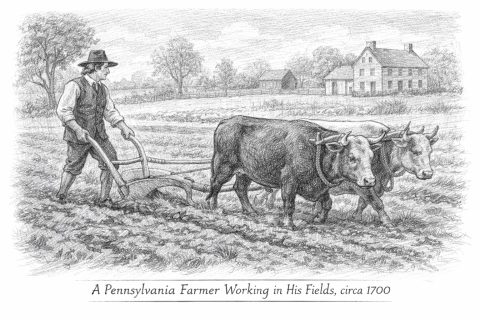
Farming was the backbone of life in the Middle Colonies. Most families lived on farms, and their daily lives were shaped by the work of planting, growing, and harvesting crops.
The land in the Middle Colonies was some of the best in North America. The soil was rich and full of nutrients, making it perfect for growing crops. The climate also helped. Winters were cold enough to kill harmful pests, while summers were warm and long enough for crops to grow. There was also enough rainfall to support farming without the need for complicated irrigation systems.
Farmers in the Middle Colonies grew a wide variety of crops. The most important were grains such as wheat, barley, rye, and oats. Wheat was especially important because it could be ground into flour and used to make bread. Corn was also grown and used both for food and for feeding animals.
Unlike in the Southern Colonies, where large plantations grew a single crop like tobacco or rice, most farms in the Middle Colonies were smaller and more diverse. Farmers often grew several types of crops at once. This made their farms more stable. If one crop failed, they could still rely on others.
Many farms were family-run. Parents and children worked together in the fields. Daily tasks included planting seeds, tending crops, feeding animals, repairing tools, and harvesting grain. Work was hard, but it was also necessary for survival.
Farmers often produced more food than their families needed. This extra food, called surplus, could be sold or traded. This helped farmers earn money and connect with nearby towns and cities.
Why They Were Called the “Breadbasket Colonies”
The Middle Colonies earned the nickname “the breadbasket colonies” because they produced so much grain, especially wheat. The term “breadbasket” means a place that produces large amounts of food, especially grain used to make bread.
The rich soil and favorable climate made it easy for farmers to grow wheat in large quantities. Once harvested, wheat was taken to mills, where it was ground into flour. This flour was then shipped to other colonies and even to Europe.
The Middle Colonies did not just feed themselves. They helped feed other parts of the colonial world. New England, for example, did not have as much farmland, so it relied on imported grain. The Middle Colonies filled this need.
Because of their large food production, the Middle Colonies became an important part of the colonial economy. Farmers were not just growing food for their families—they were part of a larger system of trade and commerce.
Being the “breadbasket” also meant stability. While other regions sometimes struggled with crop failures or relied heavily on one type of crop, the Middle Colonies had a steady and reliable food supply. This helped them grow and prosper.
Trade and Economic Life
Trade was another key part of life in the Middle Colonies. Thanks to their location and natural resources, these colonies became centers of business and exchange.
Rivers like the Hudson and Delaware made it easy to transport goods. Farmers could load their grain onto boats and send it to cities or ports. From there, goods could be shipped to other colonies or across the Atlantic Ocean.
Trade in the Middle Colonies was not limited to grain. People also traded livestock, lumber, furs, and handmade goods. Skilled workers, called artisans, made items such as tools, furniture, and clothing. These goods were sold locally or traded with other regions.
Markets and trading posts were common. Farmers and merchants would gather to buy and sell goods. This helped create a strong local economy.
The Middle Colonies were also part of a larger trade network known as the Atlantic trade system. Goods moved between the American colonies, Europe, Africa, and the Caribbean. For example, flour and grain from the Middle Colonies might be shipped to the Caribbean, while sugar or molasses might be sent back.
Money was not always used in trade. Sometimes people exchanged goods directly, a system known as barter. For example, a farmer might trade wheat for tools or cloth.
Trade brought wealth to the Middle Colonies, but it also connected them to the wider world. Ideas, cultures, and news traveled along the same routes as goods.
Cities and Urban Life
While many people lived on farms, cities were growing quickly in the Middle Colonies. These cities became centers of trade, culture, and government.
One of the most important cities was Philadelphia. Founded in Pennsylvania, Philadelphia quickly grew into one of the largest and most important cities in colonial America. Its location along the Delaware River made it a perfect place for trade.
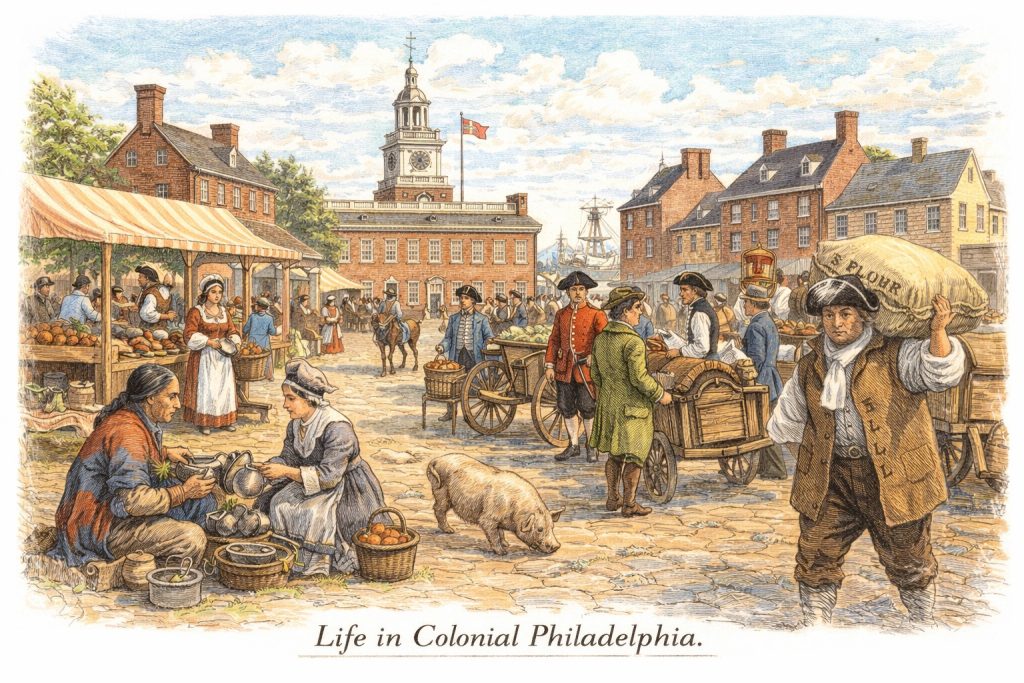
Philadelphia was known for its orderly streets, busy markets, and active port. Ships arrived carrying goods from Europe and other colonies. Merchants bought and sold goods, while workers unloaded cargo and prepared shipments.
Cities like Philadelphia offered opportunities that were not available in rural areas. People could find jobs as merchants, shopkeepers, craftsmen, or dockworkers. There were also schools, churches, and meeting places.
Another important city was New York. Located on a natural harbor, New York became a major center for trade. Like Philadelphia, it attracted people from many different backgrounds.
City life was very different from farm life. Instead of working in fields, people worked in shops, offices, and ports. Streets were busy, and people lived close together. There was more access to goods, services, and information.
However, city life also had challenges. Crowded conditions could lead to disease. There was also a gap between rich and poor. Wealthy merchants lived in large homes, while poorer workers lived in small, crowded spaces.
Despite these challenges, cities in the Middle Colonies continued to grow and play an important role in colonial life.
Diversity of People and Beliefs
One of the most unique features of the Middle Colonies was their diversity. People from many different countries and cultures settled in this region, creating a mix of languages, customs, and beliefs.
Unlike some other colonies that were founded by a single group, the Middle Colonies attracted a wide variety of settlers. These included people from England, the Netherlands, Germany, Scotland, Ireland, and Sweden. Each group brought its own traditions.
For example, Dutch settlers influenced life in New York, which was originally called New Amsterdam. German settlers brought farming skills and traditions to Pennsylvania. Swedish settlers contributed to early communities along the Delaware River.
This diversity was also seen in religion. Many people came to the Middle Colonies seeking religious freedom. This meant they wanted the ability to practice their own beliefs without interference.
In Pennsylvania, this idea was especially strong. The colony was founded with the goal of allowing people of different religions to live peacefully together. Quakers, Lutherans, Catholics, Jews, and others all lived in the region.
Because of this mix, the Middle Colonies became more tolerant than other regions. While disagreements still happened, there was generally more acceptance of different beliefs.
Diversity also influenced daily life. People ate different foods, spoke different languages, and celebrated different traditions. This created a rich cultural environment.
However, diversity also brought challenges. Communication could be difficult when people spoke different languages. There were also differences in customs and beliefs that sometimes led to misunderstandings.
Even so, the ability of so many different groups to live together made the Middle Colonies unique and helped shape the future of America.
Daily Life and Community
Life in the Middle Colonies was not just about farming, trade, and cities. It was also about family, community, and daily routines.
Families were at the center of life. Most households included parents and children, and sometimes extended family members. Everyone had a role to play. Men often worked in fields or trades, while women managed households, cooked, made clothing, and helped with farm work. Children helped with chores and learned skills they would need as adults.
Education was important, especially in towns and cities. Schools were more common in the Middle Colonies than in some other regions. Children learned to read, write, and do basic math. Education was often connected to religion, but practical skills were also valued.
Religion played an important role in daily life. People attended church services, which were also social events. Churches helped bring communities together.
Neighbors often helped each other. If a family needed help building a barn or harvesting crops, others would pitch in. This sense of cooperation made life easier and strengthened communities.
There were also forms of entertainment. People gathered for festivals, markets, and social events. Music, storytelling, and games were common ways to relax after work.
The Importance of the Middle Colonies
The Middle Colonies played a key role in the development of colonial America. Their farms provided food, their cities supported trade, and their diversity helped shape a more open and flexible society.
Because they produced so much grain, they helped feed not only their own people but also other colonies and countries. Their trade networks connected them to the wider world. Their cities became centers of growth and opportunity.
Perhaps most importantly, the Middle Colonies showed that people from different backgrounds could live and work together. This idea would later become an important part of American identity.
Conclusion
Life in the Middle Colonies was shaped by rich farmland, active trade, growing cities, and a diverse population. Farmers worked hard to produce crops that fed many people, earning the region the name “breadbasket colonies.” Trade connected communities and brought wealth, while cities like Philadelphia became centers of activity and opportunity.
The diversity of people and beliefs made the Middle Colonies unique. People from many different backgrounds lived together, bringing their cultures and traditions with them. This created both challenges and opportunities, but it also helped build a more tolerant society.
For middle school students studying this time period, the Middle Colonies offer an important lesson: when people work together, share resources, and respect differences, they can build strong and successful communities. The story of the Middle Colonies is not just about the past—it is also about the values that continue to shape the world today.
