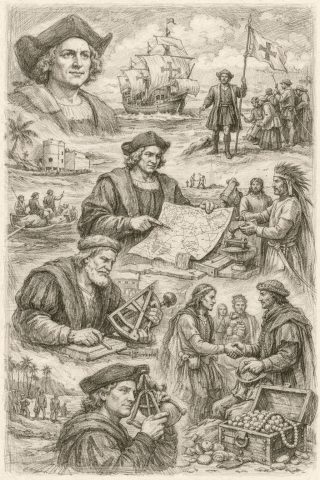
A World Ready for Exploration
By the late 1400s, Europe was changing. New ideas, new technologies, and new ambitions were shaping the way people thought about the world. For centuries, European traders had relied on long land routes to reach Asia. These routes brought valuable goods like spices, silk, and precious metals—but they were slow, expensive, and often dangerous.
At the same time, explorers from Portugal had been sailing along the coast of Africa, searching for a sea route to Asia. Their efforts showed that ocean travel was possible, and they inspired others to think big.
One of those dreamers was Christopher Columbus.
Columbus believed he could reach Asia by sailing west across the Atlantic Ocean. This idea would lead to one of the most important—and controversial—journeys in history.
Who Was Christopher Columbus?
Christopher Columbus was born in 1451 in the city of Genoa, in what is now Italy. As a young man, he worked on ships and learned about navigation, trade, and the sea.
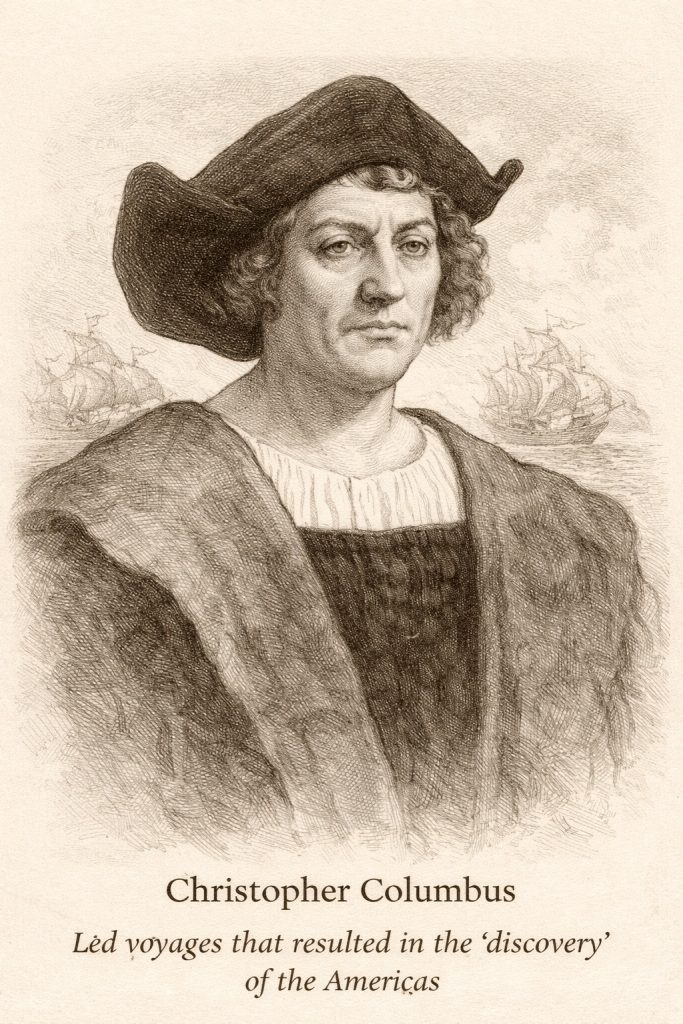
Columbus became fascinated with maps and geography. He studied the writings of earlier scholars who suggested that the Earth was round. This was not a new idea—educated people in Europe already knew the Earth was a sphere—but Columbus had a different plan.
He believed that Asia could be reached quickly by sailing west.
However, Columbus made a major mistake.
He underestimated the size of the Earth and overestimated how far Asia extended eastward. Because of this, he believed the journey across the Atlantic would be much shorter than it actually was.
In reality, there were two huge continents—North America and South America—standing in the way. But Columbus did not know that.
Searching for Support
Columbus needed ships, supplies, and money to carry out his plan. This meant he needed the support of a powerful ruler.
At first, he asked the king of Portugal for help. The Portuguese, however, were focused on their own exploration around Africa and rejected his proposal.
Columbus did not give up.
He turned to Spain.
Spanish Sponsorship
At this time, Spain had just completed an important chapter in its history. In 1492, Spanish rulers King Ferdinand II and Queen Isabella I had finished a long struggle to take control of their country. They were now ready to look outward.
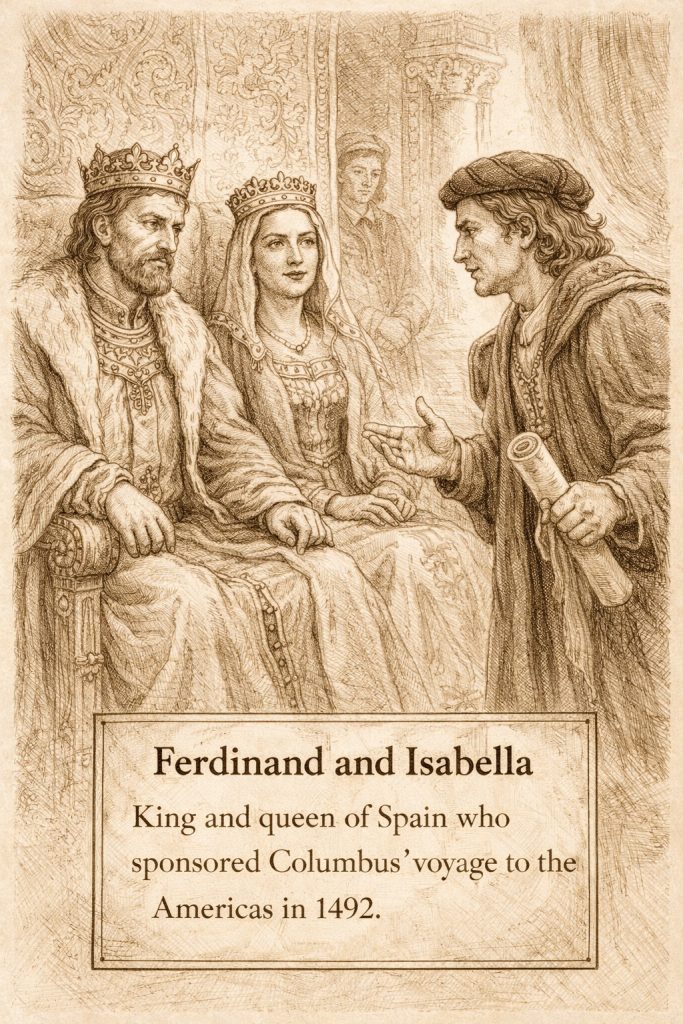
Columbus presented his plan to them:
- Sail west across the Atlantic
- Reach Asia
- Open new trade routes
At first, the Spanish rulers were unsure. Columbus’s plan seemed risky. But after careful consideration, they agreed to support him.
This decision would change the world.
Spain provided:
- Three ships
- A crew of about 90 men
- Supplies for the journey
In return, Columbus was promised wealth, titles, and a share of any riches he discovered.
The Voyage of 1492
In August 1492, Columbus set sail from Spain with three ships:
- The Niña
- The Pinta
- The Santa María
They crossed the Atlantic Ocean, heading into waters that few Europeans had ever explored.
At first, the voyage went smoothly. But as the weeks passed, the crew grew anxious.
They had no idea how far they would have to travel. Some sailors feared they would never return home.
Columbus, however, remained determined.
Land at Last
On October 12, 1492, after more than two months at sea, a sailor spotted land.
The ships had reached an island in the Caribbean, part of what we now call the Bahamas.
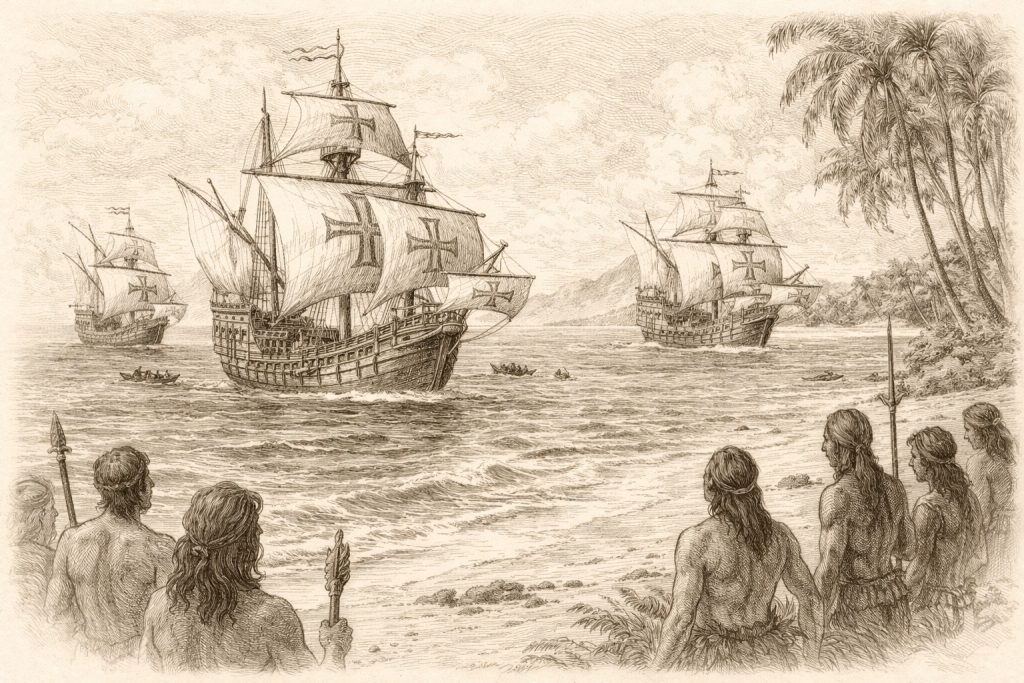
Columbus believed he had reached islands near Asia. He called the people he met “Indians,” because he thought he was in the Indies (a term used for parts of Asia).
In reality, he had arrived in a part of the world that was completely unknown to Europeans at the time.
First Encounters
The people Columbus encountered were part of the Taíno culture. They lived on the islands of the Caribbean and had their own traditions, languages, and ways of life.
Columbus described them as friendly and welcoming. At first, the interactions between the two groups were peaceful.
However, these encounters would eventually lead to serious consequences.
Columbus was interested in:
- Finding gold
- Claiming land for Spain
- Establishing trade
He explored several islands and took note of their resources.
A Misunderstanding of Geography
One of the most important things to understand about Columbus is this:
He never realized he had discovered a new continent.
Columbus believed until the end of his life that he had reached Asia.
Because of his miscalculations:
- He thought the Earth was smaller than it really is
- He believed Asia was closer to Europe than it actually is
This misunderstanding shaped everything he did.
Even as he made additional voyages, Columbus continued to search for:
- Cities of gold
- Trade routes to Asia
But he was exploring lands that were entirely new to Europeans.
Columbus’s Later Voyages
After his first journey, Columbus returned to Spain as a hero. He had found new lands and claimed them for the Spanish crown.
He would go on to make four voyages across the Atlantic.
During these voyages, he:
- Explored more of the Caribbean
- Established settlements
- Continued searching for wealth
However, things did not go as smoothly as before.
There were conflicts between:
- Spanish settlers
- Indigenous peoples
There were also disagreements among the Spanish themselves.
Eventually, Columbus lost favor with the Spanish rulers. Despite his achievements, he died in 1506 without fully understanding the importance of what he had done.
The Columbian Exchange
One of the most important results of Columbus’s voyages was something historians call the Columbian Exchange.
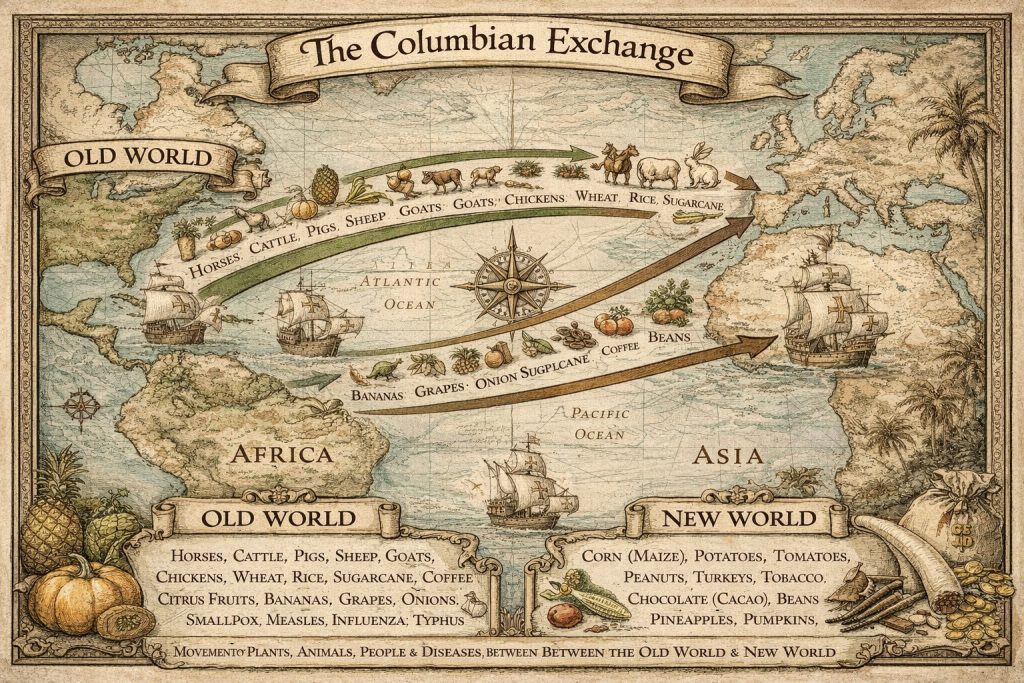
This term refers to the movement of plants, animals, people, and ideas between the Old World (Europe, Africa, and Asia) and the New World (the Americas).
This exchange changed life on both sides of the Atlantic.
What Moved from the Old World to the New World?
From Europe, Africa, and Asia came:
- Horses
- Cattle
- Wheat
- Sugar
- Diseases like smallpox
These changes had a major impact on the Americas.
For example:
- Horses transformed transportation and hunting for some Native American groups
- New crops changed diets
However, diseases had devastating effects. Indigenous populations had no immunity to illnesses like smallpox, which led to large numbers of deaths.
What Moved from the New World to the Old World?
From the Americas came:
- Corn (maize)
- Potatoes
- Tomatoes
- Chocolate (cacao)
- Tobacco
These foods became very important in Europe and around the world.
For example:
- Potatoes became a staple food in many European countries
- Corn spread across Africa and Asia
The Columbian Exchange reshaped global diets and economies.
A Connected World
Before Columbus, the continents were mostly separate in terms of trade and communication.
After his voyages, the world became more connected than ever before.
This led to:
- Increased trade
- Cultural exchanges
- The spread of ideas and technologies
However, it also led to:
- Colonization
- Conflict
- The forced movement of people, including the transatlantic slave trade
The Impact on Indigenous Peoples
It is important to understand that Columbus’s voyages had serious consequences for the people who already lived in the Americas.
These included:
- Loss of land
- Exposure to new diseases
- Forced labor
While Columbus is often remembered for his role in exploration, historians today also study the effects his voyages had on Indigenous populations.
This helps us understand history more completely.
Why Columbus’s Voyage Matters
Columbus’s journey is often called the “discovery of the Americas,” but it is important to remember that millions of people were already living there.
What Columbus did was connect two worlds that had been separate for thousands of years.
His voyage:
- Opened the Americas to European exploration
- Began a new era of global interaction
- Changed the course of history
What Made Columbus Different?
Several things set Columbus apart:
1. Determination
He continued to pursue his idea even after being rejected.
2. Bold Thinking
He was willing to try a completely new route.
3. Confidence (and Mistakes)
His incorrect understanding of geography led him to attempt a journey others might have avoided.
A Complicated Legacy
Today, Columbus is a figure who is studied and discussed in many different ways.
Some people focus on:
- His courage and determination
- His role in opening the Atlantic world
Others focus on:
- The harm caused by European colonization
- The suffering of Indigenous peoples
Both perspectives are important.
History is not always simple. It includes both achievements and consequences.
Imagining the Voyage
Imagine being a sailor on Columbus’s ship:
- Weeks at sea with no land in sight
- Limited food and water
- Fear of the unknown
Now imagine the moment when land appears on the horizon.
That moment changed everything.
Conclusion: A Journey That Changed the World
Christopher Columbus set out to find a new route to Asia. Instead, he helped connect two halves of the world that had been separated for thousands of years.
His voyage, supported by Spain, was based on a misunderstanding of geography—but it led to one of the most important turning points in history.
The Columbian Exchange that followed reshaped life across the globe, bringing new foods, animals, and ideas—but also conflict and suffering.
For middle school students studying history, Columbus’s story is a reminder that:
- Big ideas can lead to unexpected results
- Exploration can bring both discovery and change
- Understanding history means looking at all sides of a story
Christopher Columbus did not find what he was looking for.
But in trying, he helped create a new, connected world—one whose effects we still feel today.
