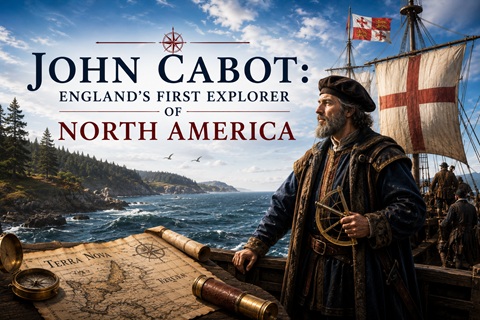
John Cabot: England’s First Explorer of North America

In the late 1400s, European nations were racing to explore the unknown parts of the world. These voyages were not just about curiosity—they were driven by the search for wealth, trade routes, and power. Countries like Spain and Portugal were leading the way, sending ships across the Atlantic Ocean and around Africa. England, however, was just beginning to enter this age of exploration. Its first major step into the New World came through the voyage of a man named John Cabot.

Though not as famous as Christopher Columbus, John Cabot played a crucial role in history. His 1497 voyage across the Atlantic Ocean marked England’s earliest claim to North America. This journey would later help shape the future of English colonization and, eventually, the creation of the United States and Canada. To understand why John Cabot’s voyage was so important, we need to explore who he was, why he sailed, what he discovered, and how his journey changed history.


Who Was John Cabot?

John Cabot was not originally English. He was born in Italy around the year 1450, most likely in the city of Genoa or Venice. His Italian name was Giovanni Caboto. Like many explorers of his time, he grew up near the sea and became familiar with ships, navigation, and trade. Italy was full of merchants and sailors, and Cabot likely spent many years learning how to sail and how to plan long voyages.

Image of explorer John Cabot

Cabot became interested in the idea of finding new routes to Asia. At that time, goods like spices, silk, and precious metals came from places such as China and India. These goods were very valuable in Europe, but they were difficult and expensive to obtain. Traders had to travel long and dangerous routes over land or sail around Africa. Explorers believed that if they could find a direct route across the Atlantic Ocean, they could reach Asia more quickly and cheaply.

Christopher Columbus had already made his famous voyage in 1492, sailing west across the Atlantic and landing in the Caribbean. However, Columbus believed he had reached Asia, even though he had actually discovered lands that Europeans did not yet fully understand. Cabot was inspired by this idea but believed he could find a better, more northern route to Asia.

Eventually, Cabot moved to England, where he hoped to find support for his plans. England’s king at the time, King Henry VII, was interested in competing with Spain and Portugal. He agreed to support Cabot’s voyage, hoping it would bring wealth and new lands to England.


The Voyage of 1497

In May 1497, John Cabot set sail from the English port of Bristol. He had one small ship called the Matthew and a crew of about 18 men. Compared to other expeditions, this was a very small and risky journey. The Atlantic Ocean was vast and dangerous, and many people feared sailing too far from land.

Cabot’s plan was to sail westward across the North Atlantic, but farther north than Columbus had gone. He believed that by taking a more direct route, he might reach Asia faster. This idea was based on the belief that the Earth was smaller than it actually is—a common misunderstanding at the time.

The voyage took several weeks. The crew faced cold weather, rough seas, and the constant uncertainty of not knowing what lay ahead. Unlike modern sailors, they did not have advanced maps or instruments. Navigation depended on the stars, simple tools, and experience.

Finally, in June 1497, Cabot and his crew sighted land. They had reached the coast of North America. While historians are not completely certain of the exact location, it was most likely in what we now call Newfoundland or Labrador, in present-day Canada.

This moment was extremely important. Cabot had reached the North American mainland, making him one of the first Europeans since the Vikings (who had visited the area centuries earlier) to do so.


Claiming Land for England

When Cabot landed on this new shore, he followed a tradition common among European explorers: he claimed the land for his country. This meant that he declared the territory to belong to England, even though it was already inhabited by Indigenous peoples.

Cabot likely planted a flag or a cross to mark England’s claim. This symbolic act was considered important in European law and politics. It showed that England now had a right to the land and could return later to explore, trade, or settle there.

John Cabot planting an English flag to claim North America for the English crown.

This claim was especially significant because it gave England a foothold in the New World. While Spain was focused on Central and South America, and Portugal was exploring Africa and Brazil, England now had its own claim in North America.

Cabot did not find gold or spices, but he did discover something else valuable: rich fishing waters. The waters off Newfoundland were full of fish, especially cod. This would later become an important resource for European fishermen.


What Did Cabot Actually Discover?

Although Cabot believed he might be close to Asia, he had actually reached a completely different continent. The land he found was part of North America, though Europeans did not fully understand this at the time.

Cabot likely explored the coastline briefly but did not travel far inland. There is little evidence that he met Indigenous peoples during this first voyage, though they certainly lived in the region.

His journey was not about building settlements or staying in the new land. Instead, it was about exploration—finding new places and reporting back to the king.

After claiming the land for England, Cabot returned to England with news of his discovery. He reported that he had found land rich in resources and that it might be possible to reach Asia from there.


Why Was the Voyage Important?

At first, Cabot’s voyage might not have seemed as exciting as Columbus’s discoveries. He did not bring back gold or riches, and he did not establish colonies. However, his journey had long-lasting importance.

1. England’s First Claim to North America
Cabot’s 1497 voyage gave England its earliest claim to land in North America. This claim would later be used to justify English exploration and settlement in the region.

More than 100 years later, English settlers would establish colonies along the eastern coast of North America, including places like Jamestown and Plymouth. These colonies eventually grew into the United States.

2. Opening the North Atlantic
Cabot’s journey showed that it was possible to cross the North Atlantic Ocean and reach land. This helped open up a new route for exploration and trade.

Fishermen from Europe soon began traveling to the waters near Newfoundland to catch fish. This created early economic connections between Europe and North America.

3. Expanding Geographic Knowledge
Even though Cabot did not realize it, his voyage helped Europeans begin to understand the true size and shape of the world. Over time, explorers would learn that the lands across the Atlantic were not Asia but a “New World.”


What Happened After the Voyage?

After his successful voyage in 1497, John Cabot became something of a hero in England. King Henry VII rewarded him and supported plans for another expedition.

In 1498, Cabot set out again, this time with a larger fleet of ships. However, this second voyage is surrounded by mystery. Historians are not sure exactly what happened. Some believe that Cabot may have reached farther south along the North American coast. Others think that his ships may have been lost at sea.

There are no clear records of his return, and it is likely that Cabot died during this second voyage. His story, therefore, ends with uncertainty.


The Bigger Picture: Exploration and Its Consequences

John Cabot’s voyage was part of a larger period known as the Age of Exploration. During this time, European countries were expanding their knowledge of the world and seeking new opportunities.

However, it is important to remember that these explorations had serious consequences. The lands that Cabot “discovered” were not empty. Indigenous peoples had lived there for thousands of years, with their own cultures, traditions, and societies.

When Europeans began to explore and later settle these lands, it led to major changes. Indigenous populations faced disease, conflict, and displacement. While exploration brought new connections and opportunities, it also caused great harm.

Understanding this full picture helps us see history more clearly. John Cabot’s voyage was important, but it was only the beginning of a much larger story.


Why Should We Remember John Cabot?

Today, John Cabot is remembered as England’s first explorer of North America. His 1497 voyage may have been small, but it had a lasting impact.

His journey helped set the stage for future exploration, trade, and settlement. It connected England to the New World and played a role in shaping the history of North America.

For students of history, Cabot’s story is a reminder of how one journey can change the course of events. It also shows how exploration is often driven by a mix of curiosity, ambition, and competition.


Conclusion

John Cabot’s voyage of 1497 was a turning point in history. Sailing from England in a small ship, he crossed the Atlantic Ocean and reached the shores of North America—most likely Newfoundland or Labrador. By claiming this land for England, he gave the country its earliest foothold in the New World.

Although Cabot did not fully understand what he had discovered, his journey opened the door for future exploration and settlement. Over time, England’s claim would grow into a powerful presence in North America.

His story is one of courage, risk, and discovery. It reminds us that history is often shaped by individuals who are willing to explore the unknown. At the same time, it challenges us to think about the broader effects of exploration and the people whose lives were changed by it.

In the end, John Cabot’s voyage was not just about finding new land—it was about beginning a new chapter in the history of the world.