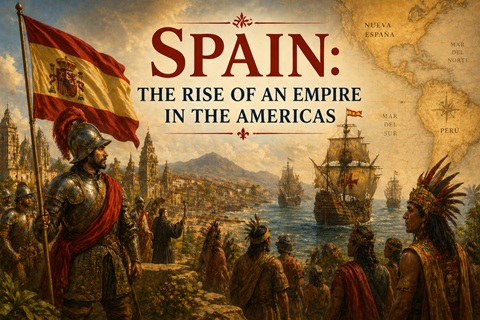
In the late 1400s and early 1500s, the world was changing in big ways. European nations were searching for new trade routes, new lands, and new wealth. Among these nations, Spain quickly rose to become the most powerful empire in the Americas. But how did this happen? Why did Spain become dominant before other countries like England or France?
The answer lies in a combination of bold explorers called conquistadors, vast riches in gold and silver, and a powerful system that allowed Spain to control enormous territories. Together, these factors helped Spain build one of the largest empires the world had ever seen.
The Age of Exploration Begins
The story of Spain’s empire begins with exploration. In 1492, Christopher Columbus sailed across the Atlantic Ocean under the Spanish flag. Although he was actually looking for a route to Asia, he instead reached the Caribbean islands. This moment opened the door for Spain to explore and claim lands in the Americas.
Spain acted quickly. Other European countries were still figuring out their plans, but Spain began sending ships, soldiers, and settlers across the ocean. This early start gave Spain a major advantage.
Who Were the Conquistadors?
One of the most important reasons for Spain’s success was the role of the conquistadors. The word “conquistador” means “conqueror” in Spanish. These men were soldiers and adventurers who came to the Americas in search of wealth, land, and glory.
Conquistadors were not always official representatives of the Spanish government. Many were private individuals who hoped to become rich and famous. They often paid for their own expeditions and took great risks.
Two of the most famous conquistadors were:
- Hernán Cortés, who conquered the Aztec Empire in present-day Mexico
- Francisco Pizarro, who conquered the Inca Empire in South America

How Did the Conquistadors Succeed?
It may seem surprising that small groups of Spanish soldiers were able to defeat large and powerful empires like the Aztecs and Incas. But several important factors helped them succeed.
1. Advanced Weapons
The Spanish had weapons that Native American groups had never seen before. These included:
- Steel swords and armor
- Guns (though they were slow to reload)
- Cannons
- Horses, which gave them speed and power in battle
Even though the Spanish were often outnumbered, their technology gave them a huge advantage.
2. Alliances with Native Groups
The conquistadors did not fight alone. In many cases, they formed alliances with Native American groups who were enemies of the Aztecs or Incas. These allies provided soldiers, knowledge of the land, and support.
For example, Cortés gained thousands of Native allies who helped him defeat the Aztec capital of Tenochtitlán.
3. Disease
One of the most tragic and powerful factors in Spain’s conquest was disease. Europeans brought illnesses such as smallpox to the Americas. Native Americans had no immunity to these diseases, and millions died.

This greatly weakened large empires and made it easier for the Spanish to take control.
4. Leadership and Strategy
Conquistadors like Cortés and Pizarro were skilled leaders. They used clever strategies, surprise attacks, and diplomacy to defeat their enemies. They also took advantage of internal conflicts within Native empires.
Gold and Silver: The Treasure of the Americas
Once Spain conquered large areas of land, it discovered something incredibly valuable: gold and silver.
These precious metals became the foundation of Spain’s wealth and power.
Gold
Gold was one of the main reasons conquistadors came to the Americas. They had heard stories of cities filled with gold, such as the legendary El Dorado. While many of these stories were exaggerated, the Spanish still found large amounts of gold, especially in Mexico and the Caribbean.
Gold was used for:
- Coins
- Jewelry
- Religious objects
- Trade with other countries
Silver
Even more important than gold was silver. In the 1500s, Spain discovered huge silver mines, especially in places like:
- Potosí (in present-day Bolivia)
- Zacatecas (in present-day Mexico)
These mines produced enormous amounts of silver—more than Europe had ever seen before.
Why Was Silver So Important?
Silver became the backbone of Spain’s economy. It allowed Spain to:
- Pay for armies and wars
- Trade with countries around the world, including China
- Build cities and support its empire
Ships loaded with silver sailed from the Americas back to Spain. These treasure fleets made Spain incredibly rich.
Spain’s Dominance in the 1500s
By the mid-1500s, Spain had become the most powerful country in the Americas—and one of the most powerful in the world.
A Vast Empire
Spain controlled a huge empire that included:
- Much of Central and South America
- Large parts of North America (including Florida and the Southwest)
- Islands in the Caribbean
This empire stretched across thousands of miles.
Strong Government Control
Spain developed systems to manage its empire. One important system was the encomienda.
Under the encomienda system:
- Spanish settlers were given control over Native American labor
- In return, they were supposed to protect and convert Native people to Christianity
In reality, this system often led to harsh treatment and forced labor.
Spain also created viceroyalties—large regions ruled by officials called viceroys who represented the king.
The Role of the Catholic Church
Religion played a major role in Spain’s empire. Spanish missionaries came to the Americas to convert Native Americans to Christianity.
Churches, missions, and schools were built throughout the empire. The Catholic Church became a powerful institution in colonial life.
Why Spain Became Dominant First
Several key reasons explain why Spain became the leading power in the Americas during the 1500s.
1. Early Start
Spain began exploring and colonizing the Americas before most other European countries. This gave it a head start in claiming land and resources.
2. Successful Conquests
The conquistadors quickly defeated major Native empires like the Aztecs and Incas. This gave Spain control over large populations and rich lands.
3. Enormous Wealth
The discovery of gold and silver made Spain incredibly rich. This wealth allowed Spain to build a strong military and maintain control over its empire.
4. Strong Leadership
Spanish rulers supported exploration and conquest. They provided authority and structure to manage the empire.
5. Global Influence
Spain’s wealth and power made it a major player in global trade. Spanish silver was used all over the world, connecting Europe, the Americas, and Asia.
Life in the Spanish Empire
Life in Spain’s American empire was very different depending on who you were.
Spanish Settlers
Spanish settlers (called peninsulares if born in Spain and creoles if born in the Americas) often held positions of power. They owned land, controlled businesses, and led the government.
Native Americans
Native Americans faced major challenges:
- Loss of land
- Forced labor
- Disease
- Cultural changes
Some communities adapted, while others were destroyed.
Enslaved Africans
As Native populations declined, Spain began importing enslaved Africans to work on plantations and in mines. This added another layer to colonial society.
A New Society
Over time, a complex social system developed based on race and birthplace. This system determined people’s rights and opportunities.
The Impact of Spain’s Empire
Spain’s empire had lasting effects on the world.
Cultural Exchange
The Spanish brought:
- Language (Spanish is now widely spoken in the Americas)
- Religion (Catholicism)
- New foods, animals, and technologies
At the same time, Europeans gained new crops like corn and potatoes from the Americas.
Economic Changes
The flow of gold and silver changed global trade. It connected continents and helped create a global economy.
Human Cost
The empire also came at a great human cost:
- Millions of Native Americans died from disease and conquest
- Many people were forced into labor or slavery
- Entire cultures were changed or lost
Challenges to Spanish Power
Although Spain was dominant in the 1500s, its power did not last forever.
Other European countries, such as England, France, and the Netherlands, began to explore and colonize the Americas. They challenged Spain’s control.
One important event was the defeat of the Spanish Armada in 1588. This weakened Spain’s naval power and allowed other nations to compete more effectively.
Conclusion
Spain’s rise to power in the Americas was not an accident. It was the result of bold exploration, determined conquistadors, and the discovery of vast riches in gold and silver.
The conquistadors conquered powerful empires using advanced weapons, alliances, and strategy. The wealth from gold and especially silver made Spain incredibly rich and allowed it to build a vast empire. In the 1500s, Spain stood as the dominant power in the Americas, shaping the course of history.
However, this empire came with both achievements and consequences. It connected the world in new ways, but it also caused great suffering for many people.
Understanding how Spain built its empire helps us see why it became the first great power in the Americas—and why its influence is still felt today.